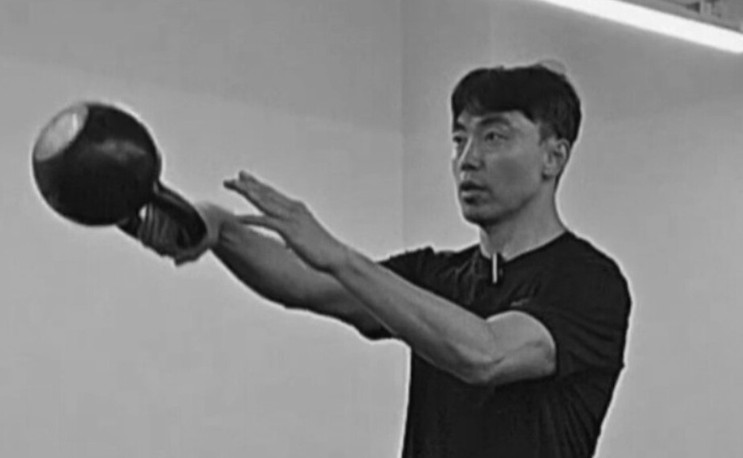
The Basic Switch
Start with a one-arm swing. At the top of the float, bring your free hand to the handle. For an instant, the hands meet; the outgoing hand releases as the receiving hand closes.
Do not toss the bell sideways. Do not lift it with the arm or reach after it. The kettlebell should continue along the same path as if no switch had taken place.
The catch should be quiet and free of any sudden tug. If you must hurry, reach, or twist, park the bell and clean up your swing.
The Rotational Switch
Experienced practitioners may slightly turn the kettlebell during the float, so the handle presents itself at a comfortable angle to the receiving hand.
The rotation—clockwise with the right hand, counterclockwise with the left—must be small and controlled. It changes the orientation of the handle—not the path of the bell. Your shoulders remain square, and your body does not twist to follow the kettlebell.
The rotational switch adds complexity. First, own the basic switch. If that exchange is not smooth and predictable, rotation will only decorate an error.
Start Today
Begin with a moderate bell and plenty of open space. Practice only a few switches at a time—for example, three swings on the right, switch, three on the left, then park the bell. Add repetitions only when every exchange feels identical.
Do not focus on catching faster. Make the bell easier to catch by improving its trajectory.
Master the float, and the movement becomes art.