Subject: LRI INK | One DOL Win. One IBT Win in Air Quotes.

May 7, 2026

To visit the blog post, click on the link below the article.

The Fine Print on Sean O'Brien's Big “Win”

by Michael VanDervort

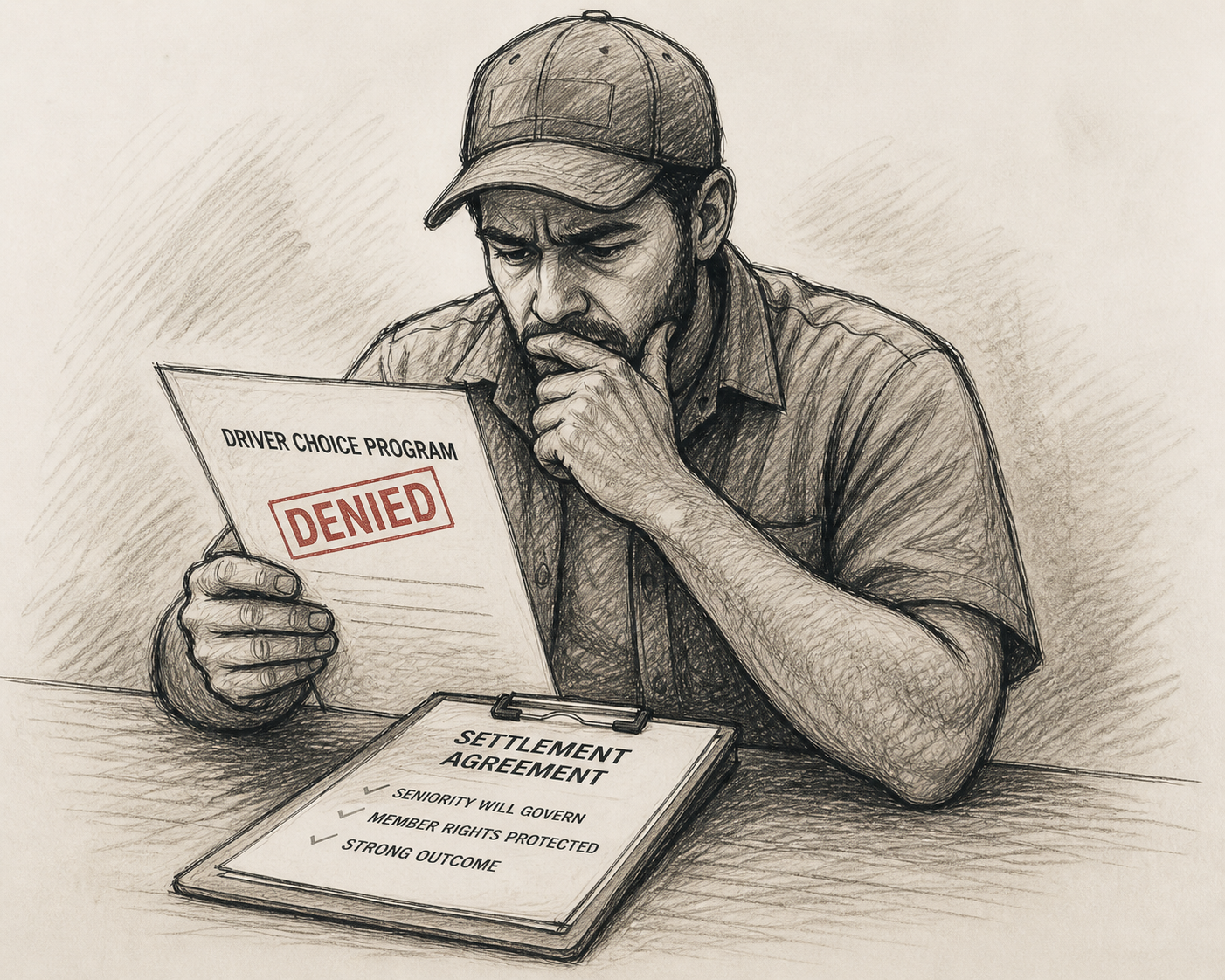
We've been following the Teamsters' response to UPS and the Driver Choice Program for a while. The IBT called it illegal, ran to federal court, and lost. Then the parties reached a settlement, which we covered here. O'Brien called it a strong outcome. Seniority would govern. Member rights would be protected.


The unrest didn't stop. It seems to be getting worse.


Drivers are reporting unexpected denials. Allegations of favoritism are circulating in Teamsters Facebook groups. And the gap between what members were told the settlement means and what the DCP plan document says is getting harder to ignore.

What Members Were Told

O'Brien's April 5 announcement was clear. Total buyouts capped at 7,500. Selections based on seniority. The Central Region is back in the program. "Union seniority and the rights of all our members will be honored."


Members reasonably concluded that seniority was the deciding factor. Apply, rank high enough, and get approved.


That's not what the document says.

What the Document Says

The UPS Workforce Transition Governance Committee retains "absolute discretion to determine the eligibility of each person." Applications are evaluated "according to the local needs of the business." Seniority breaks ties within a specific facility, after UPS has already decided how many people that building can afford to lose.


A driver with 25 years can be denied at a facility that UPS needs to keep staffed. UPS confirmed this in its own April 5 statement: "Applications will be approved based on seniority and the needs of the business, as originally planned."


As originally planned. Management discretion wasn't removed. It was repackaged.

What Members Are Experiencing

High-seniority drivers are being denied at facilities UPS needs to staff. The "needs of the business" provision is doing exactly what it was written to do. The problem is that members expected something different, and many still don't know where they stand.


A $150,000 decision. A union that told them to hold the line. A settlement was announced as a victory. And now denial letters are arriving with no clear explanation of why seniority didn't protect them the way they were told it would. Nobody at the local level has a clean answer. Nobody at the international level is clarifying. The document that would settle the question hasn't been released.


That's creating a trust problem for the union.

The Question Members Are Already Asking

Thirty-seven Central Region locals broke with O'Brien in March. That fracture was papered over on April 5. It wasn't healed.


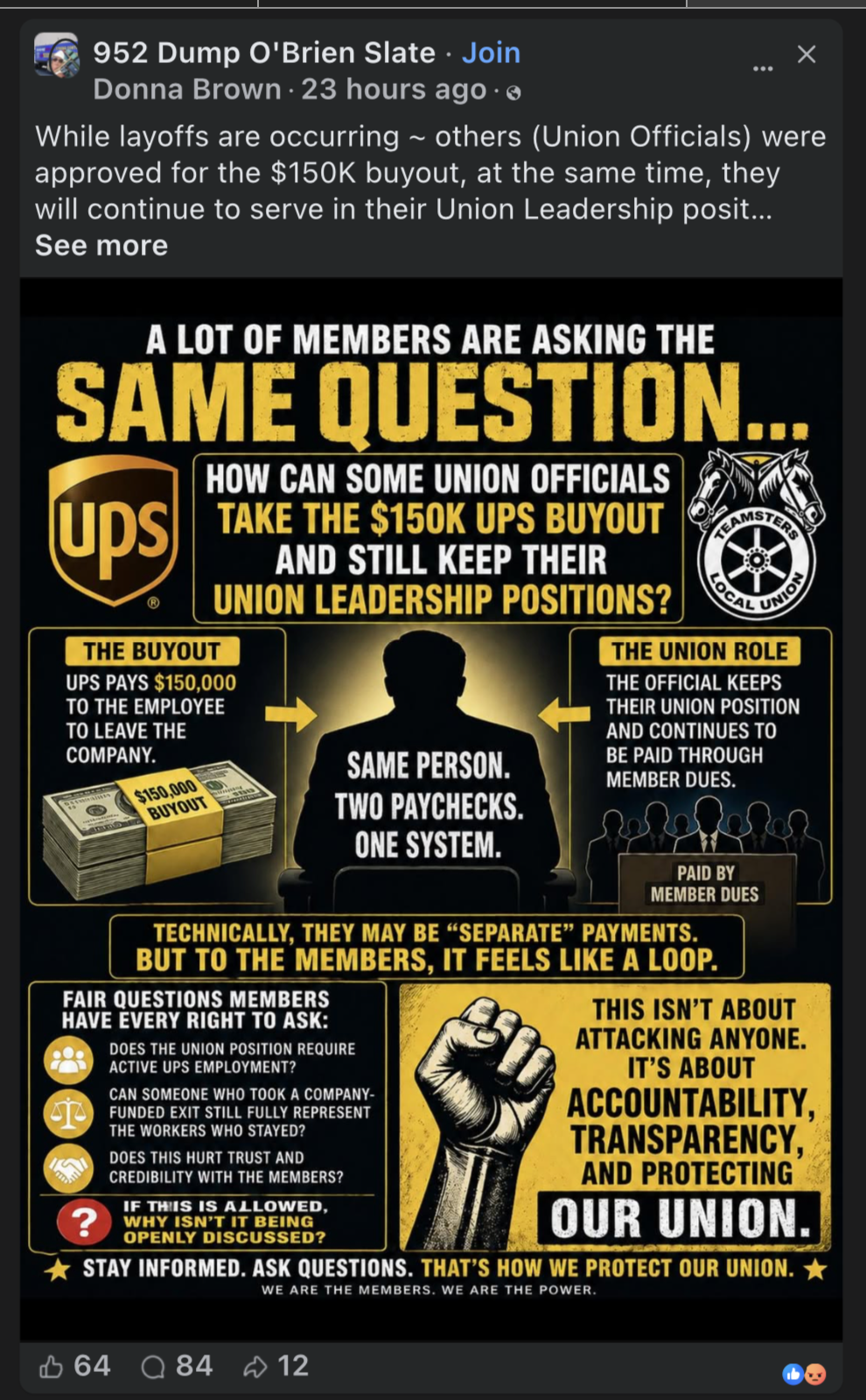
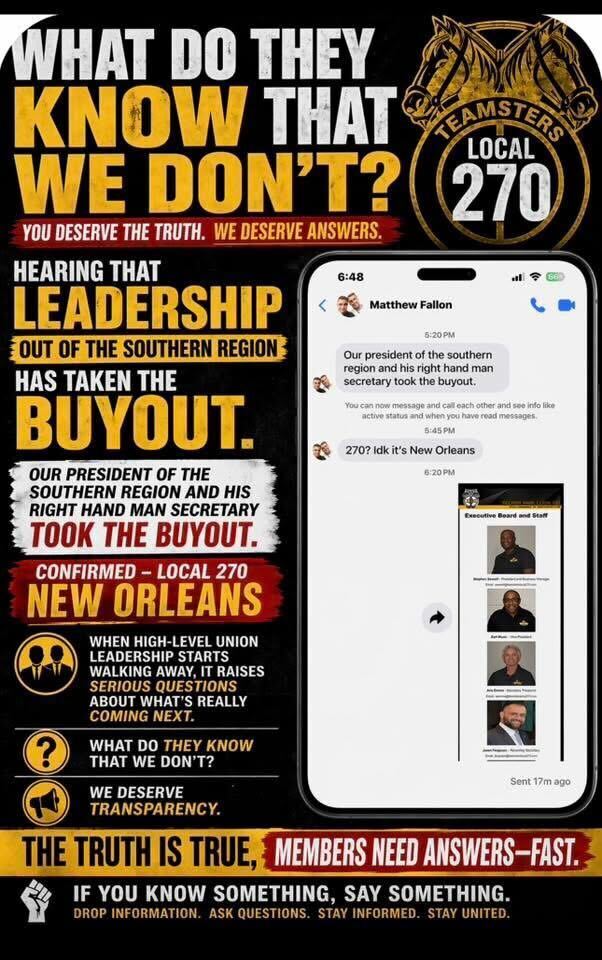
Graphics are now circulating in Teamsters Facebook groups, making allegations that local officials took the buyout while staying on the IBT payroll. One, attributed to members of Teamsters Local 270 in New Orleans, names the southern region president and his secretary directly. The question being asked: "What do they know that we don't?"

It's not the only question circulating. Under the NMA's Article 16, IBT officers and business agents on union leave of absence retain their UPS seniority without loss for the duration of their union service. The plan document defines seniority by reference to the applicable supplement and does not explicitly exclude employees on union leave from eligibility. Which raises a question members in several locals are now asking directly: do IBT officers out on leave get these buyouts over working drivers?


Nobody has answered that publicly. The settlement agreement has not been released. But high-seniority active drivers are being denied, while that question goes unanswered. That combination fuels the allegations circulating in those groups.


Members are naming names. In public. Six weeks before the IBT's 31st International Convention opens in Las Vegas, in a year when the general president ballot goes out in October. Because they don't trust what they were told.

What Employers Should Be Watching

Drivers are making $150,000 decisions without a clear picture of the rules. That's the real cost of overselling a settlement. When union leadership needs a win more than it needs an accurate win, members pay for the gap in real money, in missed opportunity, and in trust they won't get back.


The plan document was public. The language was plain. What O'Brien announced and what UPS retained are both in writing. One showed up in the press release. The other is showing up in denial letters.

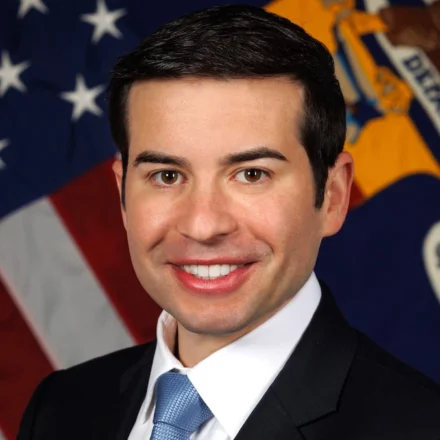
Who Is Keith Sonderling? What Employers Need to Know About the New Acting Labor Secretary

by Kimberly Ricci

The Department of Labor is working its way out of an awkward era.


For three months, literal tabloid headlines plagued the department after the New York Post first reported that ex-Secretary Lori Chavez-DeRemer is under internal investigation by the DOL’s Office of Inspector General for allegedly committing travel fraud, drinking alcohol during work hours, and having an "'inappropriate' relationship with a subordinate."


In mid-April, Chavez-DeRemer officially exited the Labor Department, and her portraits were pulled off the walls. This undercut Teamsters chief Sean O’Brien, who lobbied hard for her nomination, and deputy Keith Sonderling was swiftly named as acting secretary. His experience includes a four-year stint as EEOC commissioner and three years as deputy administrator of the DOL’s Wage and Hour Division. He has been described as “the steadiest option” to lead the DOL, and here are highlights of his early efforts:

The new DOL staff assembles

Sonderling’s promotion reportedly was no surprise to those who knew he had “take[n] an outsize role running the agency” during Chavez-DeRemer’s frequent travels. To that point, CHRO Association Senior Labor and Employment Counsel Roger King commended Sonderling’s readiness to lead the agency: “His job title considerably understates his importance on labor and employment matters to the administration.”


This week, Sonderling’s inner circle came together. They include Courtney Walter as chief of staff; Cynthia McKnight and Garrett Burty as deputies; and Joseph Burgese as senior advisor. Three out of four previously worked with Sonderling at the EEOC and the Wage and Hour Division.

A joint employment shift

On Apr. 22, the DOL unveiled its proposed rule on establishing when joint employment liability would apply. In a DOL statement, Sonderling described this as “a clear standard” to “give businesses more confidence to invest in partnerships, help employees understand their rights,” and streamline the DOL investigation process.


The proposal would create a single standard that applies under the Fair Labor Standards Act, the Family and Medical Leave Act, and the Migrant and Seasonal Agricultural Worker Protection Act. In doing so, the standard would evaluate four factors based upon whether an employer:


(1) Hires or fires;
(2) Substantially supervises or controls scheduling or workplace conditions;
(3) Determines wages and method of payment; and
(4) Maintains employment records.


After the proposed rule’s publication, questions arose about how closely it resembles the previous Trump-era standard that was vacated by a federal judge, who found that it narrowed the standard too much regarding the FLSA. However, labor attorneys predict that the new proposal will survive because the four factors are based upon an employer’s “reserved” control rather than “actual” control.

Redefining independent contractors

In late February, Sonderling announced the DOL’s proposed rule that would roll back the Biden-era 2024 worker classification standard and favor an “economic reality” inquiry to distinguish between independent contractors and employees.


This proposed rule also evaluates whether an individual has control over their work or is running an entrepreneurial enterprise. Other factors include permanence of the working relationship and how important the person’s work is to the company’s core operations.

Moving into the AI future

This month, Sonderling revealed the DOL’s new AI in Registered Apprenticeship Innovation Portal, which is billed as “a one-stop resource for organizations looking to build artificial intelligence literacy” by developing mentoring opportunities. The portal offers training modules to build skills in various industries, including healthcare and manufacturing. Companies can also upgrade preexisting apprenticeship programs with AI integration.

Increased 401(k) investment options

In March, Sonderling announced a proposed regulation from the DOL’s Employee Benefits Security Administration following a Trump executive order. The proposed rule creates safe harbors for 401(k) plan fiduciaries through criteria to evaluate alternative asset classes for investments. As Sonderling put it, “The department’s days of picking winners and losers are over.”

What could come next

Sonderling sailed through Senate approval (53 - 46) for his position as Chavez-DeRemer’s deputy. It’s too soon to say whether Trump will nominate him as DOL chief, although he could also serve indefinitely like Biden pick Julie Su did if there are any obstacles to his confirmation.


Meanwhile, it’s clear that Sonderling leans into employer-friendly policies, although the proposed rules above are still moving through notice and comment periods, so employers should stay tuned for updates.


Friday 5: Apple, Cannabis, Grievances, Petitions, And A $10 Pamphlet

by Kimberly Ricci

Crafting grievances, one font at a time:

Someone thought the picket line needed a style upgrade. Making Signs That Matter is a real, $10, 28-page paperback dedicated entirely to helping union activists make “better” protest signs. Apparently, scrawling "On Strike" in marker on cardboard wasn't cutting it anymore.


The guide covers messaging strategy, color theory, font readability, and media optics, which means that somewhere out there, a union organizer is A/B testing their grievances. Employers might find comfort in knowing that at least some strike energy is being redirected into Hobby Lobby supply runs.


At least it's shorter than most CBAs. And probably easier to read.

Machinists trying to take another bite of the Apple:

Apple’s recent announcement of store closures continues to reverberate. To recap, the tech giant is closing three stores, one of which happens to be the first unionized Apple store, in Towson, Maryland. In the process, Apple cited the “departure of several retailers and declining conditions” at the Towson mall, but the Machinists union groused over how its members were not offered guaranteed transfers.


Apple then cited the Towson store’s union contract, which the company says prevents it from extending the same transfer opportunities received by workers at the other two closing stores (in California and Connecticut).


This week, the Machinists filed a ULP alleging retaliation and discrimination against the Towson workers, accusations against which the company “strongly disagrees” while maintaining that the IAM “agreed that, in the event of a mall or store closure, employees would be transferred or rehired if Apple opened a new store within 50 miles of Towson's current location.”


At this time, Apple has no plans to open a new store within that 50-mile range, and the company added, “We will continue to abide by the agreement that was negotiated and agreed upon with the union. We look forward to presenting all of the facts to the NLRB."

The NLRB made a call on cannabis processing workers:

We’ve been keeping tabs on the complex web of cannabis labor relations, for which 50 states have 50 different sets of regulations. Also at issue: the NLRA’s applicability remains a grey area due to some employees being classified as agricultural workers, who aren’t covered by the NLRA.


Now, the NLRB has issued a decision in a case that we predicted could transform the industry’s labor relations. In BeLeaf Medical LLC, the Board considered whether the company’s post-harvest workers–who liken themselves to tobacco workers who ferment leaves–could bypass the “agricultural workers” label and unionize with UFCW.


This week, the Board denied the Missouri-based company’s request for review on a regional director’s finding that BeLeaf’s processing workers aren’t agricultural workers. In doing so, the Board declared, “The activities of the Post-Harvest employees generally are not performed by ordinary farm employees, and the activities in question have only an attenuated relationship to farming in the traditional sense.” That’s not all.


Concurring Board member Scott Mayer recommended heavy fact-finding and a “case-by-case approach” for similar cases given this industry’s ”emerging or rapidly evolving … operational processes,” which “may give rise to novel considerations.” In other words, the BeLeaf decision likely will not have a blanket effect, which doesn’t exactly provide clarity for employers. Yet this means that the Board isn’t wild about the idea of an organizing free-for-all for every role within the cannabis industry.

The DOL’s all-in on AI:

Newly minted acting Secretary of Labor Keith Sonderling is wasting no time announcing the department’s AI in Registered Apprenticeship Innovation Portal, which is billed as “a one-stop resource for organizations looking to build artificial intelligence literacy” and develop mentoring opportunities accordingly. The portal aims to provide guidance and training modules for AI Skill Building by Industry, including healthcare, finance, and manufacturing. Companies can also upgrade their existing apprenticeship programs by adding AI integration.


Additionally, the Department of Labor announced the debut of National Apprenticeship Week, which will annually be celebrated Apr. 27-May 2.

CWA is attempting to hold more (trading) cards:

The Communication Workers of America’s extension into video game organizing took a related turn last year when they unionized TCGPlayer workers from the eBay trading card marketplace. This week, developers of the Magic: The Gathering Arena digital game, based upon the trading card game, filed a representation petition against their employer, Wizards of the Coast, while seeking to join CWA. The workers want AI protections and are pushing back against the company’s RTO policy.


Meanwhile, the CWA has been staying busy. They've expanded beyond their core communications-sector membership to organize tech workers. They’ve also targeted ski resort workers and carried out multiple strikes on entire mountains while giving the Teamsters a run for their dues.


Somewhere, Sean O'Brien is watching CWA poach another industry and adding it to his list of grievances. And he probably didn't need a $10 pamphlet to figure out how to make noise.

About Labor Relations INK

Labor Relations INK is published weekly and is edited by LRI Consulting Services, Inc. Feel free to pass this newsletter on to anyone you think might enjoy it. New subscribers can sign up by visiting here.


If you use content from this newsletter, please attribute it to LRI Consulting Services, Inc. and include our website: http://www.LRIonline.com 


Contributing editors for this issue: Greg Kittinger, Michael VanDervort, and Kimberly Ricci.


You are receiving this email because you subscribed to receive our labor relations newsletters and updates. You can manage your email preferences by clicking the link at the bottom of any of our email communications.


About LRI Consulting Services, Inc.

LRI Consulting Services, Inc. exists to help our clients thrive and become extraordinary workplaces. We improve the lives of working people by strengthening relationships with their leaders and each other. For over 40 years, LRI Consulting Services, Inc. has led the labor and employee relations industry, driven by our core values and our proven process, the LRI Way.


Share