Subject: LRI INK | Q1 2026 NLRB Data Is In, Here's What's Hot. Compelling Decertification Interview

April 30, 2026

To visit the blog post, click on the link below the article.

Healthcare Organizing's Small-Unit Trend Has Been Building. New Data Makes It Hard To Miss

by Kimberly Ricci

As always, LRIrightnow's First Quarter 2026 NLRB Review contains more data than any one article can cover, but for the moment, we're focused on what it can tell us about the healthcare industry. As we explored with the 2025 NLRB Review, this industry's 88% union victory rate is more complicated than it seems. The same goes for findings in the new report.


To add historical depth to what we observed for healthcare, we also ran queries directly against the full LRIrightnow databases for a five-year comparison covering Q1s from 2021 through 2026. Through that additional context, the newer data points solidify into a longer-term trend.

Five Years Of Data, One Clear Direction

Hospital petition volume has held steady, but that's not all.


In Q1 2024, unions filed 60 petitions against general medical and surgical hospitals. In Q1 2026, the number was identical with 60 petitions spread across 50 employers. That steady number looks different in context: overall representation petition volume declined 11% over the same period. As we previously noted, worker organizing plummeted in 2025 for many industries, but in hospitals, it has held constant.


What is shifting, however, is the size of the units being targeted. Five years of LRIrightnow database queries–pulled from the General Medical and Surgical Hospitals establishment category–show that the share of hospital petitions targeting units of 10 workers or fewer grew from 26% in Q1 2021 to 37% in Q1 2026. That equates to 9 of 34 petitions in Q1 2021 and 22 of 60 in Q1 2026. Meanwhile, median unit size trended downward over the same period from 35 workers to 30.


Unions are not filing more hospital petitions than they were five years ago, but they are consistently filing petitions for smaller units. For a reason.

Source: LRIrightnow Q1 2026 NLRB Review

The Unit-Size Tactic That Should Be On Every Hospital's Radar

Of the 60 hospital petitions in Q1 2026, 22 targeted units of 10 workers or fewer. Another seven involved units of 11 to 25. So, more than half of all hospital petitions in the first quarter involved units small enough to fit in a break room. Unions are slicing and dicing bargaining units to manufacture a winnable unit inside a much larger workforce, with a department here and a classification there, and using that foothold to keep filing.


In Q1 2026, one Washington, D.C. hospital appeared in our data with three separate petitions filed by the DC Nurses Association targeting units of 4, 5, and 5 workers. And at a New Mexico hospital, CWA filed for two units of 3 and 4 workers. This is the unit-slicing argument, clear as day.


We aren't talking about a coordinated campaign driven by a single union, either. In Q1 2026, those 60 hospital petitions came from SEIU, CWA, the Teamsters, AFSCME, UFCW, and several nursing-specific unions. The data reflects how multiple unions have sized healthcare up as an easy target, and they’re using the small-unit strategy with similar results.

The Stakes Are Not The Same As Other Industries

Fragmented bargaining units inside a single health system lead to chaos that unions will further try to capitalize upon. Smaller units can pit workers against each other and create competing contract cycles that consume management time and resources regardless of whether a strike occurs.


When strikes do happen, the consequences extend well beyond the employer. Unions wage costly strikes that don't produce meaningful results for workers, and they are detrimental to the communities that hospitals serve. Patients face delayed procedures and reduced access to care, and workers walk picket lines for promises unions fail to deliver.

Meanwhile, Big Labor has already moved on to new organizing targets while collecting dues as the dust settles.

What Healthcare Employers Should Gather From This Data

The small-unit trend in healthcare isn't brand new, but the data shows it is growing more prominent while hospital petition volume holds steady. Multiple unions are independently targeting this industry with similar tactics, and the data shows that this isn’t likely to change.

Unions are looking for the smallest viable unit, filing, and moving on to their next target. That approach doesn't serve hospitals, the communities they serve, or the workers themselves, but unions aren’t concerned about those consequences. They are focused on their own growth, even if the unit fits in a break room with room to spare.


The First Quarter 2026 NLRB Review is available for purchase ($150) at LRIrightnow.com.

LRIrightnow Q1 2026 NLRB Data: Petitions and Elections Report Is In. Here Is What It Is Telling Us, and What We Will Be Watching

by Michael VanDervort

Three months of data does not tell you where the year is going. It tells you what questions to ask.


That is the right way to read LRI RightNow’s First Quarter 2026 NLRB Elections and Petitions Review. Not as a verdict on 2026, but as the opening chapter of a story that Q2 and Q3 will continue to write.


Let’s take a look at some of the numbers.

Fewer Campaigns, Higher Stakes per Campaign

Union representation petitions dropped 11% compared to Q1 2025, from 538 to 479. At the same time, the petition-to-election conversion rate climbed from 68.8% to 78.1%. Unions filed fewer and took nearly all of it to a vote.


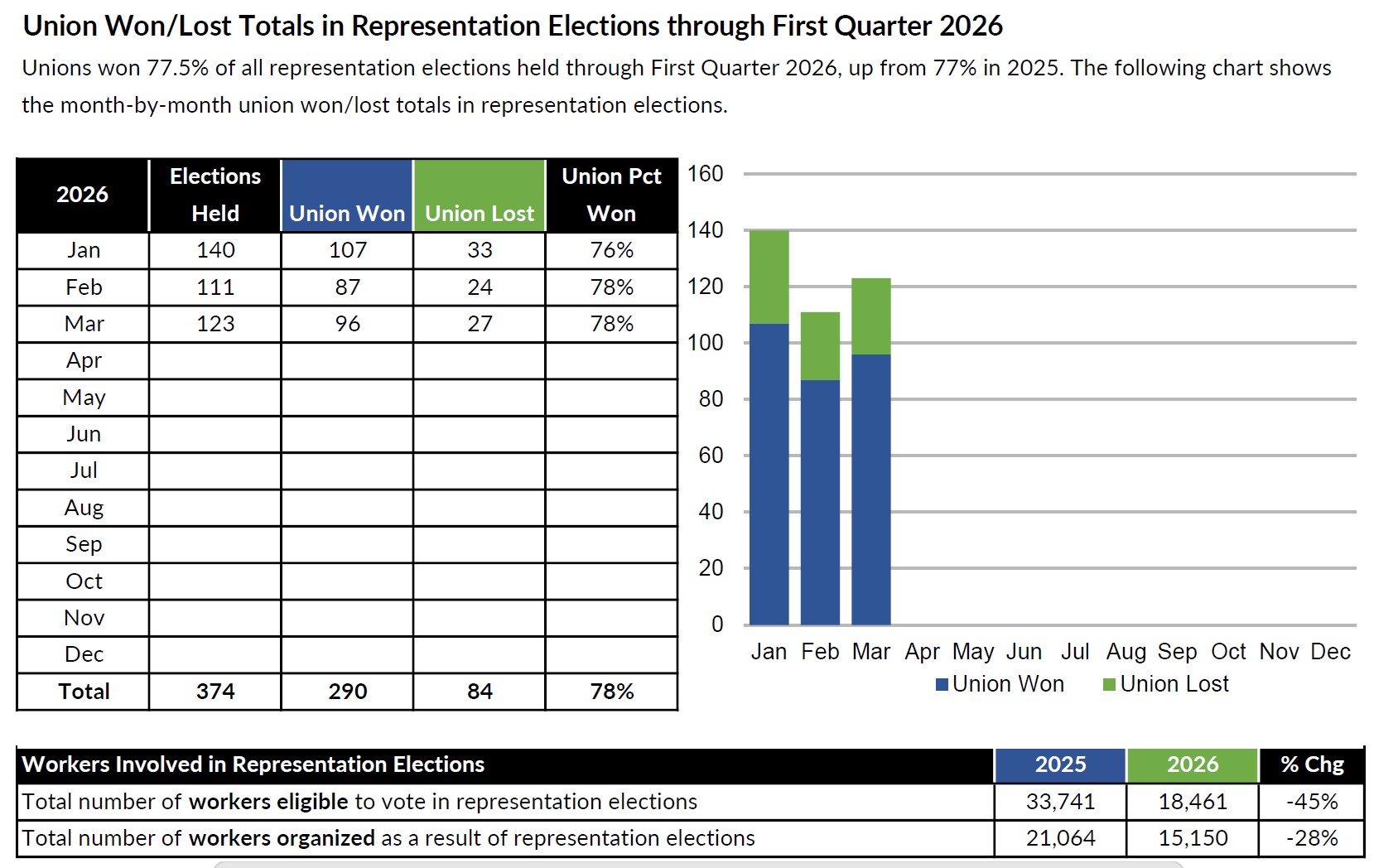
The Union's win rate in RC elections was 77.5%, consistent with its 2025 finish. Total workers organized through Q1 fell 28% year over year, largely because targeted unit sizes were smaller on average. Whether the petition decline is a strategic shift or a seasonal dip is one of the things Q2 will start to answer.


The Teamsters: Most Active, Most Complicated

The Teamsters were involved in 87 representation elections in Q1 2026. Their petition activity tells an even bigger story: 119 RC petitions filed, signaling the campaigns already in the pipeline will keep them at the top of the activity charts heading into Q2 2026.


But look at the rest of the numbers. Their win rate was 74%, below the overall RC average of 77.5%. They faced seven decertification elections and lost three. For a union that has spent two years projecting strength and momentum, those cracks are worth noting.


One quarter does not make a trend. The Teamsters remain formidable. But there is a tension between the story they have been telling about themselves and what is happening at the ballot box. If that gap persists into Q2 and Q3, it becomes a more interesting story. If the numbers revert, it was noise. We will be watching.

Where the Activity Is Concentrated

The national win rate is useful context. The state, regional, and unit-size numbers are where practitioners actually live.


Region 19, covering the Pacific Northwest, led all NLRB regions with 48 RC elections. Oregon posted a 91% union win rate, the highest among states with meaningful volume. Washington had 30 elections, with an 87% success rate. Ohio ranked 88% among high-volume states. New Jersey was the lowest at 68%. A practitioner in Newark is operating in a different environment than one in Portland, even when reading the same national headline.


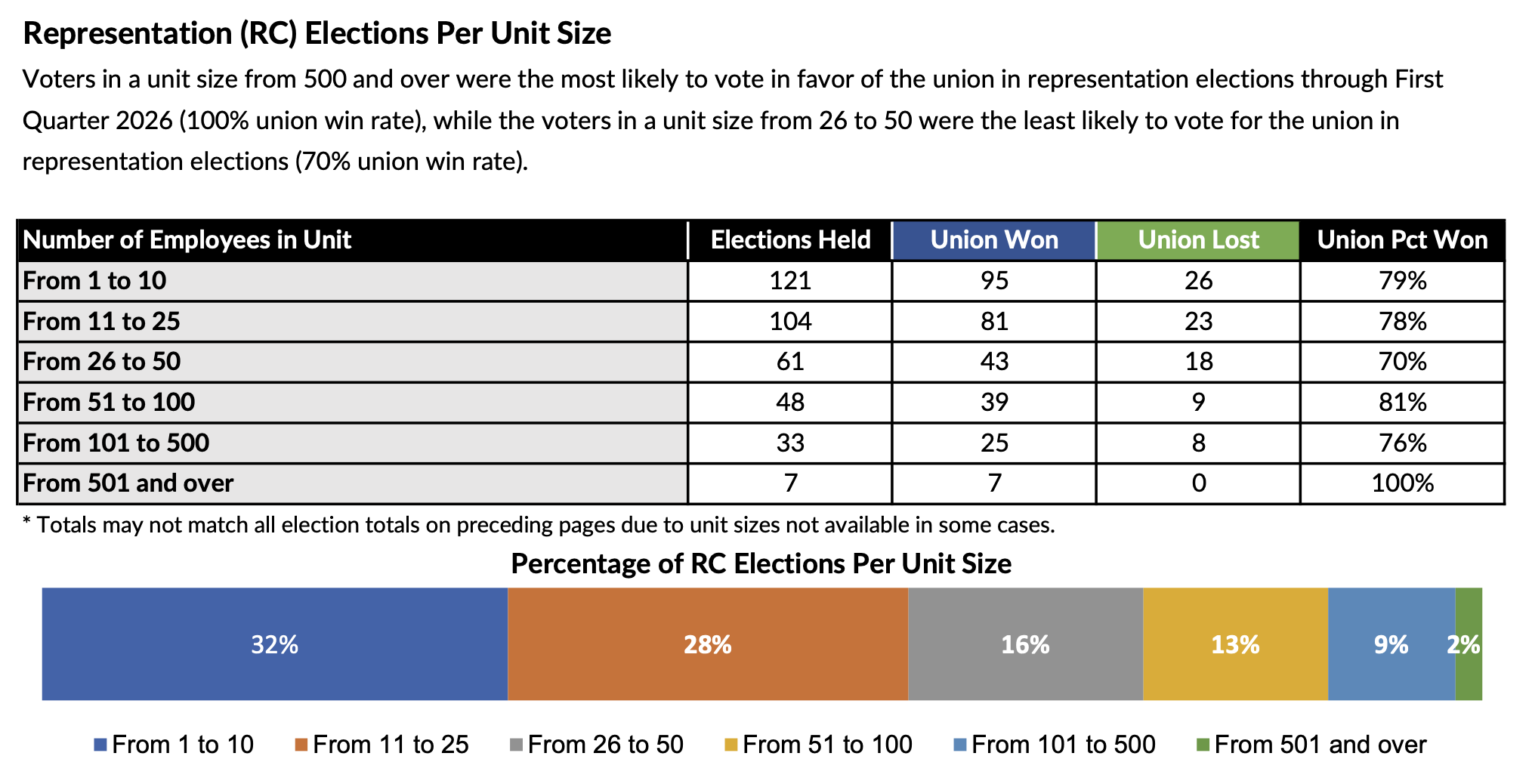
Small units tell a quieter but significant story. A third of all RC elections occurred in bargaining units with 10 or fewer employees: 121 elections, with a 79% union win rate. Most of that volume is concentrated in Services and Entertainment, Accommodation, and Food Services. These are workplaces with thin management layers and high turnover, where early warning signs of organizing are easy to miss, and the traditional campaign playbook rarely applies.

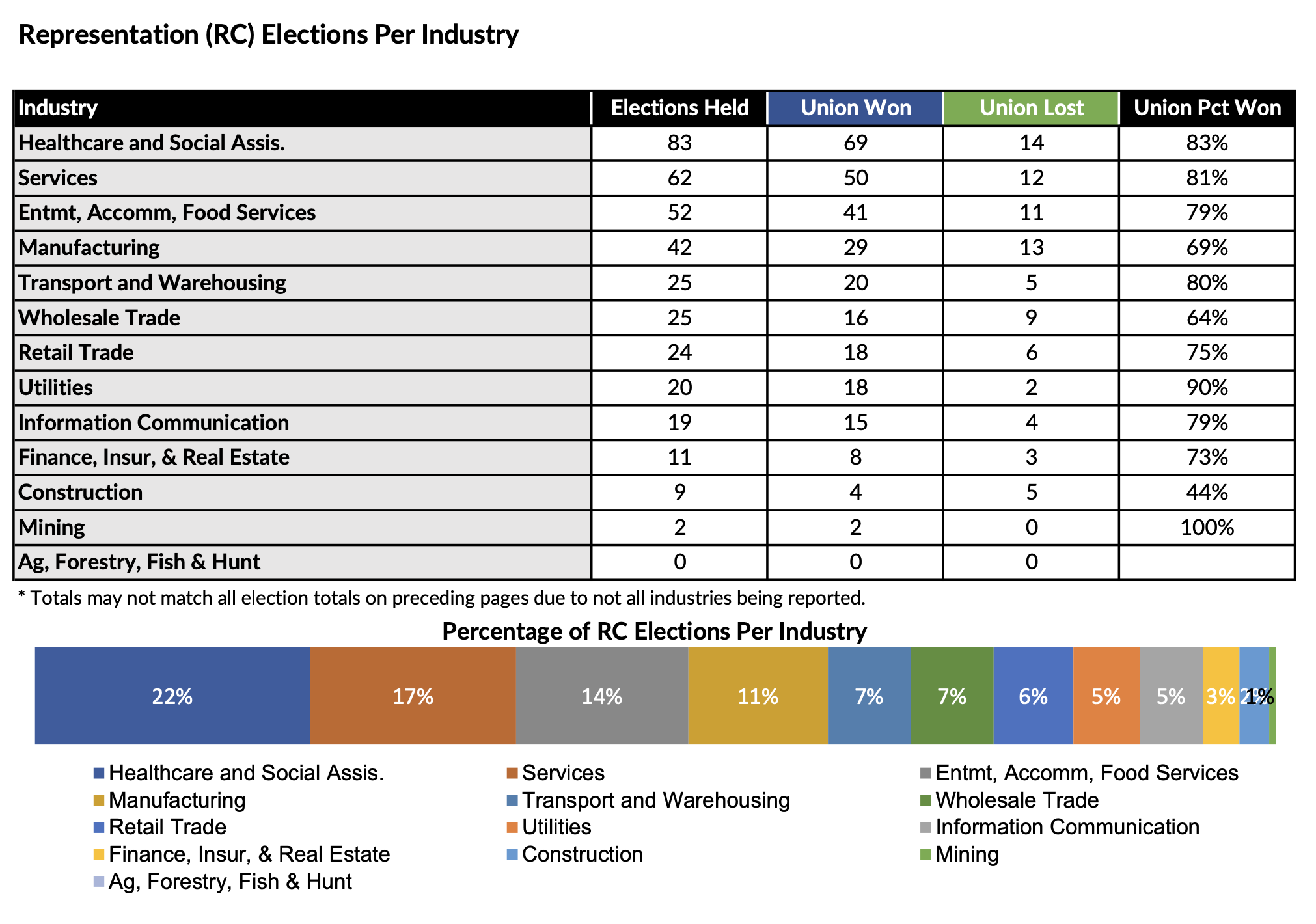
Healthcare and Social Assistance led all industries with 83 RC elections and an 83% union win rate. That combination has held for several years. Q1 shows no sign of it changing.

What to Watch in Q2

Is the decline in petition volume real or seasonal? If Q2 rebounds sharply, Q1 was a dip. If it holds, something more structural may be shifting in how unions select campaigns.


Do the Teamster numbers stabilize? A 74% win rate and three decertification losses in one quarter are not a crisis. But if the pattern persists, the gap between their public positioning and ballot performance becomes a legitimate story.

Get the Full Petitions and Elections Report

The LRI RightNow Q1 2026 NLRB Elections and Petitions Review covers all RC, RD, and employer-filed elections and petitions, broken down by union, NLRB region, state, industry, and unit size.


Access the full Q1 2026 report at LRIRightNow.com.


LRI RightNow has tracked NLRB elections and petitions data for more than 25 years, gathering certification information directly from the NLRB and its regional offices on a daily basis.

A Decertification Effort Narrowly Failed. The Petitioner Isn't Done Yet

by Kimberly Ricci

In case you didn't get to read this article when we pushed it out on Monday, I highly recommend you go check this one out ASAP. 


The subject: a decertification campaign at a potato processing plant in American Falls, Idaho, that fell just 10 votes short of succeeding. The final count was 311 to keep the union, 291 to remove it.

We had the chance to sit down with Kira Junod, the employee who drove the effort, along with her attorney from the National Right to Work Legal Defense Foundation, to hear how it unfolded, what fell short, and why she isn't finished.


The article is long. Read it anyway. Whether you're an HR or labor relations professional, an operations leader, or someone who advises employers, there's something here for you, including a close look at why a group of employees may no longer want union representation, union pressure tactics, what management did right, and what a near-miss decertification campaign looks like from the inside.

______________________________________________________________


Kira Junod didn't set out to lead a decertification campaign, and after a razor-thin defeat, she’s ready to try again.


It all started as a joke in the locker room. A couple of her coworkers were venting during contract negotiations and half-kidding about what it would take to get rid of the Teamsters union. They came back with papers the next day, so Kira figured she'd help gather signatures. She'd worked at the Lamb Weston potato processing plant in American Falls, Idaho, for nine years, so she knew people and could cover some ground.


What she didn't expect was what she'd hear along the way.


"As I started gathering signatures, I started hearing all these stories," Kira explained to LRI Consulting Services, Inc. By the time she connected with the National Right to Work Legal Defense Foundation, the campaign had taken on a life of its own. "I hung up and thought, 'I think I just got a lawyer. What did I do?"


Click to the button below to read the entire story. 

Friday 5: A New DOL Boss, Nursing Turnover Rates, Gen Z's Workplace Talents, And More Joint Employment Shuffling

by Kimberly Ricci

A new DOL Secretary is in the house:

This week, word dropped that Lori Chavez-DeRemer would no longer lead the Labor Department, likely to the disappointment of Teamsters chief Sean O’Brien, who enthusiastically endorsed her nomination. This departure arrives over three months after the New York Post reported that Chavez-DeRemer was under internal investigation by the DOL’s Office of Inspector General for alleged travel fraud, alleged boozing during work hours, and an alleged “‘inappropriate’ relationship with a subordinate.” This situation led to multiple staffer dismissals, and the DOL is moving on.


Chavez-DeRemer’s deputy Keith Sonderling has stepped into the role of acting labor secretary, and as Politico suggested, this promotion came as a surprise to nobody within the department. The publication quotes CHRO Association Senior Labor and Employment Counsel Roger King in pointing toward Sonderling’s readiness for the job: “His job title considerably understates his importance on labor and employment matters to the administration.” Meanwhile, CNBC reports that Chavez-DeRemer will soon be interviewed as part of the ongoing probe into those allegations.

The high cost of nursing turnover stays high:

The 2026 NSI National Health Care Retention & RN Staffing Report, which gathers data from over 500 U.S. hospitals, confirms what many suspected about the difficulty in recruiting and retaining registered nurses.


Last year, it cost each hospital an average of $5.19 million to manage RN turnover, with the national average for RN turnover rate being 17.6% (with the highest turnover being 22.5% for behavioral health specialty nurses). From there, each turnover of an RN costs an average of $60,090, and it takes an average of 56-102 days to recruit an experienced RN replacement. Healthcare industry publications are taking note of this report, and we can expect more follow-up analysis to come.

Those Starbucks contract negotiations? Still messy:

Not too long ago, Starbucks Workers United publicly downgraded their contract demands, which now include a more realistic and sustainable $17 minimum wage for baristas, at the bargaining table. This seemed to signal that a national bargaining framework was on the near horizon, and the company agreed to revive negotiations.


Unfortunately, those positive vibes didn’t last long, and the union recently filed a ULP for alleged bad-faith bargaining. We also noticed that SWU broke its pattern of saving up batches of petitions for end-of-month dumps because they began filing again earlier this month with 16 petitions for representation elections so far in April. And in what feels like a symbolic move, workers at the very first Starbucks to ever exist, at Seattle’s Pike Place Market, filed a petition last week.


In related news, the NLRB will reevaluate the Biden Board’s 2024 decision about Starbucks’ conduct during SWU’s nationwide organizing drive. Last week, the Fifth Circuit Court of Appeals issued a remand after finding that the company "applied the wrong test" in 2024 when attempting to determine whether the company coercively subpoenaed shift supervisors regarding communication with SWU organizers. As the Fifth Circuit wrote, “The Board did not undertake the required totality-of-the-circumstances analysis” of employer conduct, so stay tuned for how this case turns out.

The current state of the joint employment shuffle:

This week, the DOL’s joint employer proposal prompted questions on whether it could possibly survive the courts. The proposal aims to create a single standard while evaluating four factors–which would “weigh the economic reality of the potential joint employer’s control, direct or indirect, over the employee”--that would apply under the Fair Labor Standards Act, the Family and Medical Leave Act, and the Migrant and Seasonal Agricultural Worker Protection Act.


Acting Labor Secretary Keith Sonderling added that the DOL wants to establish “clarity” with a standard that would “give businesses more confidence to invest in partnerships, help employees understand their rights, and make the department’s investigations more efficient.”


However, the proposed standard resembles the 2020 version that was struck down by a federal judge who found it to be “inconsistent with the FLSA.” Yet Bloomberg Law’s analysis points toward labor and employment attorneys differentiating this proposal to be better “primed to withstand the kind of judicial review that struck down its predecessor.” How so? The new version would weigh the four factors by considering an employer’s “reserved” control, rather than evaluating only by “actual” control.


Meanwhile, the NLRB recently reinstated its 2020 joint employer standard, but it's also complicated. Yes, the Board revived how businesses must exercise “substantial direct and immediate” control over core workplace conditions, shared with another business, before they can be classified as a joint employer. However, the D.C. Circuit Court of Appeals’ order for the Board to reaffirm Browning-Ferris regarding one employer showed that the NLRB won’t be the final word on liability for this subject, either.

What are Gen Z’s workplace strengths?

HR Dive took notice of research from AI screening platform Cangrade on Gen Z workers’ biggest workplace strengths. These workers possess high emotional intelligence and stress management skills, and they also want meaningful communication from leadership and to feel a sense of belonging. The latter subject is vital for leaders to note, since Gen Z-ers are prone to seeking third-party representation if they don’t find that sense of community in the workplace.


The report further suggests that Gen Z and millennial workers are equally well-suited to collaborative projects and in self-driven capacities. At the same time, the workers in this study were less likely to exhibit high critical thinking skills. Yet their relationship-building talents make them excellent candidates for client- and customer-facing roles. HR pros who want to become Gen Z whisperers would do well to read the rest of the study.

About Labor Relations INK

Labor Relations INK is published weekly and is edited by LRI Consulting Services, Inc. Feel free to pass this newsletter on to anyone you think might enjoy it. New subscribers can sign up by visiting here.


If you use content from this newsletter, please attribute it to LRI Consulting Services, Inc. and include our website: http://www.LRIonline.com 


Contributing editors for this issue: Greg Kittinger, Michael VanDervort, and Kimberly Ricci.


You are receiving this email because you subscribed to receive our labor relations newsletters and updates. You can manage your email preferences by clicking the link at the bottom of any of our email communications.


About LRI Consulting Services, Inc.

LRI Consulting Services, Inc. exists to help our clients thrive and become extraordinary workplaces. We improve the lives of working people by strengthening relationships with their leaders and each other. For over 40 years, LRI Consulting Services, Inc. has led the labor and employee relations industry, driven by our core values and our proven process, the LRI Way.


Share