Subject: LRI Ink: IATSE, ULPs, post-election culture, the UAW monitor

May 14, 2026

To visit the blog post, click on the link below the article.

What's in Ink this week: 

  • IATSE is organizing beyond entertainment. Live events, AV, conventions, streaming production. The coalition model behind it is worth understanding regardless of your industry.

  • ULP filings are on pace to hit 17,000 this year, the Board is bulk-transferring 3,500 cases to clear the backlog, and the 2025 lull is officially over.

  • Right person, right seat: Why hiring and onboarding are where post-election cultures fracture.

  • Friday Five covers the ULP mountain and the UAW monitor's latest on Shawn Fain.

Hiring and Onboarding After a Union Election

by Michael VanDervort

“You won the union election, but now you have to heal the team.”


Winning a union election is not the end of the process. It is the beginning of a more difficult one, healing the rifts in your culture that develop during a union election. The employees who supported the union are still there. So are the conditions that made the campaign possible. What the organization does in the weeks and months that follow determines whether those conditions are addressed or compounded.


Two areas where companies consistently underinvest after an election: hiring and onboarding. Both feel like operational functions. Both are cultural ones. Getting them wrong accelerates the fracture that the campaign already created. Getting them right is one of the clearest signals to the existing workforce that the organization means what it said during the vote.

Getting the Hire Right

How should approach getting the right person in the right seat?


The first principle is transparency. New hires should know the company went through a union campaign, understand where the organization stands, and hear the reasoning behind that position. Concealing that context does not protect the company. It puts new employees at a disadvantage before they have a chance to form their own view of the culture. Union supporters on the existing team will find them. Better that the company gets there first.


The same discipline applies to defining the role itself. A common failure: companies rush to fill seats without clearly defining what the job requires or what accountability looks like. A well-defined position is the starting point. Without it, even the right candidate ends up misaligned, and misaligned hires in a post-election environment create problems that compound quickly.

Core values matter

One of the most effective tools for assessing culture fit is a core values presentation. Rather than asking candidates to describe past behavior, ask them to review the company’s values and present how those values appear in their own lives. It sounds straightforward. What it does is surface how people think, what they prioritize, and whether the way they operate day to day matches the culture the organization is trying to build. Behavioral interviews tell you what someone has done. This approach shows you who they are.


Culture fit is far harder to correct after the hire than a skill gap. A values presentation makes the assessment concrete rather than intuitive, and it gives candidates a clear picture of what they are walking into. Anyone who joins without that context is set up to struggle.

Onboarding as a Cultural Statement

Paperwork and compliance training without human interaction is a setup for disconnection. New employees need to know what day one looks like, who to go to with questions, and that their feedback matters from the start. Supervisors should check in. Senior leadership should be visible. The direct relationship the company defended during the campaign has to be modeled, not just described.


Structure matters here. A new hire who spends the first week filling out forms and watching safety videos has no idea what the culture actually is. They will learn it from whoever talks to them first. In a post-election environment, that is not a variable worth leaving to chance.

The current team

One dynamic that rarely gets enough attention is the existing team. In high-turnover environments, tenured employees often stop investing in newcomers because they have seen too many people leave. That pattern has to be identified and interrupted. When long-tenured employees disengage from onboarding, new hires pick up on it immediately. The message it sends is not the one the company wants promoted.


Onboarding is a team responsibility, not an HR event. The people who work alongside a new hire every day shape that person’s understanding of the organization faster than any formal program does. Building that into how onboarding works is the difference between a new hire who integrates and one who drifts.

What Actually Keeps People

Pay comes up in every post-election conversation, and the answer is always the same: compensation needs to be fair and competitive. Once it reaches the market, it stops driving satisfaction or retention.


The concerns that fuel campaigns are seldom driven by pay issues. More often, they are about feeling unheard, inconsistent management, and a lack of voice. Those concerns require direct attention. A wage increase without addressing them is a Band-Aid, not a solution.


The practical work starts now. Review the issues raised during the campaign. Address what can be changed. Explain clearly what cannot. Invest in supervisors who can engage rather than deflect. Build a hiring and onboarding process that reflects the culture the company claims to have.


Listen to the full episode: Right Person, Right Seat


Winning a union election is just the beginning. You have 52 weeks to prove your team made the right choice, strengthen frayed relationships, rebuild trust, and avoid another campaign next year.


Explore all 13 episodes of the Next 52 Weeks series on the Left of Boom Show.


Unions Are Filing ULPs Like There's No Tomorrow (And 2025 Was Never the New Normal)

by Kimberly Ricci

You might have noticed that we love data here. For that reason, we have noticed that the past few months have been ULP heavy. Fortunately, our LRIrightnow databases can help us tell the story of why that’s the case, and as with all complicated stories, there’s more than one reason.

A look at recent years of unfair labor practice charge filing

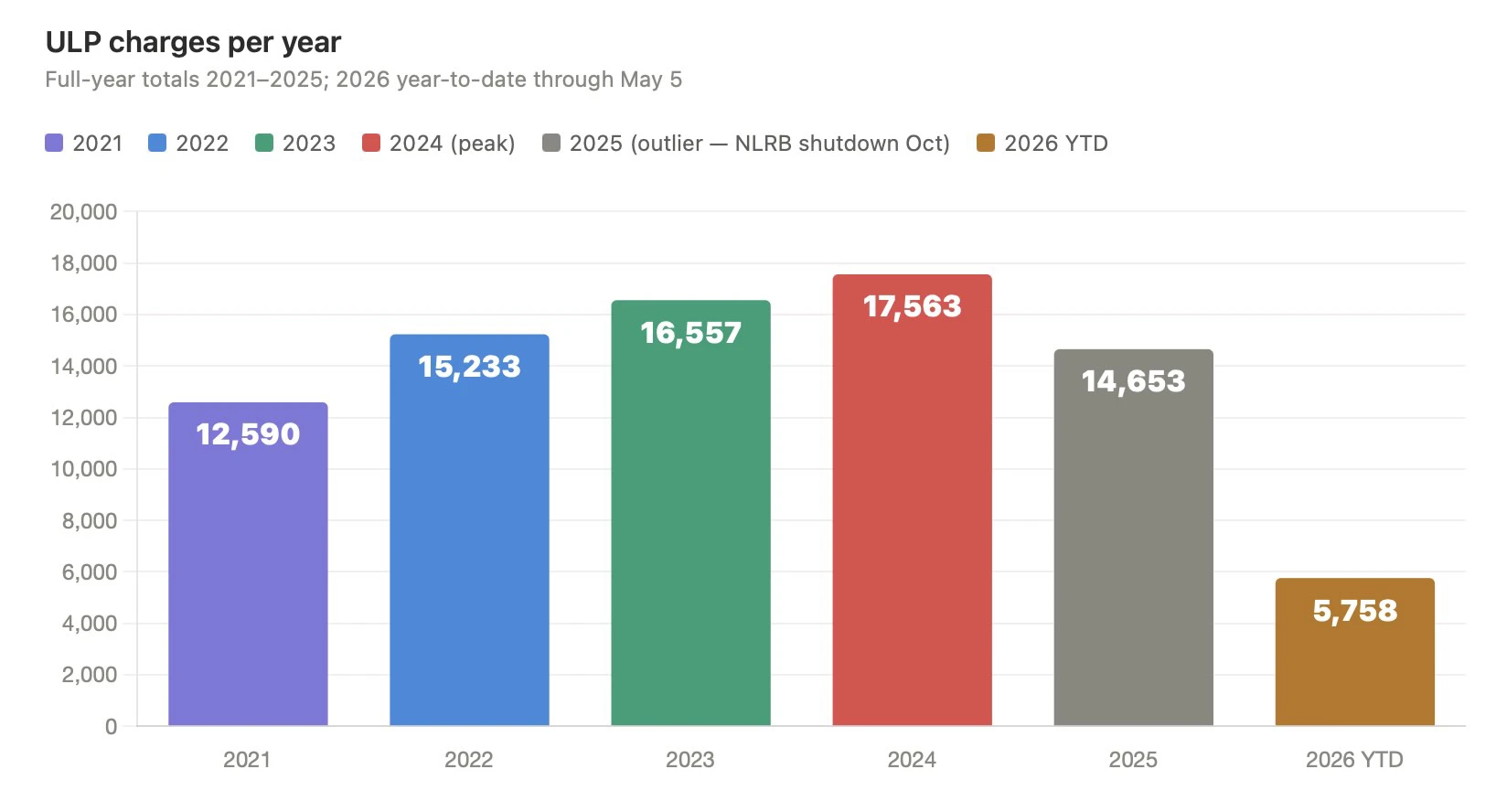
As this graph shows, ULPs trended up after 2021 and peaked at 17,563 in 2024. Yet in 2025, the annual total shifted backward to 14,653, but that didn’t happen due to an overwhelming sense of goodwill from unions toward employers. Rather, that lower number partially reflects the 43-day government shutdown, which included the NLRB and lasted from Oct. 1 through mid-Nov.


Additionally, the Board’s lack of quorum left it functionally paralyzed for most of 2025, during which regional offices operated without clear direction. During this time, unions didn’t magically stop having grievances, but it’s likely that they held back on filing charges out of uncertainty. That is, they felt apprehension about what the NLRB’s makeup would look like, and how policies would shift, when it became functional again.


The graph also shows a 2026 year-to-date ULP total of 5,758, which puts this year on track to be higher than usual, perhaps even a 17,000 total. That trend was visible in LRIrightnow’s First Quarter 2026 NLRB Review, and it has only continued. Single-day filing volumes are hitting levels that would stand out in any year:

  • Jan. 20: 112 charges

  • Feb. 17: 145 charges

  • Mar. 30: 130 charges

A slightly lower but still steady clip led into Q2:

  • Apr. 20: 98 charges

  • Apr. 22: 88 charges

  • Apr. 29: 87 charges

  • May 4: 75 charges

These numbers send a message that HR and labor relations practitioners can’t afford to ignore: 2025 initially looked like good news for employers, who bear a high cost to defend against and counter ULPs. However, this was a temporary lull.

Q2 filings: patterns and cases

More context involves the “new” Board itself. On Jan. 7, two GOP-leaning NLRB members, James Murphy and Scott Mayer, were sworn in. This shifts the Board’s balance 3-2 with Democrat David Prouty entering his dissent era, so the overall makeup of the Board is more employer-friendly than during the Biden era. This might not influence the number of charges filed, although it might shed light on their eventual resolution.


Additionally, Q2 filings are reflecting an ongoing trend: unions filing several charges against an employer during a short period. This deliberately aggressive tactic can be seen below with a twist at the end:

Brunson & Triplett Enterprises

This regional grocery store chain (operating as B&T’s Food Fresh Market) saw UFCW Local 1996 file seven separate ULP charges against it on Apr. 22. Each charge focused on a different Georgia location while alleging refusal to recognize and bargain with the union. The union’s coordinated approach on this date was meant to send a clear signal with a simultaneous paper record.

Brookfield Zoo Chicago

The Teamsters filed a steady drip of ULPs from late Mar. through early May for a total of 13 charges, mostly alleging refusal to bargain. The union used these ULPs to pressure the employer before putting 200 workers on strike in early May. Those picket lines ran for three days before the two sides reached a tentative contract.

The IBT Staff Council

The Teamsters’ staff union is striking back against their employer. On Apr. 22, workers filed eleven duty-of-fair-representation charges against the Teamsters in Washington, D.C. On May 1, three more ULPs involving refusal to bargain followed, showing that Sean O’Brien’s staffers are willing to wield the same tactics against his regime that he is happy throwing at employers.


Apparently, the Teamsters wrote a playbook on ULP filings. Guess they didn't expect their own staff to read it.

Another trend to watch: who's getting charged

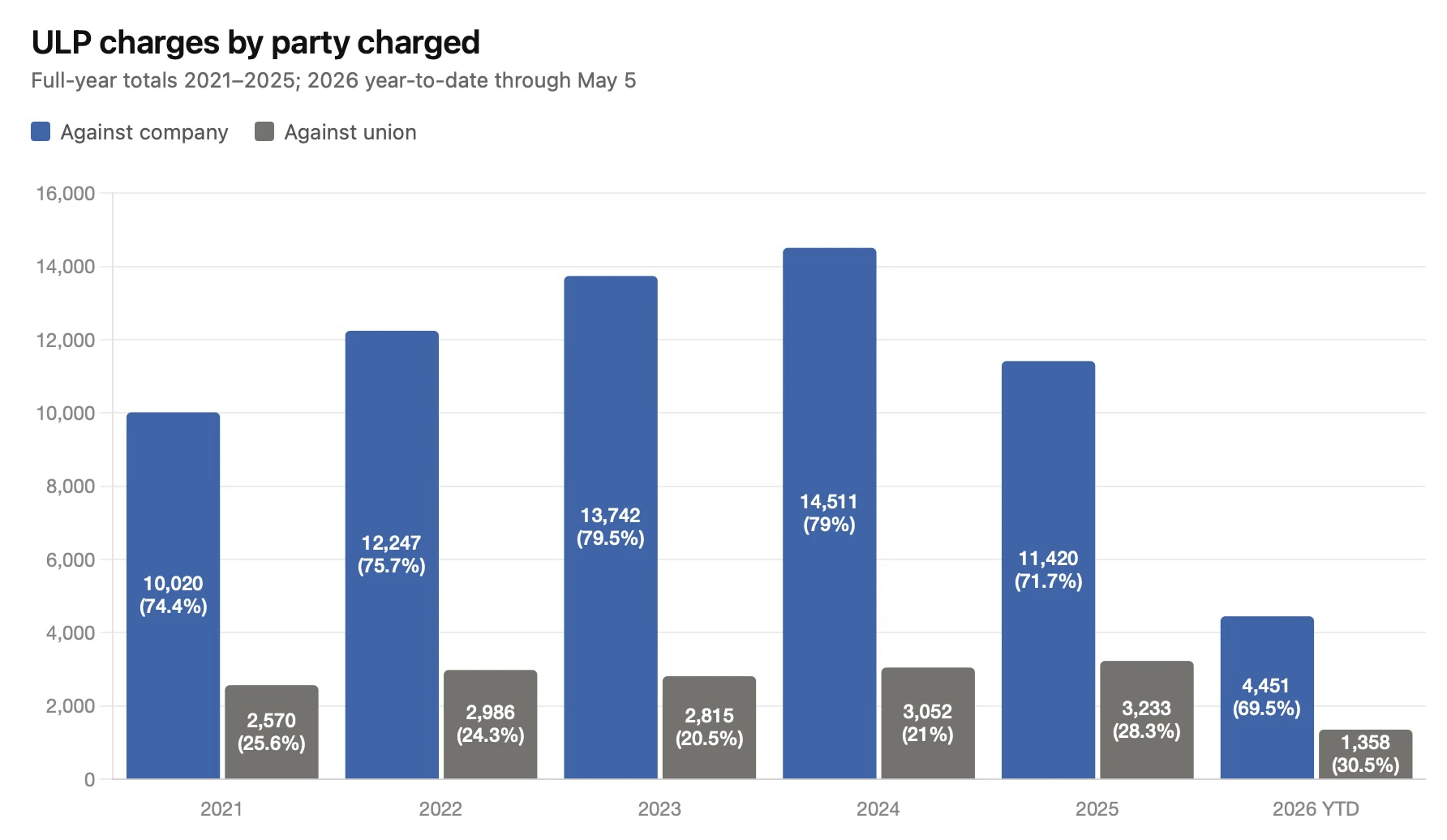
Another finding from our Q1 and Q2 data can be seen in the below graph, which stretches from 2021-26 and shows the percentage of ULPs filed against companies vs. against unions:

For now, we’ll quickly point out that 2026 reflects the highest percentage filed against unions (30.5%), which could be part of a trend, given that the 2025 figure (28.3%) is higher than previous years.


Look for us to revisit this subject in another article coming soon. For now, we’ll conclude that it might look like overall willingness to file ULPs is back after a 2025 lull, but for the reasons discussed above, that willingness never really left in the first place.


The Union You've Never Heard Of Is Following A Blueprint You Should Know

by Kimberly Ricci

Most employers are reasonably wary about the so-called “big” unions: UAW, Teamsters, CWA, IAM, SEIU, and so on. In a time of low private sector union density, these unions are poaching across industries to pump up their numbers. The effects are measurable with the Teamsters pushing into healthcare, the UAW organizing museum and higher ed workers, CWA going for ski patrollers, and the Machinists unionizing pharmacists.


Meanwhile with sector-specific unions, there’s no danger of, say, National Nurses United targeting manufacturing workers. One can make the same assumption about the International Alliance of Theatrical Stage Employees (IATSE), which is a niche “Hollywood” union but offers a useful case study in how unions grow. It's true that IATSE isn't coming for hospitals or warehouse workers. What it has built, and how it built it, is a different story.

A Larger Union Than You Think

According to IATSE’s most recently filed LM-2, this union represents at least 172,000 workers in the TV and motion picture trades as well as concerts and live theater productions. The union’s infrastructure spans 340 locals scattered across the U.S. and Canada.


This reach is wider than many employers realize. IATSE’s Tradeshow and Display Department covers the installation and dismantling of conventions, exhibitions, and corporate meetings through agreements with national employers. The union follows technical and production work wherever it goes, so you’ll find IATSE’s members in convention centers, arenas, and hotel ballrooms. Employers in live events, AV, and production who aren't unionized should understand that IATSE has the presence to get there.


Beyond IATSE’s industry reach, however, its recent activity, combined with the coalition model that follows, paints a broader picture.

Recent Moves Worth Watching

2026 wins: IATSE has unionized technicians, engineers, carpenters, ticket sellers, and sports promoters at venues including San Diego Musical Theater; Fontainebleau Hotel & Casino in Vegas; Borgata Hotel Casino & Spa in Atlantic City; and Crossroads Presents in Alliston, MA. Ditto for the Los Angeles Dodgers, ESPN, and more.


A “high-visibility” get: IATSE unionized crew members of Beast Games, a streaming competition from Prime Video show. The show’s host, Mr. Beast, has 484 million YouTube subscribers, and we can expect IATSE to continue targeting YouTube stars with viral presence to further increase its reach.


Extending and defending: IATSE already represents workers of CoComelon, the animated Netflix series. When Moonbug Entertainment declined to recognize card check on the LA set of CoComelon: The Melon Patch, the union filed ULP charges and put workers on strike. Elsewhere, IATSE filed a ULP charge against Kennedy Center alleging unlawful discharge after layoffs ahead of a planned temporary closure.

The Coalition Model

In 2021, IATSE members authorized a strike by 98.7%. What followed was four years of increasingly coordinated action across entertainment unions. WGA, SAG-AFTRA, IATSE, and the Teamsters built a solidarity coalition that showed up at each other's picket lines in 2023, during a 148-day WGA strike and a 118-day counterpart for SAG-AFTRA. During contract negotiations, this coalition has been using pattern bargaining, and “wins” by one union become the baseline for those that follow.


Each contract raises the floor for the next negotiation, and whether that method is sustainable for the industry isn’t relevant here. What matters is that other unions are watching, and they love to copycat each other.

What This Means Outside Of Hollywood

IATSE is a niche union, but it doesn’t operate like one. Further, the union’s most recent LM-2 filing shows $103.8 million in total assets and zero debt. That’s enough to sustain a lengthy campaign or a high-profile dispute, which leads to our final point.


Employers who wait until a union is at the door to ask these questions will be too late. The time to pay attention is before the petition, not after.


Friday 5: ULP Backlogs, A TikTok Ruling, And The UAW's 'Twin Peaks' Moment

by Kimberly Ricci

The NLRB’s Unfair Labor Practice (ULP) backlog is real

The Board is still digging out from underneath a ULP mountain that began during last year’s government shutdown. Additionally, the current rate of ULP filings remains high, and this week, General Counsel Crystal Carey made a call to address the situation that isn’t solving itself.


Carey announced a “bulk transfer” of around 3,500 ULP cases to lighten the load on some Regional Offices. The transferred cases include those filed prior to Jan. 7, 2026, and Carey stressed that this redistribution will support her overall goals for efficiency and streamlining processes. Her main goal, however, is to “provide determinations to parties who have been waiting months, or even years, for resolution.”


On a related note, look for our upcoming INK articles on the ULP avalanche, coming soon.

The latest UAW federal monitor report has a Twin Peaks reference. Really

The United Auto Workers union has poured many millions into funding federal monitor Neil Barofsky’s investigation into their legacy of corruption. And if you worried that the saga was going to become less entertaining, fear not.

Not only has the monitor produced reports about Fain’s foul-mouthed outbursts and retaliation-filled workplace, but a fourteenth report has now emerged to paint another portrait of him losing his temper over money.


More specifically, the report details retaliation against Secretary-Treasurer Margaret Mock, who Barofsky previously ordered to be reinstated after another report detailed her orchestrated ousting by Fain after he threw a fit over her refusal to sign off on his questionable expenditure requests.


The new 82-page report details how Fain blamed Mock as the sole point of failure for how the union’s strike fund wasn’t reinvested as quickly as he’d preferred after the 2023 Big Three strikes. Barofsky did find evidence that this failure did occur, although several other leaders and subordinates were more responsible for the delay. However, Fain decided that Mock was solely responsible, and he wanted to outright fire her.


Barofsky detailed a conversation that he had with Fain and ex-Chief of Staff Chris Brooks, who insisted that accusations of wrongdoing against Mock were fact, not simply allegations. That somehow led to a bizarre Twin Peaks reference on Page 74, where Brooks remarked, “A fact is something like ... Laura Palmer is murdered, and the allegation would be [the Monitor] murdered her, right?” Sadly, no cherry pie entered the conversation.


Barofsky has one year left in this role, so we look forward to more oddities.

Why did Starbucks Workers United pull out of a Seattle cafe?

This week, Starbucks Workers United withdrew their petition for a union vote at the iconic Pike Place Market. This location, which was the first Starbucks cafe to open, would have been a symbolic “get” for the union, although they apparently realized that they didn’t have the votes to win and decided to avoid embarrassment.


Also, more context is emerging about the union’s behavior. The Seattle Times spoke with a worker who felt tricked into attending an organizing meeting and being presented with an authorization card: “I pretended to sign because I did not feel comfortable saying no in the moment.” Another worker spoke of how the union campaign was disruptive and sowed mistrust among baristas: “I wish I would have been able to vote.”


Starbucks publicly reacted to the withdrawal with a statement: “This prevents Pike Place partners from having the opportunity to make clear publicly whether they ever wanted union representation.”

A TikTok video was ruled to be concerted protected activity

In United States Postal Service, JD-26-26, an NLRB Administrative Law Judge found the Postal Service illegally disciplined two Florida employees for protected concerted activity and maintaining overbroad workplace rules.


One worker, a rural letter carrier, had posted TikTok videos about a pay cut for himself and several colleagues. USPS argued that this activity lost protection because the worker monetized this social media account, but the ALJ rejected this while holding that employee motive is not relevant in evaluating whether an activity is protected under the NLRA.


The case hinged on the "overbroad" Stericycle standard, and employers should treat this decision as a hint to revisit their own social-media and camera-ban policies while reviewing supervisor training.

Gen Z’s struggles to enter the workforce continue

What happens when a survey suggests that “only 2% of Gen Z has the values that hiring managers want and are looking for”? That figure emerged during a discussion on USA Today’s The Excerpt podcast, where NYU professor Suzy Welch called that result “staggering” while emphasizing that this is not the result of a skills gap or lack of work ethic. Rather, Welch believes that this is a widespread case of values misalignment between workers and their employers.


Clearly, generational gaps are nothing new, but the reality is that Gen Z is the future, especially amid the wave of retiring Baby Boomers. Employers cannot fill those sizeable shoes with 2% of candidates. And what Gen Z workers want most is to be actively listened to by their employers, although this survey points toward a massive divide in that department.


We’ve talked before about how Gen Z values both communication and transparency, and how employers should take heed of how it’s vital to actively listen to younger workers’ concerns and priorities. If workers feel ignored, that creates a vulnerability point where union organizers are happy to infiltrate and fill that gap with false promises.

About Labor Relations INK

Labor Relations INK is published weekly and is edited by LRI Consulting Services, Inc. Feel free to pass this newsletter on to anyone you think might enjoy it. New subscribers can sign up by visiting here.


If you use content from this newsletter, please attribute it to LRI Consulting Services, Inc. and include our website: http://www.LRIonline.com 


Contributing editors for this issue: Greg Kittinger, Michael VanDervort, and Kimberly Ricci.


You are receiving this email because you subscribed to receive our labor relations newsletters and updates. You can manage your email preferences by clicking the link at the bottom of any of our email communications.


About LRI Consulting Services, Inc.

LRI Consulting Services, Inc. exists to help our clients thrive and become extraordinary workplaces. We improve the lives of working people by strengthening relationships with their leaders and each other. For over 40 years, LRI Consulting Services, Inc. has led the labor and employee relations industry, driven by our core values and our proven process, the LRI Way.


Share