Subject: LRI INK: NLRB GC Focuses on Backlog, Behind The Numbers Of Union Organizing

January 29, 2026

To visit the blog post, click on the link below the article.

Breaking: NLRB GC Memo 26-02 Is A Reset, Not Relief. Labor Relations Is Still Difficult. Here Are Tools That Help. 

by Michael VanDervort

Labor and employee relations work has not gotten easier. It has gotten faster, louder, and less forgiving.


The General Counsel of the National Labor Relations Board just made a rare move: stop chasing precedent and start closing cases.


GC Memo 26-02 does not launch new legal theories or tee up precedent-killing test cases. Instead, it calls out years of policy churn, inconsistent regional enforcement, and settlement resistance that helped create today’s backlog. The fix is procedural, not ideological.

Translation: fewer policy experiments, more discipline. Regions are told to follow standard Advice rules, focus on real legal gaps, and move cases faster and more consistently.


This does not change the law. Employee rights remain intact. Remedies remain aggressive. Exposure remains real.


What has changed is posture. Cases are more likely to move. Inconsistency is less tolerated. Delay is no longer the default.


Labor relations is not getting easier. It is getting less forgiving.

Labor and employee relations work does not happen in theory. It happens under pressure, with imperfect information, and usually five minutes before something goes sideways.


That reality is exactly why LRI keeps building practical, real-world resources for labor and employee relations professionals. And why we are asking you to use them, share them, and in one case, help us benchmark the field.


Here is a quick list of resources available to you that you may find useful. Feel free to share with your team members of anyone you think could benefit from these resources.

The Left of Boom Show, Watch or Listen

Conversations on labor relations and leadership focused on what happens before issues explode. Choose your format and go.


Watch on YouTube:
https://www.youtube.com/@LeftofBoomShow

Listen on the go (audio podcast):
https://feeds.captivate.fm/the-left-of-boom-show/

Browse all LRI podcasts:
https://lrionline.com/podcasts/

Bargaining Resource Hub

A centralized collection of bargaining insights, planning guidance, and real-world considerations for employers preparing for negotiations or already at the table.
https://lrionline.com/bargaining

Labor Relations Benchmarking: We Need Your Help

This is the one ask in this issue.

If you have ever wondered whether your labor relations posture is ahead of the curve or quietly exposed, this five-minute benchmark gives you a reality check. More importantly, your participation helps build an evidence-based picture of what is actually happening across organizations.


Take the benchmark (5 minutes):
https://https://benchmark.fillout.com/labor

This only works if practitioners participate. Data beats anecdotes every time.

empowER™ Labor Relations Community, Powered by HR Acuity

A growing, practitioner-led community focused on employee relations, investigations, and data-driven decision-making. Free to join and designed for real conversations, not marketing fluff.
https://empower-er.org/

Fractional Labor Relations Services

Not every organization needs a full-time labor relations team. This model provides on-demand expertise for monitoring, prevention, and response before issues escalate.
https://lrionline.com/fractional-labor-relations/

INK Newsletter

You already subscribe if you are reading this, but if you know someone who would benefit from practical labor and employee relations insights, point them here.
https://news.lrionline.com/

LRI Rightnow Labor Libraries

A digital labor relations library built for quick answers. Petitions, trends, and intelligence you can actually use when timing matters.
https://lrirightnow.com/


If there is one ask in all of this, it is simple. Use the resources. Share the ones that help.


And if you can spare five minutes, help us benchmark the work we all do every day.

That data matters more than opinions ever will.


That 88% Healthcare Union Victory Rate In 2025? It's More Complicated Than It Seems

by Kimberly Ricci

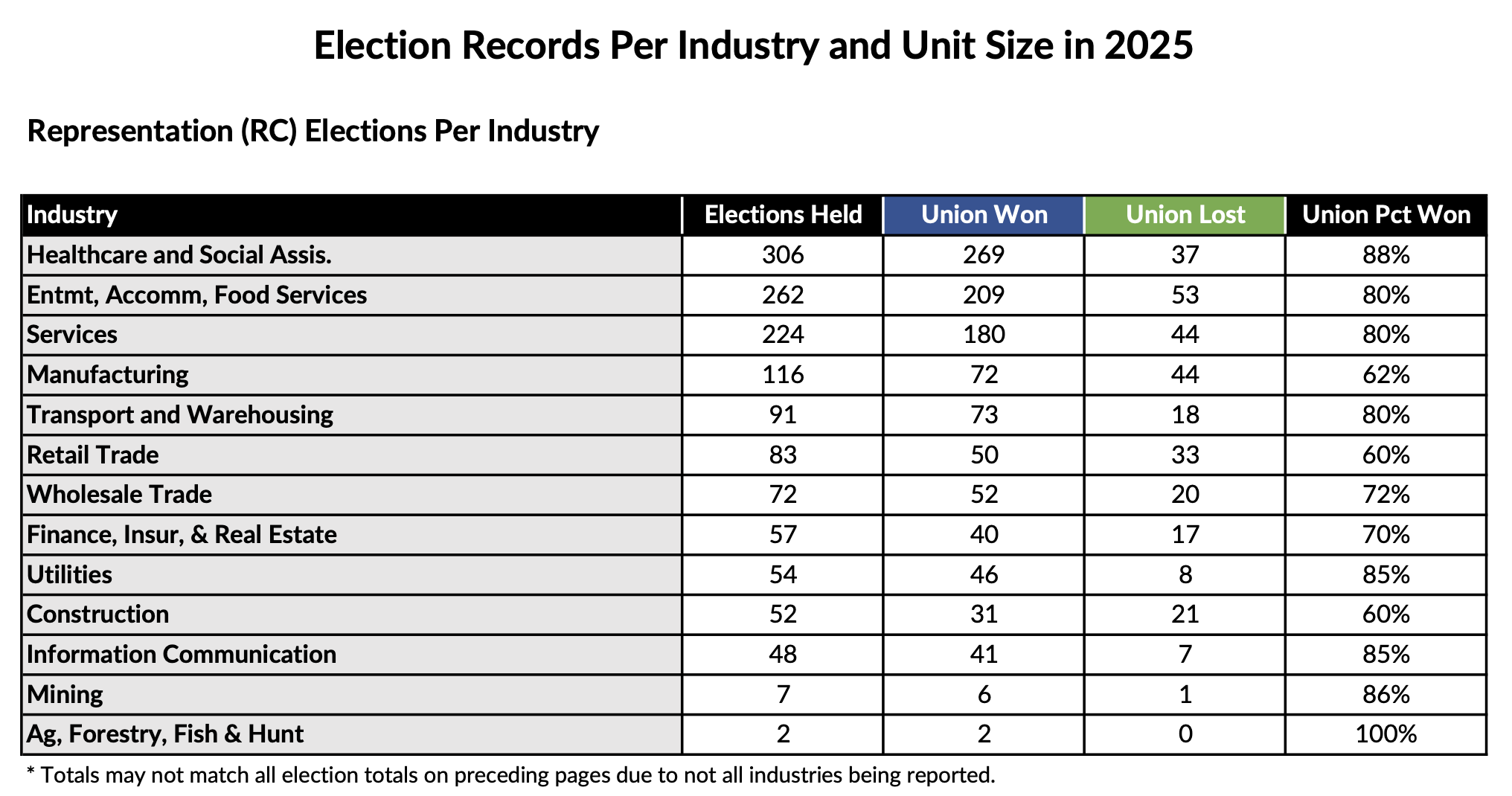
LRIRightNow's 2025 NLRB Review contains a treasure trove of data on election volume, unit sizes, union decertifications, and union win rates in a variety of industries. As noted in our roundup of standout statistics, one eye-catching tidbit (on Page 16) reveals that unions won 88% of petitions within the healthcare industry. Of the 306 healthcare elections held, unions won 269 elections and lost 37 of them.

______________________________________________________________


Introducing the LaborVision Forum for Healthcare Practitioners


New Event Spring 2026: LaborVision Forum for Healthcare

📍 Dallas/Fort Worth Airport Marriott 8440 Freeport Pkwy, Irving, TX 75063
🗓️ March 10–11, 2026
_______________________________________________________________

Let's get this out of the way first: Yes, that's a higher percentage of union wins as opposed to 60% union wins in the construction and manufacturing industries or 80% in transport and warehousing. The total number of non-healthcare elections averages out to a 75% union win rate in 2025.


Yet for the healthcare industry, plenty of context sits behind that 88%.

Why Healthcare is Particularly Attractive to Unions

The healthcare industry faces unique challenges, which accelerated during the pandemic and haven't eased up yet. These difficulties include safety concerns and staffing shortages that were exacerbated by a mass exodus of workers from the field. Unions are eager to capitalize upon resulting frustrations, including on salary issues, which might be compounded by the end of pandemic-focused waivers and emergency funding. Additionally, recent government policy changes are likely adding chaos.


As a result, unions feel like they have a lot of leverage in healthcare settings and pursue their targets as aggressively as possible, such as by slicing and dicing bargaining units in ways that are favorable to winning elections. The usual suspects in these drives include SEIU, UFCW, and many nursing unions, and in 2025, several unions that you wouldn’t ordinarily think of when it comes to healthcare--IAM, AFSCME, IBEW, AFT, and the Teamsters—attempted to poach healthcare workers.

What Are the True Effects of Unions in Healthcare Workplaces?

Not fantastic, for workers or the communities that they serve.

As an example of one union’s effects on a metropolitan area, The Center for Union Facts released a Feb. 2025 report pointing toward worse patient outcomes for Los Angeles hospital systems where SEIU has organized nurses. This study should be spread far and wide, since SEIU infiltration correlates with a disproportionate percentage of 1-star hospitals (35.3%) compared to all LA hospitals (11.8%). Also tellingly, zero SEIU-unionized hospitals in the city held a 5-star rating.


Additionally a 2023 Journal of Nursing Administration study found that union-represented nurses were less likely to report turnover, but they were more likely to experience job dissatisfaction. In other words, unions don't really make nurses any happier about being there.


That is to say, there are certainly less invasive and less expensive ways to address retention than workforces taking the gamble of union representation that leads to only broken promises in return.

High-Profile Strikes Create a Perception of Union Dominance

Healthcare workplaces are environments in which strikes are crippling to both the organization and the community. As a result, these picket lines are extensively showcased by the press. One need only look at recent reports on the New York State Nurses Association's current strike, which is now in its third week. 15,000+ nurses walked off the job to strike against three major hospital systems. Both sides planned for a weeks-long event, and the hospitals spent at least $100 million on hiring replacement nurses.


NYSNA's demands include considerable salary increases, i.e. $220,000 compared to Montefiore's current average of $165,000. This kind of attention-seeking pressure does not guarantee results for union members, who will almost certainly be disappointed by false union promises on what can happen at the bargaining table.


Case in point: Healthcare unions have repeatedly waged extended strikes without meaningful results during the Kaiser Permanente labor saga.

These high-profile strikes are rarely beneficial for workers, and they are detrimental to the communities that hospitals serve. Where is Big Labor, meanwhile? They’ve likely already moved onto organizing new targets.

Reality check: Healthcare Employers Can (and Should) Push Back

Because healthcare strikes are so visible and impact the community, there's a default belief that unionized healthcare workforces outnumber non-unionized ones. Yet that's far from true, and all is not lost. Unions do lose healthcare elections, and they'd probably lose many more if more hospitals chose to take a union campaign to election rather than voluntarily recognizing a union.


These strikes aren't good for workers, hospitals, or the communities they serve. Workers receive empty promises and walk picket lines without meaningful gains. Hospitals divert millions of dollars that could improve patient care toward replacement staffing instead. And communities suffer when healthcare access is disrupted and patient outcomes decline.


The 88% union win rate in healthcare is attention-grabbing, but it isn’t the end of the story. Healthcare employers can successfully combat organizing drives and foster the kind of workplace culture that benefits both staff and the patients they serve. That’s the case when hospitals are willing to search for the right approach and will engage directly with employees about what unions can and cannot deliver.


Big Names, Bad Results: Why UAW, UFCW, and Building Trades Can't Win Elections

by Kimberly Ricci

As part of our follow-up to LRIRightNow's 2025 NLRB Review, we looked at the standout statistics. We also discussed why healthcare unions' 88% win rate doesn’t tell the whole story about how unions do a disservice to workers, hospitals, and communities that they serve.


Now it’s time to look at which unions are awful at winning elections and why. UAW president Shawn Fain won’t be happy ab

ut this, but here are the biggest losers, according to Page 8 of our report:


UAW: 58% (14 wins, 10 losses)
UFCW: 63% (55 wins, 32 losses)
RWDSU (UFCW’s retail affiliate): 64% (7 wins, 4 losses)
Plumbers & Pipe Workers: 48% (16 wins, 17 losses)
Steelworkers: 67% (14 wins, 7 losses)


Below this chart, we will explore why these unions fall short of the 78% overall win rate in 2025 representation elections.


The UAW's Southern Struggles are Only the Beginning


The UAW's 58% win rate is 30% behind healthcare unions for a few key reasons: (1) The union’s waning Southern momentum; (2) The UAW's desperate pivot away from actual auto workers, suggesting that fewer of their traditional targets remain. Additionally, Fain’s troubles with the union’s federal monitor don’t help the situation. Let’s look closer.


Although the UAW’s first Southern auto plant victory at Volkswagen in Chattanooga generated headlines in Apr. 2024, the union lost decisively at Mercedes-Benz in Alabama one month later. The union also refused to allow members to vote on Volkswagen’s final contract offer. A budding VW decertification effort points toward waning worker support for the union’s vow to conquer the South.


With the Mercedes Alabama loss, multiple factors led to UAW defeat, including how auto workers in this state already receive competitive wages. This, along with union contracts favoring seniority for everything from wage increases to claimed job security, makes joining a union far less attractive.


Then there’s the fact that the UAW’s membership is increasingly made up of workers who, to be blunt, are not auto workers. In 2025, the union only held about a handful of elections for auto-worker units and leaned harder into organizing museum, movie theater, and clerical workers. The UAW also continued pursuing higher-ed workers, which recently made up around 25-30% of the union’s total membership.


Undeniably, the UAW’s intense poaching beyond their wheelhouse reveals their worries about the future. That’s only to be expected after they fell from their 1979 peak of 1.5 million members to their current claim of 400,000 active members. The union’s legacy of corruption also surely doesn’t impress workers, especially after the federal monitor issued several damaging reports. Further, this union's own staffers are miserable, so why would workers want to sign up for their representation?


Exactly.


The UFCW's Lackluster Retail Showing Persists


The UFCW claims 1.2 million members but struggled to pull their win rate much above 60%. The same goes for affiliate RWDSU, and the writing has been on the wall. A few years ago, former UFCW Local 300 organizing director Matt Loveday saw this coming while conceding that UFCW’s overall win rate is “very, very poor” with retail and grocery workers.


Case in point: The union tried and failed for decades to organize Walmart workers. In 2025, the union won one election at Whole Foods but lost many more at Tom Thumb, Albertsons, and several smaller grocers.


Considering how much dues money this union takes in from over 1 million members, they can certainly fund organizing campaigns. That doesn't guarantee effective execution, and organizing retail and grocery workers in a high-turnover industry is notoriously difficult. It also doesn’t help UFCW that their 2025 grocery contracts were labeled as "sellouts" and likely convinced some workers to vote against representation during elections.


Building Trades Workers Want to Build Their Own Path


These unions’ number of elections pales in contrast to their size. The Plumbers claim 390,000 members but saw 33 campaigns through to election. Whereas the Steelworkers claim 850,000 members but only held 21 elections. The Steelworkers fared better with a 67% win rate than the Plumbers’ 48%, but both unions fell below the overall 78% average.


The low number of elections from both unions could point toward high job satisfaction from workers who see no need to unionize. Additionally, the Plumbers’ units were small, often in the single digits, and it’s likely that these workers realized that they would be restricting their earning potential and losing other freedoms by living under a union constitution. For the Steelworkers, this industry’s global competitiveness likely causes workers to shun how unions protest technological advancements during contract negotiations, leading to strikes that harm workers’ pocketbooks.


What Separates "Winner" Unions from Losers


Aside from the healthcare industry, which we've already discussed, it’s not difficult to figure out why SEIU/Workers United (86%/81%) and Teamsters (71%) have higher win rates.


Much of SEIU’s election success is down to Starbucks Workers United’s momentum, although it’s not much of a “win” when no contract exists more than four years after the first Starbucks cafe unionized.


Meanwhile, the Teamsters have taken a diversified approach to organizing that is proving more successful than the UAW’s attempts. That is to say, the Teamsters still maintain their traditional focus of transportation, logistics, and food processing workers but, in 2025, this union also won elections with casino workers, public defenders, and nurses.


In other words, Sean O’Brien has never met a worker that he doesn’t want to collect dues from, which brings his union additional revenue streams. And Shawn Fain might sometimes wish that he was Sean O’Brien.


What Matters Most: Workers Choose What Works


We’ve talked before at length about how unions fail workers, and workers increasingly know this. They’re not simply buying what organizers are selling, and they’re choosing to make informed decisions while rejecting several organizations that prioritize dues collection over worker well-being.


Workers have made clear what they want: Responsive leadership, clear advancement paths, workplace cultures that make them happy to get out of bed, and competitive wages. They want the kind of employer that makes union representation obviously unnecessary. For that reason and many more, union organizing drives are worth fighting, rather than voluntarily recognizing third-party representation.

Friday Five: Strike Splits And Stalemates, Healthcare In Limbo, And More NLRB Movement

by Kimberly Ricci

The Teamsters aren’t on board with the one-day "General Strike" in Minnesota:

As we have previously discussed, the idea of a protracted General Strike is both a grassroots fantasy and a real possibility. The realness comes from UAW President Shawn Fain’s plan to coordinate contract expiration dates for May 1, 2028, so that work stoppages would occur across several industries. Far less likely is the idea of a less structured, grassroots event, where people would walk off their jobs without the NLRA protections associated with striking as a union member.


Yet those who have been watching current events have likely seen word of Jan. 23’s “ICE Out of Minnesota,” which was labeled by independent news outlet Minnesota Reformer as “a general strike.” However, this is more of a one-day economic blackout event where businesses are closing, although some worker call-outs should be expected.


Organizers have urged consumers to halt spending, and the Bring Me The News website published a list of hundreds of business locations closing for the day or operating on reduced hours. The “ICE Out” website points toward rallies beginning at 2:00 pm local time while citing Minneapolis resident Renee Good’s killing by ICE agent Jonathan Ross as a key motivation.


Meanwhile, the World Socialist Web Site points out that, unlike several other union locals (SEIU, CWA, IATSE), the Teamsters do not support this event in accordance with the UPS contract’s “no-strike provision” and instructed UPS workers to refrain from walking off the job.


It must be noted, though, that the current Teamsters’ UPS contract expires in June 2028, so it’s possible that they could (late-game) participate with Shawn Fain’s 2028 plans if he does pull off an extended general strike.


Healthcare is in a holding pattern over H-1B visas:

Hospital systems already have enough concerns over staffing ratios and finances, especially after the end of pandemic-era funding. Unions are also waging high-profile strikes, and the list of headaches keep going.


What also isn’t helping matters: A lack of clarity on whether healthcare will be exempt from $100,000 H-1B visa fees. As Becker’s Hospital Review relays from the American Association of Medical Colleges, Trump’s executive order (EO) on the matter has left hospitals wondering if or when they can finish their physician recruitment plans.


If healthcare systems are found to be non-exempt from the EO, these fees would hit rural hospitals hardest, given these communities’ reliance upon international applicants who require H-1B sponsorship to work in the U.S. If no update occurs to the H-1B EO, these hospitals might have to rely on the J-1 visa program, which has its own complications, including how hospitals would train residents before they are required to temporarily return to their home countries for two years.


The healthcare industry does not need these obstacles, so we’ll be watching to see if that H-1B exemption comes through.


Will the Bigfoot Beverages strike finally end after NLRB’s weigh in?

Last September, the Teamsters bizarrely threw a barbecue to mark the one-year anniversary of the Bigfoot Beverages strike. At that point, many union members had already moved on to jobs elsewhere, where they certainly didn’t receive generous 401(k) contributions (9% default with no need for workers to match) like those offered by Bigfoot, and the union had reportedly prevented workers from voting on a final contract offer.


Meanwhile, the Teamsters are still demanding that the company scrap the generous 401(k) offer and keep workers’ pension plans active, although Bigfoot has made it clear that no accrued pension benefits would be lost.


The union’s overreach has already hurt its own members. Now it has cost the Teamsters again, with the NLRB dismissing seven complaints after finding the charges lacked merit. In doing so, the Board found that the company was not bargaining in bad faith and did not illegally threaten workers’ jobs. More charges remain to be considered by the Board, but it’s not looking great for these workers who have been striking with no meaningful results.


Seems like it’s time to finally throw in that towel.


The NLRB General Counsel shuffle and the naming of names:

The NLRB hit the ground running after finally receiving a quorum. They’ve issued dozens of unpublished decisions and a first published decision that details a plan for labor law predictability through regional directors if the Board loses its quorum later this year when David Prouty’s term expires.


Meanwhile, ex-Acting General Counsel William Cowen isn’t going too far. He will now temporarily oversee the NLRB’s 26 regional offices until further notice. New GC Crystal Carey also announced new staffers, including Lynisa B. Michalski as acting deputy general GC and Sylvester Giustino as director of the Office of Congressional and Public Affairs. Additionally, Bloomberg Law reports that the NLRB lost 150+ employees, or 10% of its staff, in 2025 during federal-agency trimming, and this reduction is expected to slow down the Board’s backlog clearing.


IAM is looking for the next generation of union organizers:

We’ve told you before about Big Labor’s efforts to recruit younger workers to fill unions’ coffers for the future. These tactics include a new toolbox of organizing strategies and training programs on how activists can become “salts” in order to infiltrate businesses with the intent of organizing while deceiving coworkers.

Now, the International Association of Machinists is (publicly) getting in on that game. This perhaps should have been expected, given that their Pharmacy Guild affiliate union was launched by four Gen Z founders who leverage their social media followings for publicity.


IAM is now pushing Young Worker Committees, and they are inviting Gen Z members to build committees at their own locals. The union held a training week attended by young workers, who learned about social media strategy as well as “organizing on the issues, common sense economics, human rights, and establishing effective committees.” “Salting” wasn’t outwardly on the agenda, but you can bet it happened on the down low.


The union has also announced a “Young Workers March on Washington,” which is scheduled for Feb. 7, that will focus on economic concerns faced by Gen Z in particular.


Meanwhile, the Start Applying Labor Transparency (SALT) Act awaits action from the House Committee on Education and the Workforce. If the law is enacted, salts would be required to file disclosure forms with the Department of Labor, much like employer consultants must already do. At that point, workers would always be made aware when they’re working alongside somebody who’s receiving a paycheck to persuade them.


About Labor Relations INK

Labor Relations INK is published weekly and is edited by LRI Consulting Services, Inc. Feel free to pass this newsletter on to anyone you think might enjoy it. New subscribers can sign up by visiting here.


If you use content from this newsletter, please attribute it to LRI Consulting Services, Inc. and include our website: http://www.LRIonline.com 


Contributing editors for this issue: Greg Kittinger, Michael VanDervort, and Kimberly Ricci.


You are receiving this email because you subscribed to receive our labor relations newsletters and updates. You can manage your email preferences by clicking the link at the bottom of any of our email communications.


About LRI Consulting Services, Inc.

LRI Consulting Services, Inc. exists to help our clients thrive and become extraordinary workplaces. We improve the lives of working people by strengthening relationships with their leaders and each other. For over 40 years, LRI Consulting Services, Inc. has led the labor and employee relations industry, driven by our core values and our proven process, the LRI Way.


Share