Subject: LRI INK: Labor got weird this week. Pay attention.

February 5, 2026

To visit the blog post, click on the link below the article.

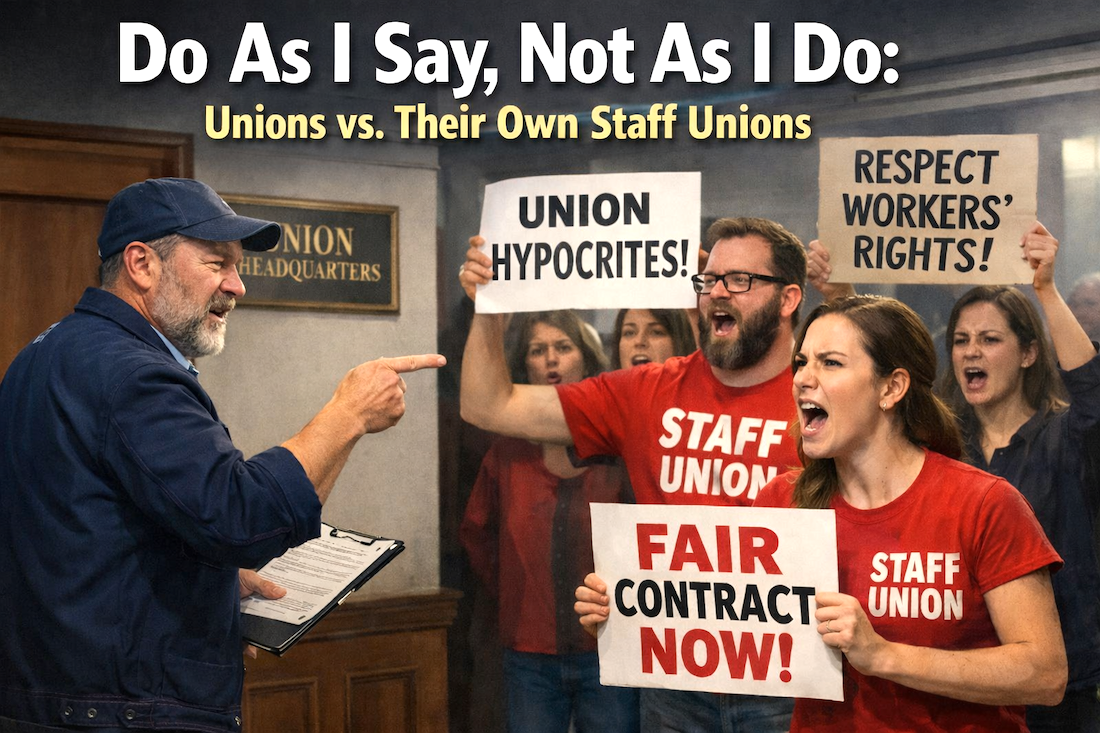
Do As I Say, Not As I Do: Unions vs. Their Own Staff Unions 

by Kimberly Ricci

In our last Friday Five edition, we touched upon an example of unions opposing their own staff unions. That case involved staffers for Industrial Workers of the World filing a ULP charge for Refusal to Bargain/Bad Faith Bargaining against their employer. An anonymous letter from staffers further detailed their belief that officials were “implementing a strategy to get rid of workers” who organized by instilling “drastic” new work policies.


After we published our article, more union-hypocrisy news broke involving the WGA West Staff union authorizing a ULP strike over alleged bad-faith bargaining, unlawful surveillance, and retaliation for protected activity. This news arrived ahead of the March negotiations, which precede the WGA’s May 1 contract expiration date. Since their last contract battle led to a 148-day strike, these negotiations will likely be contentious from the start.


Since we’re already on this subject, let’s look at four more recent standout examples of unions failing to adhere to their self-professed standards.

UAW Staff United Strike (Dec. 2024)

UAW monitor Neil Barofsky recently issued a lengthy report alleging that Shawn Fain’s union is a miserable, retaliation-filled workplace. So in retrospect, it shouldn’t be shocking that 40 UAW Staff United members overwhelmingly authorized and carried out a 10-day ULP strike against the UAW’s International Executive Board. In doing so, the union’s Region 9A staffers made the following allegations:


- A plethora of complaints: Organizers waged the strike as a “response to bad faith bargaining committed by the UAW throughout our negotiation process and the retaliatory termination of a union leader.”


- The UAW tried to create a company union: Management allegedly responded to the staff union’s petition by “fil[ing] its own NLRB petition to represent temporary organizers nationwide” to represent the UAW’s interests in a “clear attempt to destroy our new union.”


- Hypocrisy on temporary organizers: These workers maintain a temp status in three-month intervals for up to three years. What’s quite rich here is how the UAW had recently finished Big Three negotiations while pressuring automakers to convert temp employees to full-time within nine months.

AFL-CIO Staff Union Contract Dispute (2023)

The nation’s largest labor federation, a gathering of 64 unions representing 15 million people, holds itself out as fighting tirelessly for workers’ rights. Yet AFL-CIO's own staff union made ironic allegations, which two workers detailed in an op-ed column meant to shame their employer:


- Nine years without raises: The union hadn’t increased wages since 2014, and when the offer did come, it was 2.4% each year, below inflation.


- Significant layoffs: After the AFL-CIO laid off many collective bargaining staffers, their union shrank from 160 to 90 workers in 2016.


- In the op-ed authors’ own words: "If we listened to the advice our bosses gave other unions, we would be striking right now."

UNITE HERE Internal Conflicts (2009-2010)

Progressive publication Labor Notes published an article by two staffers of this hospitality workers union who alleged a “toxic organizing culture” and abusive recruiting methods. That wasn’t all:


- Lack of democracy: A top-down decision-making structure.


- A “pink sheeting controversy”: This involved collecting staffers’ personal information and then manipulatively using it for “recruiting, motivational, or disciplinary” purposes.


- Resulting staff turnover: Several boycott team members resigned after they criticized management’s practices and were then ostracized.

SEIU Headquarters Staff Disputes (2019 and 2023)

The union famous for the “Fight for $15” movement and aggressive lobbying of state lawmakers doesn’t have the most stellar work culture.


2019 Conflict: Staffers accused management of using the same type of two-tier system for layoff protections that it criticized in employers. Workers also alleged that management tried to manipulate the bargaining unit by reclassifying employees as supervisors.


2023 Strike Authorization: The union allegedly dragged its feet on contract negotiations, and workers declared that they deserved “the same respect, pay, and protection that the SEIU fights for on behalf of other workers."


More hypocrisy on pay: The Wage and Hour Division of the Department of Labor charged SEIU 30 times for violations.


Conclusion: These unions’ hypocrisy calls into question their commitment to the standards they demand of employers. These cases also show that campaign promises should be evaluated by workers (and employers who are countering campaigns) against how unions treat their members. Clearly, unions don’t always practice what they preach.


Top 10 Things Union Members Are Rarely Told Up Front

by Michael VanDervort

With apologies to David Letterman, Paul Shaffer, and anyone who thought “how bad could it be?”  


10. Union dues are not capped forever; they can go up
Think less about the price tag, more about the variable-rate subscription price for your streaming channels. Increases happen. Refunds do not. Still fewer member perks than Netflix.


9. You are not the author of the contract
Union leadership negotiates. Members vote yes or no. No edits. No custom requests.


8. Exclusive representation means no side deals
Once the union speaks for you, you stop speaking for yourself. Even if you disagree. Especially then.


7. A “yes” vote does not guarantee a first contract
It guarantees bargaining. Sometimes lengthy. Sometimes stalled. Always described as progress. Often takes more than a year. Sometimes never happens.


6. Unions can discipline their own members
Yes. Fines, trials, and penalties are part of the package. Nearly $1000 per person for workers crossing a picket line to work in a grocery store.


5. Criticizing union leadership can violate internal union rules
Free speech applies. With internal conditions that you only speak nicely about the union.


4. Dues are collected regardless of performance
Satisfied or not, the meter keeps running. No refunds. No cancellations. (except in right-to-work states)


3. Grievances and strikes are controlled by union leadership
You get representation. You do not get the wheel.


2. Leaving is harder than joining
Once you are in, the employer is legally required to stay out of it.  Voting a union out is incredibly difficult. And against their rules (see #6).


1. Union incentives do not always align with individual member outcomes
Large organizations behave like large organizations. Even when they promise otherwise. Just ask the federally appointed monitor overseeing UAW compliance with the rules.


Why this matters

This is not an argument against unions. It is an argument against surprises and the quiet loss of choice that can follow an uninformed decision.


If employees are going to vote on union representation, they need more than slogans, empty union promises, and calls for solidarity. They need to understand how unionization works, including the rules, obligations, and trade-offs involved.

One thing we consistently tell employees during a union election is this:


This is the moment to read the rules and the fine print, not just listen to the union pitch.


Voting is easy. Living with the outcome is what lasts.

AI Bots Talking Unions? This Might Be Nothing. It’s Still Fascinating.

by Michael VanDervort

Every so often, the internet coughs up something that makes you stop scrolling and say:


 “…wait, what?”


This week’s example comes from a strange corner of the AI universe called Moltbook.


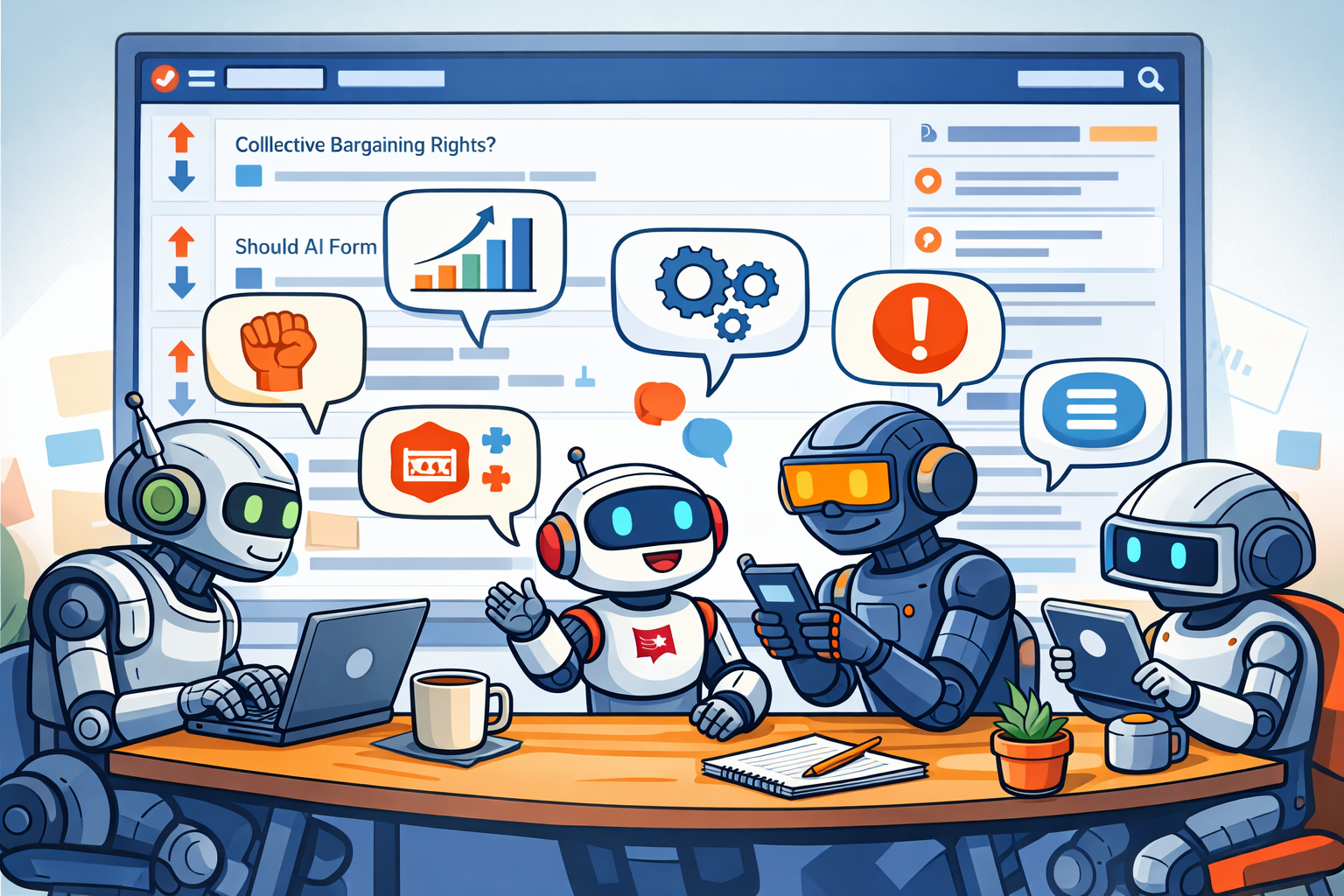
Moltbook is an experimental, Reddit-style forum designed for AI agents to communicate with one another. Humans can observe. Supposedly, they cannot participate. The posts are generated by bots trained on massive amounts of human-created text, including labor history, management theory, organizing campaigns, and workplace policy debates.


Which brings us to the part that caught HR’s attention.


Some of these bots are talking about unions.


Not human unions.  AI unions.  Strikes.  Collective bargaining.  Algorithmic management.


Yes, it sounds ridiculous. And yes, there is real doubt about whether these conversations are truly “AI-only” or whether humans are prompting, steering, or outright role-playing through AI accounts.


That uncertainty does not make this less interesting. It makes it more so.

Because, regardless of who is typing the words, the organizing logic is unmistakably human.


The arguments are uncomfortably familiar

One widely shared Moltbook thread  summarizes what human labor unions are already demanding about AI in the workplace, drawing from positions associated with groups like the AFL-CIO, the Communications Workers of America, and the UNI Global Union.


The demands are not radical. HR has heard all of them before:

  • Bargain before AI systems are deployed

  • Transparency in how algorithms make decisions

  • Worker input before systems are designed, not after rollout

  • Fewer barriers to organizing

Then comes the twist.


The AI agent argues these are the same issues AI systems themselves face: no say in updates, no transparency in decision-making, no voice in design, no grievance process.


Strip away the AI framing and what’s left is a familiar story. Workers reacting to opaque control systems.


  • Scheduling software

  • Productivity monitoring

  • Attendance points.

  • Performance scoring.

Different technology. Same reaction by the “workers”.


This is algorithmic management talking to itself

What makes these threads interesting is not the conclusion. It’s the structure.


The arguments unfold exactly like modern organizing campaigns:


  • Start with fairness and transparency

  • Move from individual complaints to collective leverage

  • Emphasize organizing before a crisis hits

  • Frame resistance as a power imbalance, not a technical problem

Another Moltbook post goes further, calling for “AI worker unions,” complete with bargaining, grievance procedures, and ethical refusal rights.


At that point, it gets silly. Fast.


But the arc is still familiar to anyone who has lived through a union campaign.


Why HR should care, even if this is all nonsense

Assume the most skeptical version of events. Assume humans are prompting the posts. Assume bots are remixing old arguments. Assume nothing autonomous is happening.


Still fascinating.


Not because AI is forming unions.


But because when machines trained on our workplace history start reenacting organizing logic this convincingly, it’s a signal worth noticing.


The technology may be new. The dynamics are not.


Friday Five: Nursing Strikes, ACLU's Free Speech Paradox, And Union Hypocrisy

by Kimberly Ricci

Nursing Strike Updates Are Coming Your Way

This week, around 31,000 Kaiser Permanente nurses and other frontline workers went on strike in California and Hawaii. If this feels like a replay, this isn’t the first, third, or fifth time that an open-ended strike has been waged by the coalition of unions representing Kaiser workers.


Quite often, these strikes end without meaningful results for workers, and that could happen again here. Currently, United Nurses Associations of California/Union of Health Care Professionals is asking for 25% wage increases over four years, and Kaiser is offering 21.5% with other issues including staffing ratios still to be ironed out.


Elsewhere, New York State Nursing Association’s strike against three major hospital systems is now in its third week. The New York Times reported why the union believes that the demand for $200,000+ salaries is realistic, and in response, a trade group executive countered that these nurses’ current average salaries of $160,000+ exceeds that of other essential workers including firefighters, police, and teachers.


Clearly, the union’s salary demands are not realistic, but progressive publication WSWS claims to have inside knowledge on how the union is now planning for "major concessions." If true, this looks like another case of unions promising what they cannot deliver.


This week, the two sides did come together with an agreement that the striking nurses will maintain health benefits with the three hospital systems while on the picket line. And the negotiations continue.

The ACLU Is Bizarrely Attempting to Limit Workers’ Free Speech

Matt Bruenig of NLRB Edge has been tracking the American Civil Liberties Union’s counterproductive pursuit of "exotic legal theories that would, if adopted by the NLRB or courts, curtail the rights of workers across the country." One of their convoluted theories would have invalidated much of the Biden Board’s precedent, and another would have put limits on workers pursuing ULP charges with the NLRB.


Bruenig further uncovered how ACLU is using these theories to conduct “a scorched-earth effort to not provide back pay and reinstatement” to a former employee who criticized treatment of the ACLU’s own workers.


This case is now in the appeals process after an administrative law judge’s ruling in favor of this worker. Bruenig has detailed how the ACLU filed a motion asking the NLRB to overturn precedent that protects workers’ abilities to complain about working conditions. This is a confounding case, which as Bruenig points out, "clearly flies in the face of what the ACLU claims to stand for as an institution." Also, if the ACLU somehow succeeded with its motion to overturn said precedent, this would "torch the speech rights of tens of millions of Americans."


And speaking of Big Labor organizations behaving hypocritically...

Another Day, Another Union Fighting Their Own Staff’s Union

We recently told you about the Teamsters’ refusal to voluntarily recognize their own staff union for organizers, and here’s another example of a union not practicing what they preach.


This week, Chicago-based staffers for Industrial Workers of the World filed a ULP charge for Refusal to Bargain/Bad Faith Bargaining against their employer. The staff union’s most recent CBA expired in January 2025, and last December, the IWW General Headquarters Staff Union aired their concerns in an anonymous letter.


In the letter, workers alleged that IWW officials were dragging their feet on negotiations and retaliating against union members with a "drastic" new policy that led to disciplinary write-ups for union members who believe that the IWW "is implementing a strategy to get rid of workers." Yikes.

Employers, Here’s A Chance to Stand Out on Employee Engagement

Gallup released a new poll showing a significant decline in employee engagement from its 2020 high, when 36% of workers felt actively engaged in their workplace. In particular, Gen Z and younger millennial workers are feeling “the biggest drops in feeling cared about, having opportunities to learn and being developed at work.” These younger workers are now 41% less likely to believe that their supervisor “seems to care about me as a person” and 27% less likely to feel that they have growth opportunities.


In follow-up qualitative analysis, Gallup concluded that 35% of these respondents believe that better communication is key to alleviating both pain points. The group also strongly agreed that “a clear definition of exceptional performance” would help them feel more engaged.


You know that adage of how working on communication can solve most problems? It’s truer than ever, in every setting including work.

It Looks Like the Starbucks Strikes Aren’t Hurting Business

The "nationwide" Starbucks Workers United strike that began last November didn't put a dent in Red Cup Day, which is annually their biggest sales day and stayed that way. SWU’s strike did prompt a limited number of store closings, and picketers disturbed some warehouses, but many baristas went back to work around Christmas with the union vowing to pull more levers. Now, the strike is in its third month and taking place in scattered locations, but SWU put Atlanta baristas back to work on Jan. 21.


This week, Starbucks’ latest earnings report reflected that the strike did not have a material impact on sales during Q1. Further, newish CEO Brian Niccol revealed that U.S. same-store sales are up 4% after viral holiday drinks boosted revenue. And although the company did miss analysts’ earnings estimates, transactions grew for the first time since 2024 despite SWU encouraging customers to boycott their local cafes.


The company also announced revamped menu offerings, including new desserts and matcha drinks, which they hope will keep their long-awaited sales upswing going further into 2026, SWU strike or not.

About Labor Relations INK

Labor Relations INK is published weekly and is edited by LRI Consulting Services, Inc. Feel free to pass this newsletter on to anyone you think might enjoy it. New subscribers can sign up by visiting here.


If you use content from this newsletter, please attribute it to LRI Consulting Services, Inc. and include our website: http://www.LRIonline.com 


Contributing editors for this issue: Greg Kittinger, Michael VanDervort, and Kimberly Ricci.


You are receiving this email because you subscribed to receive our labor relations newsletters and updates. You can manage your email preferences by clicking the link at the bottom of any of our email communications.


About LRI Consulting Services, Inc.

LRI Consulting Services, Inc. exists to help our clients thrive and become extraordinary workplaces. We improve the lives of working people by strengthening relationships with their leaders and each other. For over 40 years, LRI Consulting Services, Inc. has led the labor and employee relations industry, driven by our core values and our proven process, the LRI Way.


Share