Subject: Casino Organizing Goes High Stakes, The Rage Machine Is Here: Corporate Campaign Risk Spikes : LRI INK

December 11, 2025

To visit the blog post, click on the link below the article.

𝐓𝐡𝐞 𝐭𝐢𝐦𝐞 𝐭𝐨 𝐛𝐮𝐢𝐥𝐝 𝐲𝐨𝐮𝐫 𝐋𝐚𝐛𝐨𝐫 𝐑𝐞𝐥𝐚𝐭𝐢𝐨𝐧𝐬 𝐬𝐦𝐚𝐫𝐭 𝐬𝐪𝐮𝐚𝐝? 𝐇𝐨𝐧𝐞𝐬𝐭𝐥𝐲, 𝐢𝐭’𝐬 𝐫𝐢𝐠𝐡𝐭 𝐧𝐨𝐰.


If you work in employee or labor relations, you already know the landscape is getting louder, faster, and a whole lot weirder.


So here is the good news. There is a place where LR and ER pros are actually talking, sharing, comparing notes, and staying ahead of what is coming next.


And it is secure, informative, and totally free to join.


Join us in the empow-ER Community, hosted by HR Acuity.


You will get access to honest discussions with ER and LR leaders, practical frameworks, upcoming trend alerts, and a network that does not require you to suffer through another social media algorithm experiment.


Here is the link to join: https://www.hracuity.com/empower-community/


If you care about staying ahead of 2026 ER and LR trends, this is where the smart people are gathering.

When The Chips Are Down: Union Organizing at Casinos Presents Complications for Tribal Sovereignty and Beyond

by Kimberly Ricci

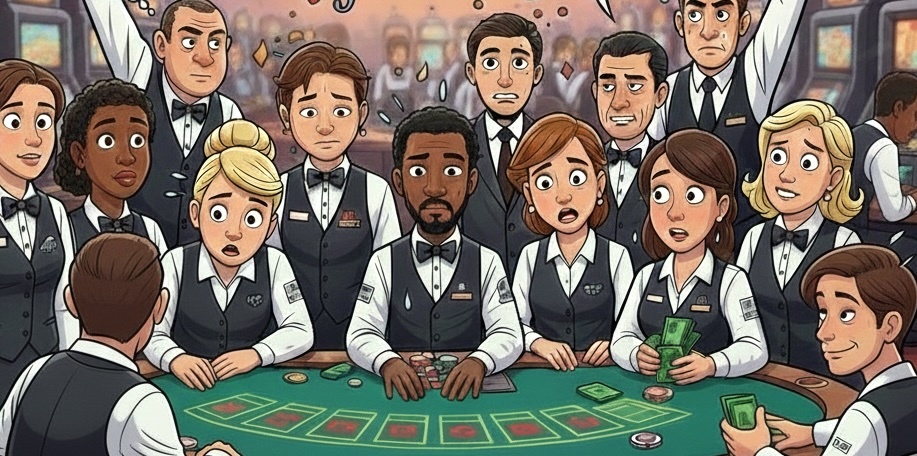
The array of unions hoping to cash in at casinos couldn’t be more aptly illustrated than at Hard Rock Casino in Rockford, IL. On Dec. 4, poker dealers and sportsbook hosts voted against (90-38) joining the UAW, but Shawn Fain’s union is only one of six that have pursued these workers. Additionally, IATSE won an election to unionize their production workers and event ushers, and the Teamsters unionized valet and slot attendants and warehouse workers. Other unions that have been circling include SEIU, UNITE HERE, and the International Union of Operating Engineers.


We’ll round up more recent casino organizing drives below. First, it’s worth examining an ongoing case in which the NLRA and tribal law must both be navigated while countering union tactics. In short, this case involves a union attempting to override Native American sovereignty.


Sky River Casino: Defending Tribal Legislative Authority

Tribes operate as sovereign nations that can enact their own labor laws, which can protect workers by guaranteeing secret ballot elections to resolve campaigns. That’s the case near Sacramento, CA, where the Wilton Rancheria tribe is fighting to uphold the 2019 tribal labor code during a UNITE HERE drive at Elk Grove Sky River Casino. Unsurprisingly, the union wants to enforce an outdated 2017 card-check agreement.


The Ninth Circuit is currently reviewing whether an arbitrator improperly disregarded tribal sovereignty by deferring to the 2017 agreement, which would subject workers to the coercion and intimidation inherent in the card-check process. Wilton Rancheria’s attorney is arguing that the tribe’s democratically enacted code should be allowed to govern at a tribally-owned casino, which opened its doors in 2022, years after the card-check agreement would have been rendered obsolete.


As promised, there are more casino organizing odds and ends:


Horseshoe Indianapolis: This past weekend, workers at the Caesars Entertainment casino voted to unionize with the Teamsters after a nearly two-month strike. Previously, a federal court upheld a decision to relocate the picket line away from the entrance, where it was disrupting operations.


Rio Las Vegas: In November, Teamsters members authorized a strike at the off-strip hotel-casino after two years of contract renewal negotiations went nowhere. No date has been set for the strike yet.


Red Rock Casino Resort and Spa: The D.C. Circuit Court of Appeals heard oral arguments in NP Red Rock LLC vs. NLRB, with judges leaning toward using the Gissel standard rather than Cemex to issue a bargaining order for a Las Vegas casino. Stay tuned for more there.


Conclusion

Organizing drives always involve navigating the NLRA while unions maneuver to interfere with employers’ right to run their own business. When tribal law is involved, Big Labor’s heavy-handed tactics grow arguably more apparent, as unions can seek to undermine tribal self-governance.


That is, unions will stop at nothing to infiltrate a workplace, and do not see tribes’ legislative authority as an obstacle to pushing workers to live under a union constitution. Such cases underscore the importance of ensuring unions never gain a foothold, regardless of who owns the business.


Help Us Build Better Labor Relations Data (Union Facilities)

by Michael VanDervort

Where Does Your Union Facility Really Rank?

If your company has unionized locations, here is the question almost no one can answer with confidence:


Where do you rank on labor relations performance?


At the Fortune 500 level, labor departments track everything. Grievance resolution rates. Arbitration velocity. Legal spend ratios. Contract administration workloads. They know exactly where they stand.


Mid-market employers? They are usually guessing. And guessing is not a strategy.


We are fixing that problem by building the first comprehensive labor relations performance database. But we need your help. To make the benchmarks real and useful, we need data from union facilities across industries and across regions.

What You Get For Participating

Everyone who completes the confidential seven-minute survey receives the complete Managing the Union Shop Toolkit:

  • The 7 Tests of Just Cause Decision Flowchart

  • The 6 Step Grievance Investigation Cheat Sheet

  • The Union Steward Communication Playbook, including ten ready-to-use supervisor scripts

  • Plus a signed copy of Managing the Union Shop if you want one. Please request it at the end of the survey.

What You Will Receive When We Hit 500 Responses

Once the data set is large enough to support reliable benchmarking, you will receive a custom report that includes:

  • Your percentile ranking across five core labor relations performance categories

  • A side-by-side comparison with top-performing facilities

  • Industry-specific insights for your sector

  • A list of targeted gaps and recommended improvements

This is the type of visibility large employers already use to get ahead of issues. Our goal is to make that level of intelligence available to everyone.

Take the 7 Minute Survey

You can complete the survey here: https://benchmark.fillout.com/labor


Every union facility that participates helps build the database that will shape the future of labor relations intelligence.


Thank you.


The Labor Relations Institute Benchmarking Team


P.S. Fortune 500 labor departments are invited too. Your data is essential for setting the benchmark.

Rage Bait, Rage-Farming: The New Frontier of Corporate Campaign Risk

by Michael VanDervort

Oxford University Press named rage bait” the 2025 Word of the Year, defining it as content intentionally created to provoke anger and outrage to drive engagement and amplification. That choice was not a linguistic novelty. It was a warning label.

As Smithsonian Magazine observed, rage bait thrives because modern platforms reward emotional intensity rather than accuracy or proportionality.

That matters because rage bait has evolved into rage farming: the sustained cultivation of outrage through repetition, coordination, and algorithm-aware tactics. Rage farming is no longer merely a political or cultural problem. It is a material risk to brands and governance, and could spill over into labor-driven corporate campaigns.


When Online Outrage Becomes Real-World Impact

The core danger of rage farming is scale without context. A relatively small number of actors can create the appearance of mass backlash, forcing leaders to react under compressed timelines and incomplete information.

Recent cases illustrate the pattern clearly.


Cracker Barrel rolled out a major brand refresh in 2025, including a simplified logo and modernized store designs. The response online was immediate and hostile, framed as an abandonment of tradition and brand heritage. Political figures weighed in, escalating the issue into a culture-war narrative.

According to reporting based on analysis from social-media intelligence firm PeakMetrics, approximately 44.5 percent of posts in the first 24 hours were identified as likely bots, indicating significant artificial amplification rather than purely organic customer sentiment.


As the controversy escalated, Cracker Barrel reported declines in traffic, faced investor scrutiny, paused remodels, and publicly acknowledged the misstep. This was not a marketing tweak. It was a governance decision driven by a distorted signal.


American Eagle’s “Great Jeans” campaign followed a similar arc. Online commentators reframed the messaging as racially insensitive. Digital-intelligence firm Cyabra reported that a meaningful portion of the amplified negative commentary came from inauthentic or fake social media accounts, driving a sentiment surge that outpaced the original reaction.

Bud Light’s boycott shows that bots are not required for damage. After partnering with a transgender influencer, the brand became the target of sustained culture-war backlash. While bot involvement is harder to quantify publicly, the impact is well documented. Reuters reported prolonged sales declines and market-share loss.


Once identity-based narratives harden, outrage can become self-sustaining.


Why This Matters for Labor and Union-Adjacent Campaigns

Labor disputes now unfold in the same digital ecosystem as brand and political controversies. Organizing drives, bargaining disputes, and corporate campaigns increasingly rely on online petitions, short-form video, coordinated messaging, and public narrative pressure.


Academic research confirms that coordinated inauthentic behavior can meaningfully shape sentiment, not just volume.


This does not imply improper conduct by unions or employees. It highlights a broader risk: external actors could try to hijack labor-related narratives, attaching political or ideological agendas unrelated to the actual workforce.

The risk for employers is miscalibration. Treat amplified outrage as employee voice and overcorrect. Ignore it entirely and miss real issues. The hard work is telling the difference.


How Companies Actually Fight Rage Farming

Countering rage farming is not about debating critics online. It is about discipline, preparation, and verification. Effective defenses combine early detection tools that flag abnormal spikes and coordinated activity, structured communication plans that prioritize facts and core stakeholders over public confrontation, and brand or IP enforcement mechanisms that address impersonation and abuse.


Social listening and threat-monitoring tools help separate organic criticism from manufactured pressure, while pre-planned response frameworks prevent emotional overreaction. The goal is not to silence criticism. It is to prevent synthetic outrage from distorting leadership decision-making or hardening into false consensus.


Tools commonly used include platforms like Brandwatch, Meltwater, Talkwalker, OctoLens, and ZeroFox, along with Google Alerts and enforcement mechanisms like BrandShield and Red Points.


The Bottom Line

Rage bait is not a social-media quirk. It is an algorithm-driven, structural feature of modern information systems.


Outrage can be manufactured, amplified, and weaponized fast enough to influence boards, investors, bargaining dynamics, and executive decisions before facts catch up.


If leaders treat online outrage as authentic stakeholder sentiment without scrutiny, they are not being responsive. They are being potentially reckless.

And if they dismiss it entirely, they are betting the enterprise on hope.


Either way, this is no longer a marketing problem. It is a management and governance problem.


Podcast: Fractional Labor Relations: Why Mid-Sized Companies Need a New Model

by Michael VanDervort

In this episode of the Left of Boom Show, Michael and Phil break down why fractional labor relations support is becoming a game-changer for smaller employers.


They discuss the real operational issues that arise with CBAs, the ongoing nature of grievance handling, and the value of having an expert on call when you need clarity. No waiting. No guessing. No escalation. This conversation cuts through the noise and gets into the practical stuff.


Why immediate expert support changes outcomes. Why proactive contract navigation matters. Why communication during disputes can protect the culture you are trying to build. And why fractional LR might be the closest thing to a Fortune 500 advantage without the Fortune 500 budget.


Key Themes Covered

• Operational issues show up without warning

• Collective bargaining agreements require real-time expertise

• Grievance resolution depends on accuracy, speed, and communication

• Advice anxiety leads to costly hesitation

• Fractional labor relations give SMBs expert support on demand

• Proactive problem solving beats reactive cleanup every time


Friday Five: Union Petitions Spike, Collusion Gets Called Out, And The AI Arms Race Intensifies

by Kimberly Ricci

No industry is immune to the organizing petition catch-up:


Since the government reopened three weeks ago, 250+ union petition filings (and nearly 1000 ULP charges) have surfaced from the NLRB. Some of these petitions feature notably large units, including an out-of-the-gate example of 900 museum workers from NYC’s Metropolitan Museum of Art.

The voluminous approach continues this week with no industry left untouched, as shown by these highlights:

  • Almost 500 workers at the Environmental Defense Fund petitioned to join News Guild-CWA while forming the EDF Together union.

  • 1,300+ National Park Service workers from 24 parks will petition to join the National Treasury Employees Union.

  • Workers from Jeni's Splendid Ice Creams in Columbus, OH petitioned at eight locations to join UFCW.

  • Doctors at MultiCare Mary Bridge Children's Hospital in Washington petitioned at three locations to join the Union of American Physicians and Dentists-AFSCME.

Seriously, an NLRB quorum is coming:

NLRB nominee/Boeing chief counsel Scott Mayer’s rollercoaster ride took a more productive turn this week.


Previously, Sen. Josh Hawley (R-MO) blocked Mayer from being advanced to a full Senate vote. Then Sen. Bernie Sanders (I-VT) did the same while protesting Gwynne Wilcox’s firing from the Board.


On Wednesday, Mayer cleared a necessary Senate HELP Committee hurdle, so he’ll get that full Senate vote along with fellow board nominee James Murphy and Crystal Carey, who’s poised to be the next general counsel.


Yes, a quorum is coming. The Board has lacked one nearly all year, and Democrat David Prouty’s term will only last until next August 27. Then the game might start over again, but ideally, another Trump nominee will pass muster before that happens because, sure, a frozen Board isn’t good for unions, but it’s also no comfort for employers seeking guidance.

Union collusion with the USPS called out by an ALJ:

Matt Bruenig’s NLRB Edge highlighted a corruption-filled case involving Terry Daniels, a Letter Carriers Union shop steward who, according to an ALJ’s determination, was unlawfully disciplined by the USPS. The ALJ further found that union President Dave Negrotti and USPS management colluded in their illegal treatment of Daniels, who had challenged Negrotti during a presidential run. A coincidence? Surely not.


Following the NLRB’s findings that both the union and USPS committed ULPs against Daniels, the ALJ agreed that Daniels was singled out for retaliatory discipline and suspended while Negrotti “received favorable treatment including a full-time paid union position, no time clock requirements, and extensive overtime totaling $176,000 annually.” Yikes.

An outburst takes a backseat to protected concerted activity:

As Barnes & Thornburg points out, this next case provides a lesson for both union and non-union employers on how the NLRB and federal courts are viewing less-than-stellar worker conduct in the presence of protected activity.

The Fourth Circuit Court of Appeals agreed with an NLRB ruling that a security company’s weapons instructor was illegally fired over a profane outburst about a company policy. The worker dropped a “BS” while raising several concerns, including ricocheting bullets at a firing range. The Fourth Circuit’s opinion noted that some workers had been struck by bullet fragments, and the fired instructor had expressed frustrations during a management meeting.


The employer unsuccessfully argued that the instructor was exempt from NLRA protections as a manager. Whereas the instructor maintained that his complaints were protected activity. Both the federal court and Board agreed, and the termination was determined to be unlawful retaliation.

Never a dull moment for the AI races:

OpenAI CEO Sam Altman’s has reportedly, according to The Information, told workers to focus on improving ChatGPT during what he calls a “critical time” of increasingly stiff competition from Google and Anthropic’s AI models.


Altman’s concern has even led him to proclaim a “code red” over OpenAI’s “significant cash burn,” which makes a Wall Street Journal report look like a real head scratcher due to its account of Altman mulling over a collaboration with a rocket maker, Stoke Space, to install data centers (?) in space. That report also indicates that Altman wants to compete against the Elon Musk-led SpaceX. Musk, of course, has his own AI platform, Grok.


Meanwhile, Mark Zuckerberg’s AI quest is facing a significant retooling. That comes from Bloomberg’s reporting about how the underperforming Metaverse, which has been plagued with security concerns, will likely be setting aside the VR headsets and other products from “leaky bucket” Reality Labs in favor of launching Meta’s AI glasses.


Those glasses probably won’t be worn on OpenAI space voyages. After all, the AI billionaire rivalries are truly alive and well.


Stories You May Have Missed:


Trump can fire labor, employment board members without cause: Appeals court

Link

Top Court Nixes Union’s Bid to Appeal Ruling in NLRB’s Place

Link


Starbucks workers are still without a labor deal four years after their first union win. Here's why 

Link


Volkswagen workers launch decertification petition, which could lead to a break with UAW

Link


Volkswagen workers launch website to push decertification of UAW union in Chattanooga

Link


About Labor Relations INK

Labor Relations INK is published weekly and is edited by LRI Consulting Services, Inc. Feel free to pass this newsletter on to anyone you think might enjoy it. New subscribers can sign up by visiting here.


If you use content from this newsletter, please attribute it to LRI Consulting Services, Inc. and include our website: http://www.LRIonline.com 


Contributing editors for this issue: Greg Kittinger, Michael VanDervort, and Kimberly Ricci.


You are receiving this email because you subscribed to receive our labor relations newsletters and updates. You can manage your email preferences by clicking the link at the bottom of any of our email communications.


About LRI Consulting Services, Inc.

LRI Consulting Services, Inc. exists to help our clients thrive and become extraordinary workplaces. We improve the lives of working people by strengthening relationships with their leaders and each other. For over 40 years, LRI Consulting Services, Inc. has led the labor and employee relations industry, driven by our core values and our proven process, the LRI Way.


Share