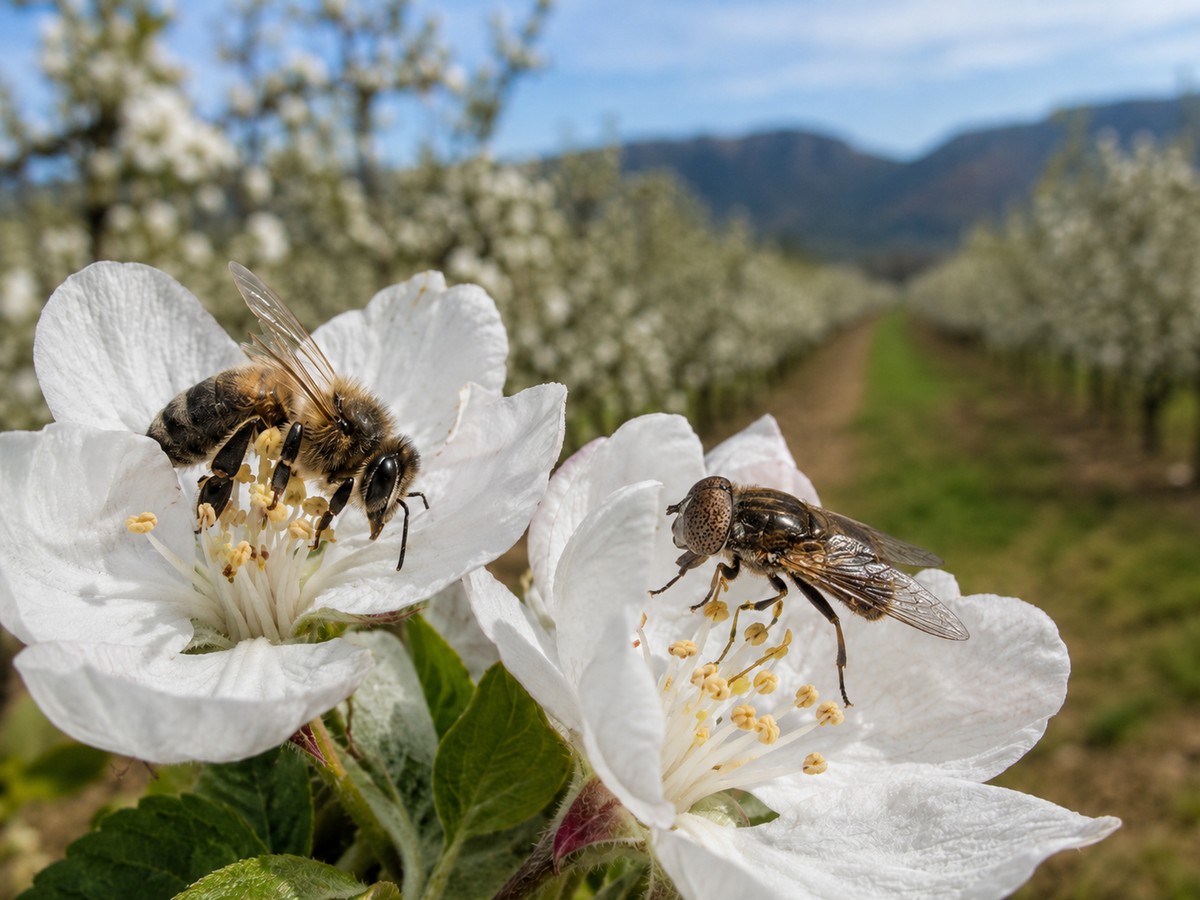
🐝 The next pollinator on the farm may not be a bee
South African growers are expanding their experiments with another commercially managed pollinator.
Hoverflies.
Spanish agritech company Polyfly is supplying two commercially reared species:
Queenfly® — Eristalis tenax
Goldfly® — Eristalinus aeneus
The flies are produced in Spain and imported as pupae in cardboard release boxes before emerging in the crop.
But this story did not begin this week.
Polyfly began supplying hoverflies to South African seed-production companies in 2025. Their use and evaluation have since expanded into crops including blueberries, avocados, cherries, strawberries, macadamias, peppers and tomatoes.
What is new is that the programme is becoming considerably more visible.
In late August, local pollination specialist Bee-Tech Group announced its first shipment of Polyfly hoverflies from Spain. Those insects are being deployed in trials involving strawberries, peppers, blueberries and cherries.
That distinction matters.
This was Bee-Tech's first shipment.
It was not the first time Polyfly hoverflies had been used in South Africa.
And before anyone announces the end of honey-bee pollination:
That is not what is happening.
Polyfly says hoverflies are intended as an additional pollination option. Depending on the crop and circumstances, they may be used alongside honey bees or, in some applications, separately.
South African controlled trials are comparing honey-bee pollination, hoverflies alone and combinations of the two. Researchers are measuring fruit set, yield and quality.
Bee-Tech director Michiel Bruggeman has also cautioned that it remains too early to draw conclusions from the South African work.
Agriculture works season by season.
The data will take time.
So why should beekeepers care?
Because the reason another managed pollinator is being investigated tells us something.
Bee-Tech has identified several pressures facing South African beekeeping, including:
Hive theft
Declining forage resources
An ageing beekeeper population
A shortage of suitable and safe sites for colonies
At the same time, growers are increasingly concerned about whether sufficient strong commercial honey-bee colonies will be available when large areas of crop require pollination simultaneously.
That concern is not coming from Bee-Tech alone.
On 27 August 2026, Hortgro warned that the Western Cape could face a spring pollination bottleneck around September.
The reason is simple.
Deciduous fruit, berries, nuts and seed-production industries can all require commercial honey-bee colonies during roughly the same period.
Hortgro warned that this overlap could result in a shortage of honey-bee colonies.
That is an important statement.
And it changes the context of the hoverfly story.
If farmers are investigating a backup pollinator partly because there may not always be enough strong honey-bee colonies available when agriculture needs them, the beekeeping industry should pay attention.
There is another problem: protected cropping
Honey bees can also face particular difficulties in some protected cropping systems.
Bee-Tech reports considerable stress in honey-bee colonies kept beneath netting for extended periods, particularly in crops such as blueberries.
Hortgro independently makes a similar point.
In fixed or fully enclosed net structures, honey bees can become disorientated or have difficulty navigating between the orchard and their hives. The scale of the problem depends on the design and size of the netted area and the positioning of colonies.
This doesn't make honey bees poor pollinators.
Far from it.
It simply means that there are agricultural environments where growers have an incentive to investigate complementary pollination systems.
What hoverflies potentially offer:
According to Polyfly and Bee-Tech, commercially reared hoverflies have several characteristics that make them interesting.
They do not form colonies.
Every adult forages independently.
Honey bees can recruit large numbers of nestmates to a more attractive food source through colony communication.
Hoverflies don't have that colony-level recruitment system.
The theory is that this may make them less likely to collectively switch away from the target crop when more attractive flowers become available nearby.
The two commercial species are also promoted for different environmental conditions.
Queenfly — Eristalis tenax
Queenfly is the larger species.
Polyfly reports that it becomes active at approximately 8°C to 10°C and can continue working at temperatures of around 30°C, making it better suited to cooler production periods such as winter and early spring.
Goldfly — Eristalinus aeneus
Goldfly is smaller and intended for warmer conditions.
Polyfly reports activity beginning at around 15°C, with the flies tolerating substantially warmer conditions.
Its smaller size may also be useful in flowers that are difficult for larger pollinators to enter.
Polyfly also reports hoverfly activity under some cool, cloudy and windy conditions when honey-bee flight activity may decline.
Those characteristics are interesting.
But there is an important Bee Ware qualification:
These are currently developer and early field claims.
South African growers and beekeepers still need independent local data across different crops, climates and production systems before we can know exactly how effective commercially reared hoverflies will be.
Early observations are not the same thing as established commercial results.
And what do they cost?
This may ultimately decide everything.
Farmer's Weekly reported on 3 September 2026 that importing the hoverflies from Spain remains complicated and expensive.
There is not yet a reliable direct cost comparison with conventional honey-bee pollination in South Africa.
Local production could potentially become viable if sufficient demand develops, but the immediate objective remains proving the concept under South African conditions.
So the commercial question remains unanswered:
Does the additional fruit or seed produced justify the cost?
That is the number growers will eventually care about.
A pollinator can be biologically interesting.
It can be technologically innovative.
But if the additional yield or fruit quality does not justify the expense, it will struggle to become a significant commercial tool.
There is also a biosecurity question
This deserves careful reporting.
One of the commercial species being released, Eristalis tenax, is certainly not new to South Africa.
SANBI's Biodiversity Advisor records Eristalis tenax in South Africa and currently labels the species “invasive”.
The Biodiversity Explorer, associated with Iziko Museums, describes it as a widespread species that was introduced to South Africa and is now common here.
There is an important distinction, however.
A biodiversity database describing a species as invasive does not, by itself, establish the precise regulatory category applicable to a particular commercial import or release under South African environmental legislation.
It would therefore be wrong to leap from SANBI's ecological designation to an allegation that these consignments are unlawful.
There is no evidence in the public information reviewed by Bee Ware showing that Bee-Tech or Polyfly imported or released these insects illegally.
So we should ask, not accuse.
There is nevertheless a legitimate regulatory issue to understand.
South Africa regulates the importation of insects.
The Agricultural Research Council's insect-quarantine service states that insects imported for biological control, scientific study or other beneficial purposes have to pass through quarantine before being released back to the importing agency.
The ARC further states that this service applies to
parties holding a valid import permit.
South Africa's Department of Agriculture also requires import authorisation for controlled goods under the Agricultural Pests Act and operates phytosanitary import controls through the National Plant Protection Organisation of South Africa.
The public reports reviewed for this article do not provide the actual permit numbers or quarantine documentation relating to the Polyfly consignments.
That doesn't mean the documents don't exist.
It simply means they are not contained in the public material we reviewed.
Therefore a useful industry discussion would include:
What import permits cover these consignments?
What quarantine procedures were followed before release?
What ecological-risk assessment was required?
How are pathogen-free claims verified?
What environmental authorisations, if any, apply to repeated commercial releases?
How will effects on native pollinator communities be monitored?
And there is another interesting point.
The commercially supplied hoverflies are not sterile.
Polyfly told Farmer's Weekly that successful reproduction is considered unlikely because the insects require particular environmental conditions and sufficient food resources to reach sexual maturity, and that most released individuals would die before reaching that stage.
That explanation may prove entirely reasonable.
But if large numbers of insects are going to be released repeatedly into agricultural environments, then reproduction and establishment are also perfectly reasonable things to monitor scientifically.
That is not alarmism.
That is what responsible biosecurity looks like.
Bee Ware's interpretation
I don't think beekeepers should view hoverflies as the enemy.
If another pollinator improves fruit set in environments where honey bees struggle, agriculture should investigate it.
If combining hoverflies with honey bees produces better results for a particular crop, growers should know that too.
Pollination technology should be judged on evidence.
But neither should South African beekeepers miss the warning contained inside this story.
The hoverflies themselves may not be the biggest story.
Why agriculture is interested in them might be.
South African agriculture depends heavily on insect pollination, while commercial beekeepers continue dealing with shrinking forage resources, hive theft, safe-apiary constraints, drought, fires, disease and the considerable cost of preparing strong colonies for pollination.
Hortgro makes the relationship very clear:
Threats to the beekeeping industry also threaten fruit production.
And one of the major long-term problems is the loss of forage required to sustain enough colonies to meet growing agricultural demand.
Hortgro's proposed response is therefore not simply:
Find another pollinator.
It says one of the best ways to support both commercial beekeeping and fruit production is to: secure, conserve and create honey-bee forage resources.
That point deserves far more attention.
Because perhaps the most important question raised by commercial hoverflies is not:
Can flies replace bees?
At this stage, South African trials haven't demonstrated that they can — and that isn't what the developers are claiming anyway.
The more important question may be:
Why are we reaching the point where agriculture feels it needs an insurance policy against insufficient honey-bee pollination capacity?
If the answer includes disappearing forage, too few safe apiary sites, hive theft, an ageing commercial beekeeper population and too few strong colonies being available during peak spring demand, then introducing another pollinator doesn't solve the underlying problem.
It gives agriculture another tool.
And perhaps a useful one.
But South Africa still needs something much more fundamental:
A strong, commercially viable beekeeping industry capable of producing the healthy colonies that agriculture depends upon.
Hoverflies may become part of the pollination toolbox.
Honey bees remain part of the agricultural infrastructure.
And that is the conversation South African beekeepers should be having.
This highlight is directly related to our push towards creating a strong, well-educated and business focused beekeeping community centred around multi-tiered income streams such as pollination, bee removals and honey production.
Moreover, there continues to be an ever-increasing need to build skills for making colonies and managing apiaries across multiple sites!
#BeeWare #BeekeepingSouthAfrica #SpringBeekeeping #Pollination #HoneyBees