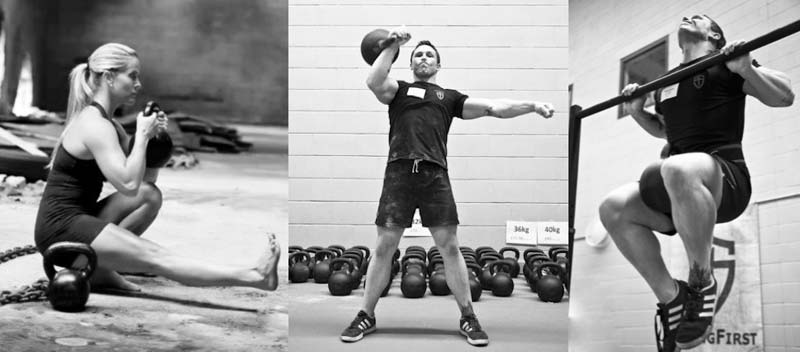
Whether we lift kettlebells, a barbell, or our own bodyweight, at StrongFirst we use ladders often. For strength, conditioning, muscle building, and more.
A ladder is a programming tactic in which some variable (reps, weight, or rest periods) gets progressively harder as you go along.
Built-in recovery periods enable the trainee to tolerate a high volume with heavy weights without burning out.
Skill gets polished. Easier “lower rungs” enable mindfulness of technique subtleties.
Psychologically, a variable load is easier to handle than multiple sets with the same load parameters.
Today we will talk about rep ladders in which you add reps without changing the weight for strength and muscle building.
Your options for strength:
1-2-3
1-2-3-4
1-2-3-4-5
2-3-5
2-4-6
Your options for mass:
4-6-8
4-6-10
4-6-8-10
4-8-12
5-7-12
Ladders do not have to be linear. Great powerlifting coach Boris Sheyko includes “jerky ladders” into his plans. E.g., (1, 3, 5, 2, 4) instead of (1, 2, 3, 4, 5).
Select a weight that allows you to do several more repetitions than the top run of your ladder. E.g., start (1, 2, 3) ladders with 5-7RM, (2, 4, 6) ladders with 8-12RM.
A high rep hypertrophy ladder needs more reps in reserve. E.g., (5, 7, 12) with an estimated 20RM.
We will address the rest periods and other variables in upcoming issues of this newsletter.
Ladders are a great way to train for the Iron Maiden/Beast Tamer Challenge.