Subject: Complex methods aren’t the problem—your foundation is

Too many trainees jump into advanced methods too soon. At StrongFirst, we are not against sophisticated tools and tactics. Many of us use them. But they only work after the fundamentals are in place.

NOT for beginners: Built Strong online seminar

taught by Fabio Zonin, StrongFirst Certified Master Instructor on June 20-21

Adding complexity too early is like bolting a turbocharger onto a car with bald tires and a bent frame. The engine is not the limiting factor—the structure is.

If you can’t hinge properly, why are you tracking bar velocity in your deadlift?

If you can’t perform a lift with control, what’s the point of a complex wave cycle?


If you are unable to properly brace and power breathe, why bother working on anything else?

A Full Body Fist


Here is an example of strength fundamentals practice. The following drill will help you learn the skill of generating full-body tension, the cornerstone of the StrongFirst curriculum.


I like to call it a full body fist.

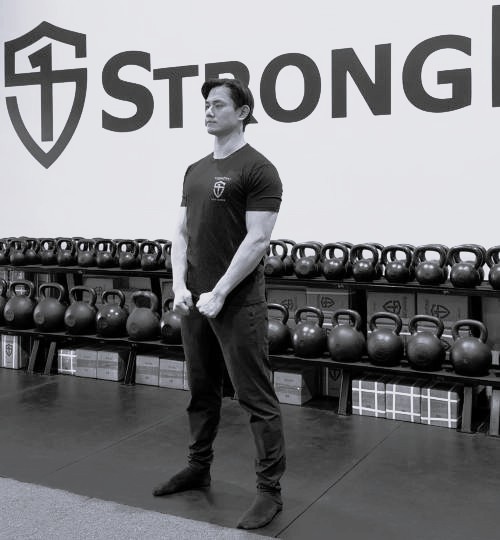
The full body fist

Owen Chau, StrongFirst Certified Team Leader, a Beast Tamer,

and the author of today’s issue, demonstrates a “full body fist.”

Just like each finger contributes to a closed fist, multiple steps work together to create total-body tension.


A simple way to practice this is the standing plank.


Start standing with feet about shoulder-width apart, then build tension in layers:

  1. Drive the feet down into the ground.

  2. Tense the quads and pull the kneecaps up.

  3. Squeeze the glutes as if you’re trying to crush a walnut.

  4. Brace the midsection as if preparing to be punched in the stomach.

  5. Set the shoulders: imagine squeezing sponges in your armpits; the shoulders stay down and away from the ears.

  6. Finally, bring it all together, clenching your fists in front of you.

You should be able to adjust the tension up and down without losing the shape. You should be able to increase or decrease effort while maintaining position and structure.

If you’re tempted by complexity, pause and ask yourself:

  • Have I been training consistently for at least a year?

  • Can I perform the basic movements (hinge, squat, press, pull) with control and strength?

  • Do my time and energy realistically allow for more complexity?

If the answer is no, that’s your sign. Go back. Build the base—or stick with what’s been working. Once you're truly ready, advanced methods won’t feel like magic. They’ll just make sense.

If you need to work on your basics—and who doesn’t?—StrongFirst video courses, kettlebell, barbell, and bodyweight will get you dialed in:

Last Call