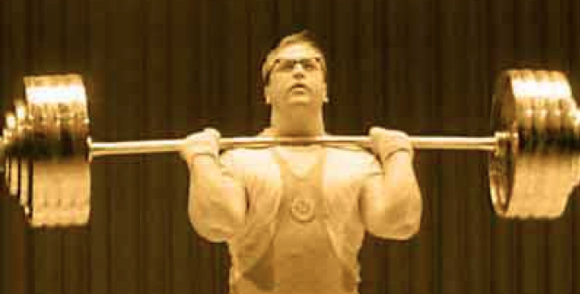
The barbell military press is a classic test of upper body strength and a powerful strength builder. At StrongFirst, we teach it on a foundation of our kettlebell skills. And while the principles (bracing, wedging, etc.) remain the same, tactics change to accommodate a different implement. The double kettlebell press is ergonomically perfect. The barbell poses two challenges. One is how to rack it without hyperextending your back. When the bar is heavy, there is no way to avoid extending your spine. If you do not, you will fail to position it over your feet, and the barbell will simply fall in front of you. The first thing you need to do to unload your back is extend your hips strongly—cramp your glutes and drive your pelvis forward. Just as in the kettlebell press, but more so. The more extended your hips are, the less the spine has to. It goes without saying that you need flexible hip flexors; something we address early on in our kettlebell curriculum. The second tactic to spare your lower back is to extend your upper back. A flexible thoracic spine—something we hammer in our kettlebell workshops and certs—not only will enable you to reduce the lumbar extension; it will make you stronger. You will be able to elevate your rib cage, pre-stretch your pecs, and provide a more stable support for the racked bar. We will address the second challenge unique to the barbell military press in the next issue. |