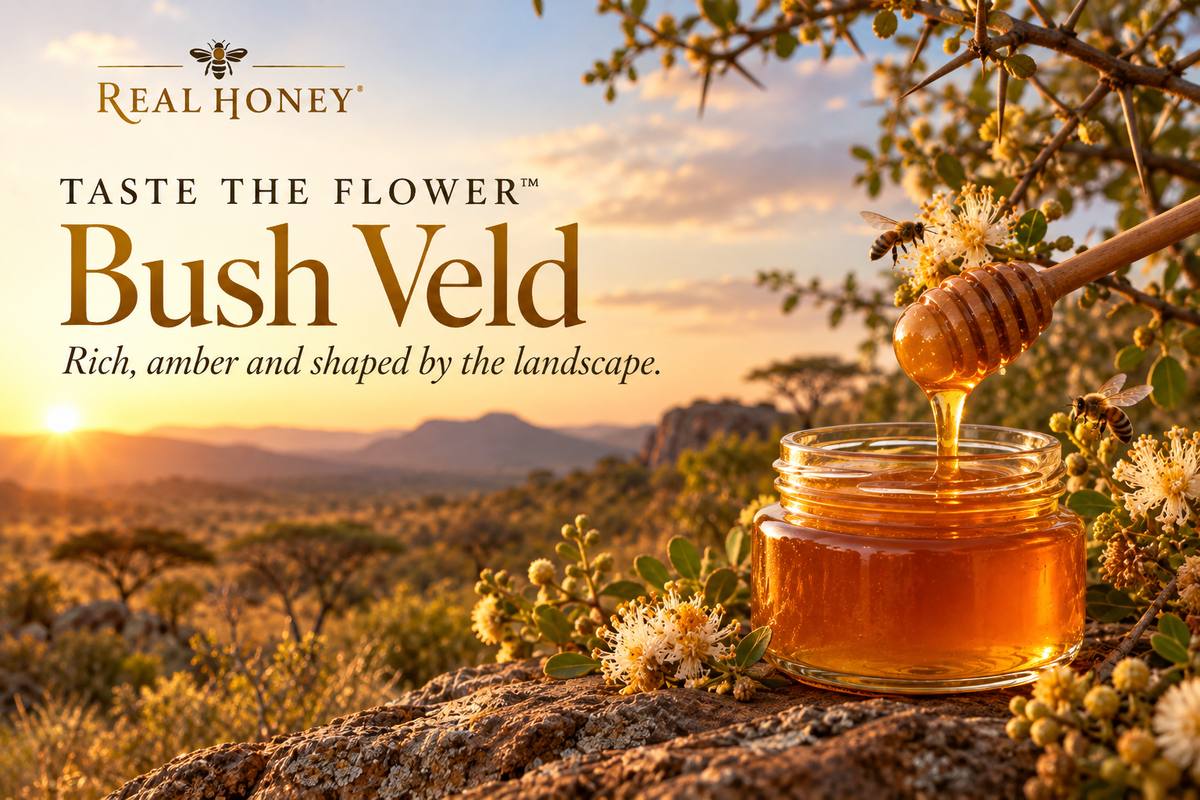
Subject: Taste the Flower: Bush Veld — what does a landscape taste like?

Wild flowers, trees and shrubs. One South African landscape captured in the jar.
 

Taste the Flower™: Bush Veld | Wild Flora

What happens when there isn’t just one flower?

Macadamia.

Litchi.

Blue Gum.

Sunflower.


Until now, every Taste the Flower™ edition has started with one dominant floral source.


Bush Veld Honey changes the rules.


Here, the bees are working across a landscape — flowering trees, shrubs, veld plants and seasonal wild flowers growing around the bushveld of Modimolle in Limpopo.


The result is not the flavour of one flower.

It is the flavour of a place.


Rich. Amber. Aromatic. Complex.


Welcome to Bush Veld Wild Flora Honey.


The Flower

This time, there is more than one.

Bushveld does not flower all at once.

One tree opens.

Then another shrub.

Rain arrives.

A flush of wild flowers appears.

One nectar source strengthens while another disappears.


For the bees, the landscape is constantly changing.


That means Bush Veld Honey is fundamentally different from a single dominant-flower varietal.


Instead of one floral signature, the bees bring together nectar from the mixture of flowering vegetation available around them at that particular time.


The landscape becomes the recipe.

The Bee Forage

Bees don’t need a monoculture.

South Africa’s indigenous honeybees evolved in landscapes filled with changing natural forage.


They need nectar for carbohydrates - which they make honey with.

They need pollen for protein.


And natural veld can provide both through a succession of flowering plants.


South African honeybee-forage research recognises indigenous trees, shrubs and natural vegetation as important components of the forage available to our bees.


That diversity matters.


A good bee landscape is not necessarily one spectacular flower.


Sometimes it is dozens of different plants flowering at different moments.

And the bees know exactly where to find them.

The Honey

What does Bush Veld Honey taste like?

This is where things become less predictable — and more interesting.


COLOUR
Rich amber, sometimes moving towards darker amber depending on the harvest.

AROMA
More pronounced and naturally floral.

FLAVOUR
Richer and fuller than many of the lighter orchard honeys.

CHARACTER
Layered rather than dominated by one obvious floral note.

FINISH
Full-bodied, with the character changing subtly from one harvest to another.


There is an important reason for that variation.


The bees are not working exactly the same combination of flowers every year.


Rainfall changes.

Flowering changes.

Forage changes.


So genuine wild-flora bushveld honey changes too.


Different flowers. Different season. Different honey.

The Harvest Story

From Modimolle, Limpopo.

This Bush Veld Honey comes from the Modimolle region of Limpopo.


Here, the bees forage through the surrounding wild flora rather than being defined by one cultivated crop.


That distinction matters.


A Macadamia harvest tells the story of a flowering orchard.

Sunflower tells the story of a field.

Bush Veld tells the story of a landscape.

The exact combination of flowering vegetation can change with rainfall, temperature, season and local conditions.


And because the flowers change, the honey can change with them.

That is not inconsistency.

That is provenance.

Taste It Properly

Now look for complexity.

Take half a teaspoon of Bush Veld Wild Flora Honey.


1. Look at the colour
Compare its amber tone with Litchi, Macadamia or Blue Gum.

2. Smell before tasting
Does the aroma feel stronger or more layered?

3. Taste slowly
Allow the honey to warm on your tongue.

4. Look beyond sweetness
Can you find several different impressions rather than one obvious flavour?

5. Compare it with a lighter varietal

Try Bush Veld beside Litchi.

Litchi may feel delicate, floral and relatively easy to describe.

Bush Veld may be harder to pin down.


That is precisely the point.

You are no longer tasting one dominant flower.

You are tasting a landscape.

Best Food Pairings

Give the stronger flavour something to work with.

Bush Veld Honey has enough character to stand up to richer foods.


MATURE CHEESE
Try it with mature cheddar, blue cheese or a strong hard cheese.

TOAST & FRESH BREAD
Simple food lets the honey do the talking.

ROASTED NUTS
Excellent with almonds, pecans or macadamias.

YOGHURT
Particularly good with thick plain or Greek-style yoghurt.

MARINADES
Pair with mustard, chilli, garlic, herbs or citrus.

ROASTED VEGETABLES
Use sparingly in glazes for carrots, pumpkin or sweet potato.


And if you really want to understand the harvest:

Taste it straight from the spoon first.

Taste This Landscape

Pure Bush Veld - Wild Flora Honey

Rich amber. Aromatic. Full-bodied. Wild flora.

A South African wild-flora honey from Modimolle, Limpopo, created from the mixture of flowering trees, shrubs and veld plants available to the bees.

500 g — R100

Available online and from the Real Honey Bar in Hennopspark, Centurion.

Bring your own container when visiting the Honey Bar and ask which varietals are currently available for refill.

Compare Another Flower

Next: Bushveld / Wild Flora

So far, we have followed bees into:


Macadamia orchards.

Litchi orchards.

Flowering Blue Gum trees.

And vast Sunflower fields.


But what happens when there isn't just one dominant flower?


Next, we leave the crop behind and head into the South African veld.


Different trees.

Different shrubs.

Different wild flowers.

One landscape.


And honey that can capture something much more complicated.


Next edition: Taste the Flower™: Bushveld / Wild Flora

Real Honey Bar
Shop 6, Coachmans Centre
26 Jakaranda Street
Hennopspark, Centurion

Whatsapp: 061 980 6551

Cell: 081 426 4333

Visit: www.realhoney.co.za