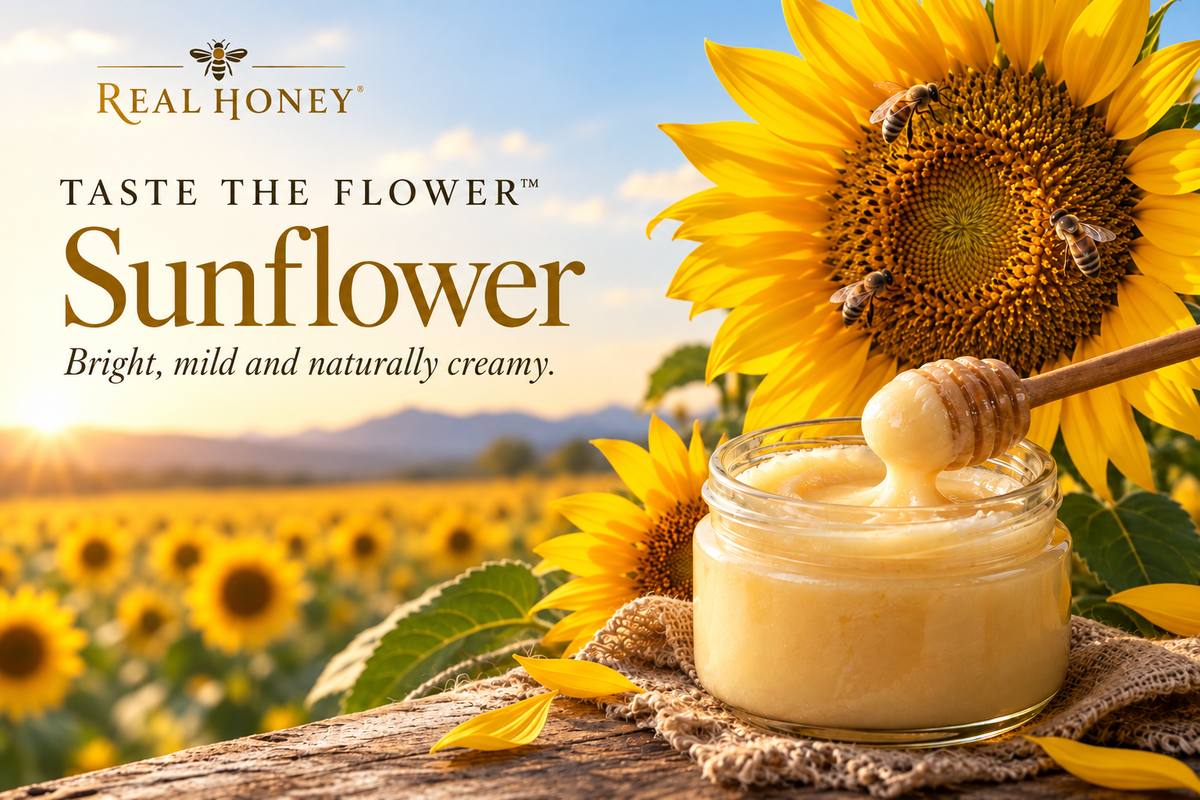
Subject: Taste the Flower: Sunflower

A honey that naturally loves to crystallise.
 

Taste the Flower™: Sunflower

One flower? Look a little closer.

A sunflower looks like one enormous yellow flower.


It isn't.


That familiar dark centre is actually made up of hundreds — sometimes thousands — of tiny individual florets.


And when a field of sunflowers opens?

For honeybees, it becomes an enormous seasonal food source.


Nectar.

Pollen.


And, under the right conditions, the beginning of another distinctive varietal honey.


Sunflower Honey.

Mild, approachable and particularly interesting for another reason:


Sunflower honey naturally likes to crystallise.

The flower leaves its signature not only in the flavour — but in the texture too.


The Flower

A field made for bees.

Few flowering crops make their presence known quite like sunflower.


Across a flowering field, thousands of large yellow heads follow the season — and every one contains a dense collection of much smaller flowers.


Those tiny florets mature progressively across the flower head.

For visiting bees, that means a sunflower is not simply a landing platform.


It is a concentrated patch of nectar and pollen.


Multiply that by an entire field and the scale becomes extraordinary.


In South Africa, sunflower is an important summer crop, particularly across the country's summer-rainfall grain-producing regions.

The Bee Forage

A crop for farmers. A food source for bees.

South African research identifies sunflower as an important forage source for honeybees.


When the crop flowers, bees visit the individual florets for both nectar and pollen.


Their movement across the flower heads also transfers pollen.

But there is an interesting distinction.


Not every sunflower crop depends on managed pollination to exactly the same degree.


Oilseed cultivars can differ from specialist seed-production crops, where good insect pollination can be especially important.


For the beekeeper, however, a large flowering sunflower crop can offer something extremely valuable:


a concentrated seasonal forage opportunity.


Flowering times differ with region, planting date and weather, but South African beekeeper forage records commonly place sunflower flow during the summer crop season.


Worth noting, sunflowers used to flower for 6 weeks in 2004/5 when I started beekeeping and chasing honey production with honeybees.


Now, due to hybridisation by seed companies like Monsanto, sunflowers only flower for 3 weeks.

The Honey

What does Sunflower Honey taste like?

Sunflower is an approachable honey, but it has one characteristic that makes it particularly interesting.


FLAVOUR
Mild and easy to enjoy.

AROMA
Gentle rather than heavily perfumed.

CHARACTER
A straightforward floral sweetness that works particularly well as an everyday honey.

TEXTURE
This is where Sunflower gets interesting.


Sunflower honey tends to crystallise relatively quickly.

That is a completely natural property of honey.


It is also one of the reasons sunflower honey works so beautifully as creamed honey.


Instead of fighting crystallisation, we can use it to produce an incredibly smooth, spreadable texture.


Different flower. Different honey.


And sometimes:


Different flower. Different texture.

The Harvest Story

When the whole landscape turns yellow.

Sunflower is different from the orchard honeys we tasted earlier in the series.


This is a broadacre field crop.

The farmer plants it.

The plants grow.

The flower heads open.


For a relatively short period, the field becomes a massive source of food for visiting insects.


Beekeepers can place colonies close enough to take advantage of that flowering period.


Then, as the crop finishes flowering and seed development takes over, the opportunity passes.


The beekeeper moves on.

The farmer moves towards harvest.


And inside the hive remains something from that brief yellow landscape:

the honey.

Taste It Properly

This time, taste the texture too.

Our first three Taste the Flower™ editions asked you to pay attention to colour, aroma and flavour.


Sunflower adds another dimension.

Texture.


Take a small spoonful of creamed Sunflower Honey.

1. Look at it
Notice that it is no longer clear and liquid like many freshly bottled honeys.

2. Feel the texture
It should be smooth, thick and easily spreadable.

3. Let it melt
Put a small amount on your tongue and allow it to soften.

4. Find the flavour
Once you get past the sweetness, notice how mild and approachable it is.


5. Compare


Think back through the series:

Macadamia
Smooth and subtly nutty.


Litchi
Light, floral and fruity.


Blue Gum
Mild and gently aromatic.


Sunflower
Mild, floral and naturally suited to a creamy, crystallised texture.


Honey doesn't have to remain clear and runny to be good honey.

Sometimes the crystals are part of the experience.


That is Taste the Flower™.

Best Food Pairings

Spread this one.

Creamed Sunflower Honey opens up slightly different possibilities in the kitchen.


TOAST & FRESH BREAD
Probably its natural habitat. Spread it rather than drizzle it.


RUSKS
A proper South African pairing.


CRUMPETS & PANCAKES
The thick texture stays exactly where you put it.


PORRIDGE & OATS
Add a spoonful and allow it to melt into a warm breakfast.


CHEESE
Try a small amount with mature cheddar or a creamy soft cheese.


BAKING
Its mild flavour makes it useful where you want honey sweetness without dominating the recipe.


Or forget the recipe entirely.

A spoon is sufficient.

Taste This Flower

CURRENT STATUS: TEMPORARILY OUT OF STOCK ONLINE

Sunflower is seasonal — and this is exactly why Taste the Flower™ exists.


Instead of pretending every varietal is available all year round, we would rather tell you when the next harvest arrives.

500 g — R100 Also available in 1 kg jars for R178

Available online and from the Real Honey Bar in Hennopspark, Centurion.

Bring your own container when visiting the Honey Bar and ask which varietals are currently available for refill.

Compare Another Flower

Next: Bushveld / Wild Flora

So far, we have followed bees into:


Macadamia orchards.

Litchi orchards.

Flowering Blue Gum trees.

And vast Sunflower fields.


But what happens when there isn't just one dominant flower?


Next, we leave the crop behind and head into the South African veld.


Different trees.

Different shrubs.

Different wild flowers.

One landscape.


And honey that can capture something much more complicated.


Next edition: Taste the Flower™: Bushveld / Wild Flora

Real Honey Bar
Shop 6, Coachmans Centre
26 Jakaranda Street
Hennopspark, Centurion

Whatsapp: 061 980 6551

Cell: 081 426 4333

Visit: www.realhoney.co.za