Subject: Unions Respond to AI Implementation, Museum Organizing Risk, Teamster Mess: LRI INK

November 20, 2025

To visit the blog post, click on the link below the article.

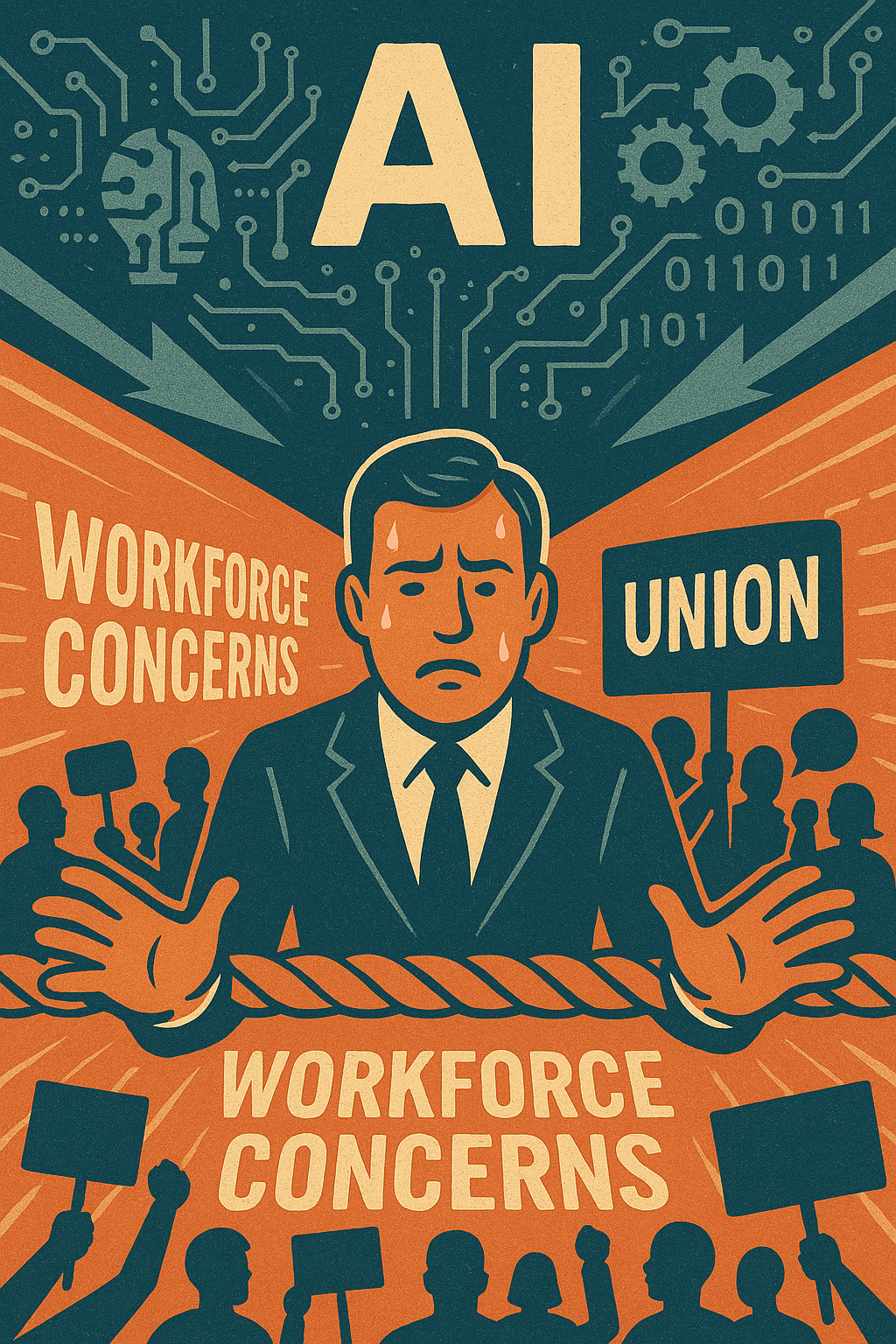
AI Is Changing the Workplace, Unions Are Responding to AI Implementation

by Michael VanDervort

Here Is What Employers Should Do Next.


Artificial intelligence is no longer a theoretical conversation in the workplace. Scheduling tools, productivity dashboards, routing software, generative AI, and automated decision-making systems are emerging in almost every industry. As these tools expand, unions are rapidly shaping their own public positions on AI, algorithmic management, and worker data rights. Employers should expect this to influence organizing campaigns, bargaining priorities, and regulatory strategies over the next several years.


Recent research from the UC Berkeley Labor Center analyzed a wide range of union and worker-organization statements and found consistent themes: transparency, limits on surveillance, guarantees of human judgment, and protection from bias. These themes are becoming the foundation of a new wave of workplace concerns. Whether or not a workplace is unionized, employees are likely to hear these messages online, in the media, or from colleagues in other industries.


For private-sector employers, this presents both a challenge and an opportunity. The challenge is that AI can increase fear and uncertainty when it is misunderstood or implemented poorly. The opportunity lies in clear communication and careful planning, which can prevent these concerns from becoming union organizing issues.


Below are the key trends employers need to understand.


Unions Are Framing AI Around Job Security, Fairness, and Control

Across sectors, unions are emphasizing three core ideas:


1. Workers deserve transparency.
Employees want to know what a system does, what data it uses, and how it affects scheduling or performance evaluations. Lack of clarity fuels rumors and mistrust.


2. Algorithms should not replace human judgment.
Most union statements fully reject automated discipline or discharge. They want a guarantee that humans remain accountable for employment decisions.


3. Monitoring and productivity tools must be fair and proportional.
Customer ratings, GPS, wearables, biometric systems, and camera analytics are being scrutinized. Unions argue these tools can be inaccurate or discriminatory if used without safeguards.


These are the ideas workers will hear in organizing campaigns and on social media. It is also how unions will frame AI-related concerns in bargaining.


Why This Matters for Employers

AI issues tend to escalate when employees feel uninformed or excluded. In many workplaces, the problem is not technology itself. The problem is how employees perceive it. When workers don’t understand how systems operate, they may believe:


  • “The computer is doing all the discipline.”

  • “The company is watching everything we do.”

  • “They are replacing us with automation.”

  • “No one asked us before they rolled this out.”

These concerns can quickly evolve into grievances, organizing activity, or public criticism. Employers who overlook communication and training when adopting new technology are more likely to face resistance.


Practical Steps Employers Can Take Right Now

The goal is not to avoid technology. The goal is to deploy it responsibly and predictably. The following steps can reduce confusion, increase trust, and lower the risk of AI becoming a workplace flashpoint.


1. Publish a clear and concise AI Transparency Statement

Employees should understand:


  • what data the company collects

  • what the technology does

  • what decisions AI will not make

  • how the company protects privacy and fairness

A short document that answers these questions can significantly reduce anxiety.


2. Train supervisors to communicate about technology

Supervisors are the first point of contact when employees become confused or frustrated. They need to be prepared to explain why a system is used, how it works, and what controls are in place to ensure its effectiveness. They should avoid dismissive responses such as “don’t worry about it” or “that’s just how the system works.” These statements heighten suspicion and prompt employees to seek answers from third parties.


3. Review high-risk monitoring and algorithmic tools

Employers should evaluate:


  • whether monitoring practices are narrowly tailored

  • whether algorithms reinforce bias or create unrealistic expectations

  • whether customer ratings influence pay or discipline

  • whether devices collect unnecessary data

If a tool cannot be defended publicly or legally, it is worth revisiting.


4. Establish human review for all high-impact decisions

Even if AI tools help analyze data, a human should make final decisions in areas such as:


  • attendance

  • discipline

  • performance evaluations

  • routing and scheduling

  • job assignments

This approach protects employees from system errors by ensuring a human touch, and it also protects employers from liability.


5. Use a structured rollout process for new technology

Before launching a new system, employers should:


  • announce the change early

  • pilot the tool with a small employee group

  • test for safety, fairness, and accuracy

  • clarify what will and will not change

  • provide a method for employees to ask questions

Careful rollout reduces operational problems and builds credibility.


Looking Ahead

AI adoption will continue to grow, and unions will continue to sharpen their messaging around transparency, fairness, and worker control. Employers that treat AI as a technical issue rather than a workforce-trust issue are more likely to encounter resistance. Employers who communicate early, involve employees appropriately, and maintain human oversight will reduce conflict and increase confidence in new tools.

The NLRB Is Open For Business, And Museum Worker Petitions Are Flowing

by Kimberly Ricci

Earlier this summer, we noticed a wave of museum workers filing union petitions. That infiltration of the art world wasn’t simply a passing trend. The NLRB recently began posting notices of union elections after the federal government reopened, and 900+ workers at NYC’s Metropolitan Museum of Art petitioned to join the United Auto Workers. Meanwhile, workers from at least four other cultural institutions–Detroit Institute of Arts, Los Angeles County Museum of Arts, National Museum of Mathematics in NYC, and Adler Planetarium in Chicago–petitioned for union votes to join AFSCME. 


The organizing employees include guest service workers, educators, technologists, curators, volunteer coordinators, and more, and it’s worth examining what leads museum workers to seek third-party representation.  


Economic Realities and Career Sustainability


This first point won’t be too surprising. Many union campaigns catch fire when workers feel that compensation isn’t keeping up with the cost of living, and museum employees’ beliefs on the subject are no different. 


To complicate matters, advanced degrees and specialized skills are often required for careers in the arts and culture. These workers can also grow disillusioned with the reality of pay structures tied to grant funding and with shakier job security than in comparable professional fields. It doesn’t help that most museum jobs are based in cities with a high cost of living. 


To that end, 300 LA County Museum of Art Workers are supposedly “struggling with wages that have not kept up with the rising cost of living in the sixth most expensive City in the world.” These workers claim to be carrying heavier workloads and more responsibilities without raises to complete the $700 million David Geffen Galleries while facing budget constraints. Similar sentiments are at work for the 900 NYC Metropolitan Museum of Art workers, who apparently believe that the United Auto Workers are somehow equipped to represent them.


Yes, that’s a head-shaking idea to behold, not only because of differing industries but also because the UAW specializes in making false promises about job security. Yet this is evidence of a disconnect between workers and their employer, and for these workers, their concerns run deeper than wages.


Workplace Transparency, Equity, and Mission


We’ve talked before about how so-called “progressive” employers like Starbucks are experiencing organizing drives after unions created the organizing mantra that the company was not “practicing values that they espouse.” The same goes for the arts, where workers tend to be younger, left-leaning, and more receptive towards Big Labor’s toolbox of strategies. They are also hyperaware of any decisions that they feel compromise a museum’s mission and integrity.


This week, the Detroit Institute of Arts Workers expressed that they are unionizing because they seek “a fair, transparent, and respectful workplace that aligns with the values the museum shares with the community.” 


Museums publicly champion social justice and equity as well as community engagement, and even when workers feel passionate and aligned with their institution's mission, they can become disillusioned over inconsistent policies and ambiguous budget cuts, as well as inequity in pay. If there’s a disconnect between a workplace’s external values and internal practices, these workers become vulnerable to third-party interference.


Conclusion


As with every other industry, museum workers want transparent communication about compensation and professional development, but ultimately, these workers feel compelled to unionize when they believe, or are encouraged to believe, that internal practices threaten the mission they're dedicated to advancing.


Those employers who are proactive rather than reactive about workplace concerns will find that they are better equipped to align their institutions’ missions with workers and guests alike. If museum leaders are successful in maintaining direct relationships with their workers, these institutions will not only avoid the bargaining table but also be better equipped to serve their mission and communities. That’s a win-win.


Next 52 Weeks:Employee Communication Fundamentals and Proactive Strategies

by Michael VanDervort

In the wake of a union election, proactive communication isn’t a luxury. It’s the difference between a healthy workplace and a combustible one. In this episode of The Left of Boom Show, Phil Wilson, CEO of LRI Consulting Services, Inc., sits down with Nick Kalm, CEO of Reputation Partners, to break down the fundamentals that every leader in your organization needs to master over the next 52 weeks.


Drawing directly from real-world work with employers across the country, Phil and Nick explore why supervisors are the most critical communicators in any organization, why clarity beats cleverness every time, and how anticipating employee questions becomes the fastest path to message discipline. They get into all of it: multi-channel communication, feedback loops, generational expectations, social media, the grapevine, and what happens when employers stop communicating the minute a union election ends. Spoiler: nothing good.


If you’ve ever wondered why your messages don’t land, why rumors spread faster than facts, or how to build a communication rhythm your team can actually count on, this episode lays out the roadmap. Practical, candid, and loaded with real examples.


Key Takeaways

  • You need to get it to where they understand it.

  • Feedback is essential for improvement.

  • Anticipate questions your audience may have.

  • Craft clear, simple messages.

  • Communication is a two-way street.

  • Knowing your audience enhances messaging. • Improvement comes from understanding feedback.

  • Clear messaging leads to better understanding.

  • Communication strategies should be audience-focused.

  • Refining your message is an ongoing process.

A Double-Edged Arbitration Sword: The Transportation Worker Exemption And A Twisty Teamsters Mess

by Kimberly Ricci

For decades, employers could rely on mandatory arbitration agreements to resolve disputes efficiently and privately, without the risks of class-action litigation. This has been especially true in the transportation and logistics industries, but a shift could be on the way.


This term, the Supreme Court will hear Flowers Foods, Inc. v. Brock, a case that could rewrite where the “transportation worker exemption” lands within the Federal Arbitration Act (FAA). Meanwhile, a separate dispute involves the Teamsters' intention to use arbitration to challenge UPS’s use of gig-based delivery services. The outcomes of these conflicts could potentially transform how logistics employers must handle labor disputes.


The Flowers Foods Case and the Future of Arbitration

Flowers Foods will determine how far the transportation worker exemption extends and whether local or last-mile delivery drivers are “transportation workers engaged in interstate commerce,” so that they can sidestep mandatory arbitration requirements under federal law. In turn, the case will decide whether this particular group of gig drivers, who are independent contractors, are bound to private arbitration or can file lawsuits in court.


The Supreme Court’s decision could either reaffirm arbitration as an enforceable employer tool for delivery and gig drivers or throw many clauses out, potentially opening the door for class-action lawsuits from last-mile drivers. This will likely result in a slew of test cases filed by couriers, but Flowers Foods isn’t likely to allow rideshare and app-based food delivery drivers to gain an arbitration exemption.


As Bloomberg Law points out, the Ninth, First, and Third Circuits already held that rideshare drivers don’t move passengers or goods as a part of a steady interstate flow, so they’re not exempt. Likewise, the Seventh Circuit determined that Grubhub drivers deliver food that originates in the same state where it’s consumed, so those drivers aren’t exempt either.


Another Wrinkle: Teamsters vs. UPS Over Roadie

Meanwhile, the Teamsters are threatening to use arbitration against UPS over its subsidiaries, Roadie and Happy Returns, which provide freelance drivers for “last mile” deliveries from companies such as Home Depot, Walmart, and Nothing Bundt Cakes. In particular, the Ventura County Teamsters local alleges that UPS is violating their contract by using nonunion gig drivers to avoid paying overtime to its own union drivers.


However, if the Supreme Court’s ruling in Flowers Foods expands the FAA’s transportation-worker exemption, arbitration clauses involving gig and last-mile drivers could lose enforceability. This could push the Teamsters’ UPS-Roadie conflict into court. Still, it’s also bad news for employers because losing arbitration as a dispute-resolution mechanism could make many future logistics class-action cases possible.


Conclusion

The outcomes of both Flower Foods and the UPS/Roadie dispute are poised to turn arbitration into a labor relations battleground. As a result, employers in logistics that use gig drivers for last-mile deliveries should review their arbitration frameworks and assess which of their delivery drivers may fall under the FAA.


Stay tuned because although “arbitration” doesn’t sound like the most interesting or dramatic subject, the results of these disputes could carry long-lasting and expensive implications for businesses.


Friday Five: An NLRB Return, An Industry In Crisis, A Red Cup Rebellion, And AI In Overdrive

by Kimberly Ricci

It’s Friday, and we have five labor-related stories that you might not have heard yet:


🏛️📚 The NRLB is working on it

Although the NLRB doesn’t have a quorum yet, the Board is back in sort-of business after a record-breaking 43-day shutdown. From here, employers can expect a slow return to “normal” as the Board’s small staff starts clearing out the backlog of union petitions and ULP filings. Elections will need to be rescheduled as well, and the Board has posted a list of revised due dates for certain documents and processes.


Now, if only a crystal ball could tell us when Board rulings will start being issued, or rather, when that quorum will be satisfied. General Counsel nominee Crystal Carey and Board nominee James Murphy could soon be confirmed by the Senate now that the government has reopened. The fate of Scott Mayer, who is currently Boeing's chief counsel, should also be decided in the near future after the Boeing strike is resolved late this week.


Surely, these pieces will come together before David Prouty’s term ends in August 2026? Fingers crossed.

🌿⚖️ An industry thrown into overnight disarray

The newly approved federal spending bill made the surprise move of closing a loophole, thereby making most hemp products illegal in one year. Now, a $28 billion dollar industry has been put on notice that entire farm operations could be wiped out, and an estimated 300,000 jobs could soon disappear. The eleventh-hour measure was opposed by GOP Sen. Rand Paul, who represents Kentucky, one of the top hemp-producing states. Paul tried to have the provision removed before voting against the bill.


It’s a controversial and complicated development, and it’s worth watching how unions react. In this case, the UFCW and the Teamsters are the most common Big Labor organizations involved in hemp workplaces. They will likely lobby to have the ban reversed in favor of the hemp industry being extensively regulated in the same manner as cannabis.

Not only would such an outcome be a tax-dollar boon–and let’s get real, that might have been one motivation for the ban being inserted in a spending bill–but if unions succeed in that lobbying, they’ll receive goodwill from hemp workers, who would likely be receptive toward organizing.

☕🥤Starbucks Workers United’s Red Cup Rebellion has returned

Four years after Starbucks Workers United won their first election in Buffalo, NY, baristas still have no first contract or even a national bargaining framework. As forecast, baristas at scattered stores went on an open-ended strike for Red Cup Day (Nov. 13) to protest the lack of progress in talks between the union and company. CNBC reports that 65 stores in 40 cities saw 1,000 baristas walk out on the strike’s first day.

Additionally, Starbucks and the NLRB are meeting again on the company’s appeal of a ruling that a New York cafe’s dress code policy, which limited attire to “one pin” and barred union t-shirts, violated workers’ right to organize under the NLRA. That case has arrived with the Second Circuit Court of Appeals with the company asking to halt the NLRB’s policing of workplace dress codes, and this week, a panel of judges expressed skepticism over that Board standard. One judge reasoned that Starbucks’ dress code is in line with the company’s “general desire to create a vibe for this retail establishment,” which “seems to me a reasonable position.”


We’ll have to see how those proceedings conclude, but back in 2012, the Second Circuit did side against the NLRB and with Starbucks during a time when the Industrial Workers of the World were trying to organize baristas. At that time, the court allowed the “one pin” policy to stand if “special circumstances” applied.

🤖💡🧠 Off to the AI-building races

This field’s biggest contenders are not slowing their rush to develop mega-infrastructure. To that end, Anthropic, the owner of Claude, is investing $50 billion in a swath of custom data centers stretching from Texas to New York. The facilities will begin going live in 2026 and will employ 800 permanent workers and involve thousands of construction roles. Whereas OpenAI announced plans to spend $500 billion by year’s end to begin development at five new data center sites. OpenAI projects at least 25,000 onsite jobs will be created at these five sites.


To what end? The sky is the apparent limit, at least until the need for profit comes calling. Anything could happen in the next few years, but the Wall Street Journal reports that Anthropic projects that they will break even by 2028, while OpenAI is forecast to lose $74 billion in that same year.


And in case anybody wondered how Mark Zuckerberg’s quest for “superintelligence” is going, Meta also pledged to spend over $1 billion on a 700,000-square-foot data center in Wisconsin. Zuckerberg has forecast a total spend of $600 billion on AI infrastructure through 2028.

🎲🎰🎯 Teamsters’ turmoil at casinos

A strike at the Horseshoe Indianapolis casino is approaching the one-month mark. This week, a federal court upheld the Caesars Entertainment-owned casino’s decision to have the picket line moved. The workers’ election date to join the Teamsters has been on hold due to the government shutdown, and the union sued the City of Shelbyville while claiming a violation of First Amendment rights. A federal district court judge disagreed with the union’s claim since workers weren’t asked to move off Horseshoe’s property, simply to an area less likely to disrupt casino operations further.


And in Las Vegas, Teamsters members authorized a strike at the off-strip Rio hotel-casino following two years of contract negotiations. Currently, 100 workers have been working without a contract since April 2024, and the strike could disrupt upcoming events such as the Formula One Las Vegas Grand Prix and National Finals Rodeo.


In this case, what happens in Vegas might not stay in Vegas.


Stories You May Have Missed:


The shutdown’s over, but the NLRB is still in a bind

Link


Sen. Cassidy’s Labor Law Reform Package Focuses on Fairness

Link


Shadow AI is widespread — and executives use it the most

Link


Hollywood Guilds Make Historic Push to Unionize YouTube Content Studio Theorist Media 

Link


Teamsters Allowed to Join Defense of California Labor Board Law

Link


About Labor Relations INK

Labor Relations INK is published weekly and is edited by LRI Consulting Services, Inc. Feel free to pass this newsletter on to anyone you think might enjoy it. New subscribers can sign up by visiting here.


If you use content from this newsletter, please attribute it to LRI Consulting Services, Inc. and include our website: http://www.LRIonline.com 


Contributing editors for this issue: Greg Kittinger, Michael VanDervort, and Kimberly Ricci.


You are receiving this email because you subscribed to receive our labor relations newsletters and updates. You can manage your email preferences by clicking the link at the bottom of any of our email communications.


About LRI Consulting Services, Inc.

LRI Consulting Services, Inc. exists to help our clients thrive and become extraordinary workplaces. We improve the lives of working people by strengthening relationships with their leaders and each other. For over 40 years, LRI Consulting Services, Inc. has led the labor and employee relations industry, driven by our core values and our proven process, the LRI Way.


Share