Q2 2026 NLRB Data Insights
Six months into the year, the Q2 2026 NLRB data numbers from the LRIrightnow Q2 2026 NLRB Elections and Petitions Review look relatively calm: RC election volume is down 3%, and union win rates are nearly flat. But the employee population involved in organizing activity is shrinking, decertifications are rising, and several important differences emerge when the data is separated by union, industry, region, and unit size.
Election Volume Was Stable. The Organizing Footprint Was Not
RC elections declined only 3% through the first half of 2026, but the number of workers eligible to vote in those elections fell 24%, from 56,501 to 43,080. The number of workers organized fell 9%, from 39,067 to 35,627. RC petitions also declined 7%, while the number of workers in proposed units fell 19%, from 63,412 to 51,337. Unions were winning at roughly the same rate, but across a smaller employee population.
The average proposed RC unit also appears to be shrinking. Based on the report totals, proposed units averaged approximately 50 workers per petition in 2026, compared with about 58 a year earlier. That is consistent with the report's broader concentration of activity in smaller units.
Winning More Decertification Votes, Losing Bigger Units
Unions won 47.2% of decertification elections through the first half of 2026, up from 41.3% a year ago. Even with that year-over-year improvement, unions still lost slightly more decertification elections than they won. The number of employees in units where unions lost decertification elections climbed 33% to 1,823, indicating that union losses were occurring in larger bargaining units.
Decertification pressure may also be building faster than the completed-election count suggests. RD petitions increased by 6%, and the number of workers covered by those petitions increased by 13%, even as certified RD elections declined by 4%. The petition-to-election rate fell from 50.3% to 45.6%, meaning a larger share of first-half decertification activity had not produced a certified election during the same reporting period.
The Teamsters: Most Active, Below the Overall Win Rates
No union came close to the Teamsters' volume during the first half. They filed 224 RC petitions and appeared in 178 RC elections, more than double the next-most-active union. Their 72% RC win rate trailed the national average of 78%. In decertification elections, the Teamsters won four of 11, a 36% rate compared with the overall union average of 47.2%.
Small Units Cut Both Ways
A third of all RC petitions filed during the first half, 342 of 1,024, involved proposed units of 10 workers or fewer, more than any other size category. Small units were also the largest category among certified RC elections, and unions won 79% of elections involving units of that size.
The decertification results moved sharply in the opposite direction. Unions won only one of 16 decertification elections involving units of 10 or fewer workers. At the other end of the spectrum, the single decertification election involving a unit of 501 or more employees resulted in a union win.
Services Led Petitions. Healthcare Led Elections.
Services generated the most RC petitions, with 211, while Healthcare and Social Assistance produced the most certified RC elections, with 161, and an 86% union win rate. Healthcare also produced the most decertification activity of any industry, with 33 petitions and 13 certified elections.
Measured by union win rate, Utilities led all sectors at 92%, though that result was based on 38 elections. Transportation and Warehousing combined substantial activity with an 87% union win rate across 45 elections, making it one of the stronger high-volume industry results. Construction lagged at 52%.
Employer-Filed Petition Activity Drops Sharply
The sharpest year-over-year move in the report involved employer-filed activity. RM petitions fell 27%, and RM elections held fell 31%. Where employers did file, unions still won 73.5% of RM elections, down only slightly from 75.5% a year ago.
Where Activity and Union Success Were Concentrated
Region 19, covering the Pacific Northwest, led all NLRB regions with 110 RC petitions and 84 certified RC elections. Unions won 85% of the RC elections held in the region. Region 10, however, posted the strongest union result among regions meeting the report's activity threshold, with a 93% RC win rate. Region 14 was lowest among that group at 62%.
California generated more raw volume than any state, with 155 RC petitions and 109 certified elections, but its 75% union win rate lagged the national average. Among high-volume states, Washington posted the strongest union success rate at 87%, while New Jersey was the weakest at 61%.
What to Watch in Q3
The first question is whether the organizing footprint continues to shrink even if election volume remains relatively stable. The second is whether rising numbers of decertification petitions are producing more certified elections. Unions are winning a larger share of decertification votes, but 1,823 employees were in units where unions lost, a 33% increase from the prior year. The Teamsters enter the second half with overall union win rates below the union average in both RC and RD elections, while employer-filed activity remains sharply below 2025 levels.
Get the Full Q2 2026 NLRB Petitions and Elections Report
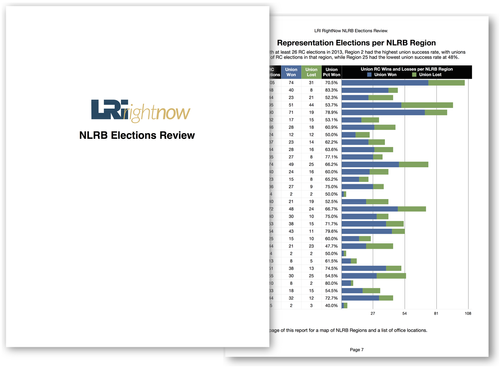
The LRIrightnow Q2 2026 NLRB Elections and Petitions Review covers RC, RD, and RM petitions and elections, broken down by union, NLRB region, state, industry, and unit size.