Subject: LRI Ink: UAW Power Struggle, NLRB Gridlock, Organizing Wave Building

June 25, 2026

To visit the blog post, click on the link below the article.

What's In Ink This Week:

  • UAW Election Challenge: Boyer vs. Fain: Rich Boyer, the VP ousted after refusing to divert union benefits to Fain's fiancée, is running for president. Mail ballots go out late August.

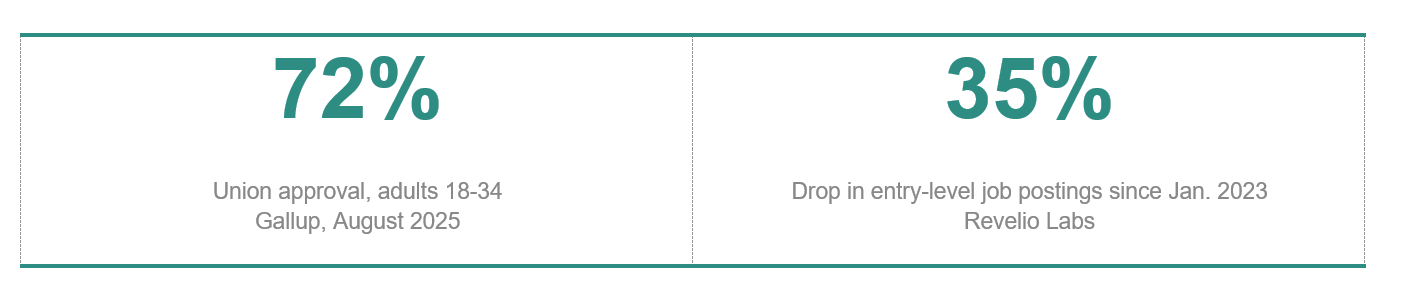
  • Gen Z's Pro-Union Surge Meets Hiring Collapse: 72% of adults 18–34 support unions, the highest approval of any age group. Entry-level job postings have dropped 35% since January 2023, with AI-exposed roles hit hardest. For the first time, a generation primed to organize is facing a concrete job market threat. All this could lead to increased organizing pressure.

  • Small Employers Buried Under 657-Day NLRB Case Backlogs: Of 23,000+ open unfair labor practice cases, 61% involve workplaces with 100 or fewer employees. Cases that took 279 days to process before 2021 now drag for 657 days. Small shops can't absorb legal costs the way big employers can.

Who Is Rich Boyer, Shawn Fain’s Most Prominent Challenger For The UAW Presidency?

by Kimberly Ricci

A funny thing happened after UAW President Shawn Fain promised to redeem his union from its legacy of corruption. Following his fall 2022 election, Fain pushed to dissolve the UAW’s reform caucus and got his wish. The union’s federal monitor, Neil Barofsky, released reports that detail Fain’s culture of retaliation and how Fain ousted two officers who refused to approve his ambiguous spending requests. Well, that combative streak is turning convention season into a bit of a soap opera.


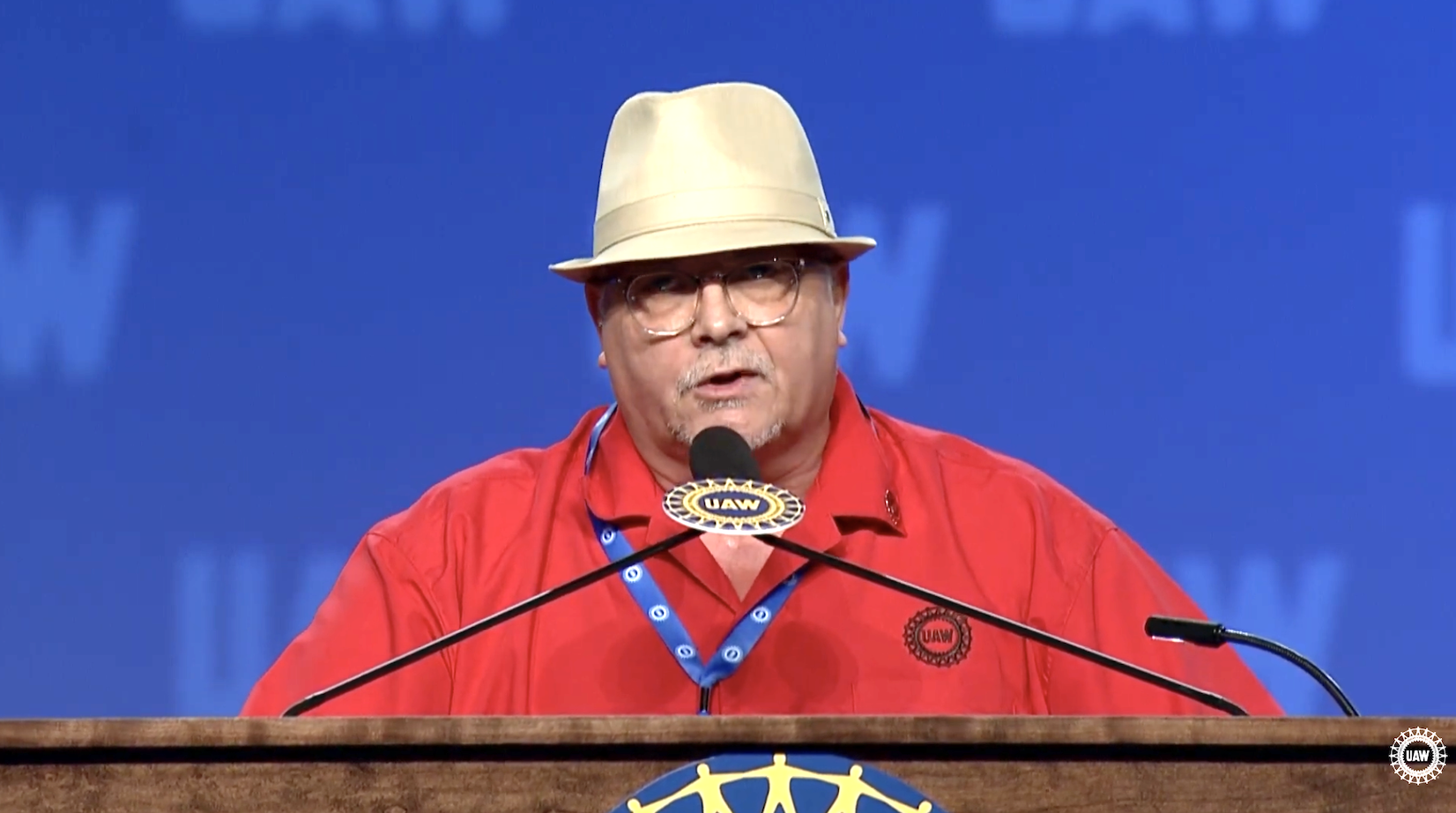
Those two ousted officers, who Barofsky ordered to be reinstated, are running for office this fall. Fain allegedly removed one of them, Vice President Rich Boyer, from his Stellantis oversight duties because Boyer “refus[ed] to divert benefits to his fiancée” and her sister. We’ll briefly talk about the other officer, Margaret Mock, in a moment, but what matters most right now is that Boyer is running against Fain for the presidency.


Fain, a career union bureaucrat who now presides over “Solidarity House,” is still a relatively popular union president and never misses a chance to self-promote, but Boyer’s candidacy is still a big deal within the union. Detroit publications have acknowledged him as the most “prominent” rival, and one who has been engaging in “an enduring feud with Fain.”

That’s not even the start of it.

Who is Rich Boyer?

Boyer joined UAW in 1985 as a worker in Chrysler’s Toledo Jeep plant. He climbed the local officer ladder, later graduated to the skilled trades committeeperson role, and was elected international VP in 2022. He’s the only candidate who currently sits on the union’s leadership council, the 14-member International Executive Board (IEB).


Last year, Boyer called out Fain’s decision to seize oversight of the Stellantis department. At that time, he lamented of Fain, “He ain't no leader... If you want to know the truth … It breaks my heart bad.”


Boyer also revealed that Fain generally ignores him after the firing-rehiring scandal: "I don't talk to him. If I call him, he may call back two weeks later. He doesn't answer my phone calls. He doesn't – nothing." Boyer claims that Fain previously told him “to fire [five] members of my staff, and I wouldn't do it, and I knew he was gonna come after me. I stood my ground, because them people did nothing wrong."


If reelected, Boyer wants to bring accountability to UAW finances and vows to lower member dues. At last week’s convention, delegates voted to keep those dues at 2.5 hours per month to build the strike fund up to $1.3 billion from its current $850 million. Boyer, however, wants to answer members’ call to only pay 2 hours per month in dues.


Boyer has hinted that the strike fund isn’t being used purely to prepare for strikes. "My opinion is they're taking that money out of the strike fund to run the day-to-day operations,” Boyer alleged. "Our budget isn't right." He added, "I think if I win, I'll change the mindset and the direction of the IEB. Right now, everybody's in survival mode."


Also on the presidential ballot: Will Lehmen, Brian Keller, Tricia Geiger, and Greg Mooney.

Where is Margaret Mock?

Mock was rumored to be considering a run at the presidency, too. That would have been an interesting follow-up after Fain not only pushed her out, but as the federal monitor wrote, Fain “believed having Black women present the motion against Mock, who is also Black, would shield him from potential accusations of racism.” Fain later admitted to Barofsky, “I thought it would be better coming from [them] than me, a white guy.”


Mock, however, has chosen to seek reelection as secretary-treasurer and has two challengers, Roc Ciers and Brandon Campbell.

Will Fain have another term of eating the rich?

He’s banking on it. Fain has been talking up his plans for a general strike on May 1, 2028, which coincides with the expiration date of many union contracts throughout multiple sectors. Fain also regularly trumpets his “wins,” like the recent American Axle/Dauch Corp. contract that brought a return to pre-2008 wages, long after the UAW agreed to have workers’ wages cut in half due to the financial damage from a previous UAW strike.


Yet it’s not easy to remove a union president who hasn’t been charged with federal crimes. From here, mail ballots will go out in late August, and tabulation will begin in early October. This is only the second time that the union has directly elected international officers under a “one member, one vote” policy, which was put into place as part of the federal monitor deal.

The Most Pro-Union Generation Meets A Shrinking Career Ladder

by Michael VanDervort

Same generation, same moment

Two numbers describe the same cohort from opposite directions. The most pro-union age group, 72 percent among adults 18 to 34, is also the age group absorbing the sharpest entry-level hiring contraction on record, thanks in part to AI. That is not a coincidence of timing. It is two measurements of the same underlying condition: a generation watching its first foothold in the labor market narrow at the exact moment it has the most favorable view of collective bargaining of any cohort in many years.

TL;DR

Why the combination matters more than either number alone

High union approval, or pro-union sentiment, has existed before without producing an organizing surge, because approval is a feeling, and organizing requires some collective effort. What has historically closed that gap is a concrete, personal threat to job security, not an abstract preference. The AI-driven contraction in entry-level postings is precisely that kind of threat, and it is landing on the one generation already primed to read collective action as a reasonable response rather than a fringe one. A worker who cannot find the first rung of a career ladder, in a cohort that already approves of unions more than any generation has at the same age, is a different organizing prospect than the same worker would have been five years ago.

This is not the first automation shock, but the timing is different

The early 1980s offer the closest historical parallel: manufacturing automation gutted entry-level industrial jobs at the same moment private-sector union density was already sliding from its postwar peak. The workers hit hardest had the least bargaining power to negotiate the transition, resulting in a decades-long shift of power away from labor rather than a union resurgence. The current moment inverts that setup. AI-driven disruption is landing on a generation that already approves of unions at record highs and has already led major organizing campaigns at companies like Amazon and Starbucks. The disruption this time is not hitting workers with no appetite for a collective response. It is hitting workers who have already shown they will act on one.

What is already moving regardless of the timeline

While the approval and hiring numbers get the attention, a quieter shift is further along. The generative AI contract language the Writers Guild of America negotiated in 2023 is now the most cited template for AI-specific bargaining, and Public Services International's Digital Bargaining Hub has cataloged more than 500 AI-related clauses from unions worldwide. California's May 2026 executive order on AI and the workforce directs the state's Labor and Workforce Development Agency to review by October 15, 2026 how collective bargaining is addressing new technologies. None of that depends on whether approval and organizing converge on the same timeline. It is already written into real agreements, and the pattern has a track record of spreading once it takes hold somewhere first.

What this means for employers

None of these belongs on a shelf as a forecast to revisit next year. A few things are worth doing now, regardless of how fast the timeline plays out.

  • Treat AI deployment as a labor relations issue, not an IT rollout. Any tool that touches scheduling, discipline, or performance evaluation needs a communication plan before it goes live, not one built in response to a petition.

  • Name what is still real about advancement, out loud and often. If the entry-level path is narrowing, silence on the subject reads as confirmation that no path exists at all.

  • Build AI governance language into workforce communication before anyone demands it. Human oversight commitments and transparent criteria for AI-influenced personnel decisions are the same categories already appearing in union contract proposals.

  • Build internal fluency in AI bargaining concepts now. If you have a union contract in place, this moves from a specialty skill to a baseline expectation for anyone advising on the subject.

The honest caveat

Conditions stacking up for a more pro-union generation are not the same as a wave already underway. National Labor Relations Board (NLRB) election petitions filed by employees fell to 2,100 in fiscal year 2025, the lowest count since 2022, even as approval climbed. The board spent most of 2025 without a quorum and now operates with a Republican majority, a legal and political environment that does not accelerate filings regardless of sentiment. The right way to read this moment is not that an organizing surge has arrived. It is that the structural ingredients for one, a generation primed to act, and a concrete economic threat landing on that same generation, are present together in a way we have not experienced in a while.


Watch the gap, not the headline number. Approval was high before without consequence. What is different now is that the threat closing the gap between feeling and acting is landing on the one generation that was already most inclined to act on it.


Why Small Employers Are Paying The Highest Price For The Abruzzo-Era ULP Backlog

by Kimberly Ricci

The NLRB's case backlog, which accumulated due to ex-General Counsel Jennifer Abruzzo’s enforcement push, is well-documented. As our recent in-depth report detailed, open ULP charges against employers tripled between 2021 and 2024. The median case-processing time nearly doubled, and the informal settlement rate collapsed by more than half. And the hardest-hit employers might surprise you (hint: they’re not Starbucks).


Our analysis revealed that 61 percent of the 23,000+ open ULP cases involve workplaces with 100 or fewer employees. Forty-five percent involve workplaces with 50 or fewer. The employers who are most feeling this burden are 40-person shops, local manufacturers, and regional distributors who are seeing ULPs stay unresolved for two years and counting.


Meet the owner of a 35-person HVAC company who receives a call telling him that a former technician has filed a ULP charge. Suddenly, a routine termination decision has turned into an administrative saga. From that point forward, this employer is questioning how he should handle violations of the attendance policy. Or whether he can advertise and fill the position left open by that former employee. He’s second-guessing choices and calling his attorney for every personnel matter while wondering how this looks to a federal agency that’s got him in its sights. These days, that cloud doesn't lift for 657 days on average. Before 2021, it was 279 days.

For Employers Facing ULPs, Size Matters

(Read our prior article to understand the mechanisms behind the Abruzzo memos that caused this ongoing backlog.)


For a large employer, dealing with the onslaught of ULPs is painful but manageable. These cases get handed to internal labor counsel while the business keeps running. Yet with small businesses, there's no in-house legal department to handle these matters. The company's owner or a single HR generalist is now juggling NLRB scrutiny over a single alleged ULP while running day-to-day operations. Abruzzo's push for foreseeable remedies turned straightforward termination or backpay cases into speculative and potentially business-ending risks. Quite simply, the ULP deluge that resulted from Abruzzo's memos has disproportionately fallen upon the employers who are least equipped to absorb the costs.

Still Open, Still Waiting

Our analysis found that of the 14,500 open cases at workplaces with 100 or fewer employees, about 9,800 were filed during the Abruzzo era and remain unresolved. For these employers, their active cases have no clear resolution on the calendar. The rescission of these harmful, overreaching Abruzzo memos did remove those procedural bottlenecks, but clearing the backlog is an ongoing and slow process. For the small employers whose cases entered the ULP system between 2021 and 2025, recovery won’t be felt anytime soon.


About Labor Relations INK

Labor Relations INK is published weekly and is edited by LRI Consulting Services, Inc. Feel free to pass this newsletter on to anyone you think might enjoy it. New subscribers can sign up by visiting here.


If you use content from this newsletter, please attribute it to LRI Consulting Services, Inc. and include our website: http://www.LRIonline.com 


Contributing editors for this issue: Greg Kittinger, Michael VanDervort, and Kimberly Ricci.


You are receiving this email because you subscribed to receive our labor relations newsletters and updates. You can manage your email preferences by clicking the link at the bottom of any of our email communications.


About LRI Consulting Services, Inc.

LRI Consulting Services, Inc. exists to help our clients thrive and become extraordinary workplaces. We improve the lives of working people by strengthening relationships with their leaders and each other. For over 40 years, LRI Consulting Services, Inc. has led the labor and employee relations industry, driven by our core values and our proven process, the LRI Way.


Share