Subject: LRI Ink: New Organizing Trends + AutoZone Union Noise


October 8, 2026

To visit the blog post, click on the link below the article.


Why Is The AutoZone Union Campaign Receiving So Much Attention?

by Kimberly Ricci

We recently mentioned how the United Auto Workers filed a representation petition to unionize an AutoZone location in White Plains, NY. This petition surfaced on Aug. 17 involving retail workers and drivers, totaling a unit of 11. According to the AFL-CIO, the union won this election on Sept. 29, although the results haven’t yet been certified by the NLRB.


If you’re reading this, you know that union elections happen all the time, and yes, sometimes the units are small. This news isn’t unusual, but gosh, this campaign is getting so much attention that it’s almost bizarre.


You’d have to assume that there’s some type of “plan” at work, or at least, Shawn Fain’s union wants us to believe that there are deep thoughts happening behind the curtain. So let’s play along.

Is this the UAW’s attempt at “the next Starbucks”?

This is probably what the UAW wants people to suspect about its intent, and this is also the most likely angle that the media will latch onto if any other AutoZone locations unionize. Since this employer has over 6,600 retail stores in the U.S., you can bet that the UAW has been sniffing out other locations because Fain does like his “moon shots.”


This could mean targeting one of AutoZone’s 150+ mega hubs or a warehouse that the Teamsters tried and failed to capture in the 1990s. And AutoZone could be a Starbucks-esque feather in Fain’s “Eat The Rich” cap, one that could signal a nationwide wave at an auto-focused retailer. If that worked, then the union wouldn’t need to be so ridiculously reliant upon higher-ed workers for dues.

What’s a union fat cat not to love about that scenario?

"The next Starbucks" isn’t the flex the UAW thinks it is

Let’s get real: The first unionization of a Starbucks location happened in December 2021. Unions quickly targeted other retailers in hopes of replicating that “magic.” Yet what’s really happening with Starbucks Workers United is nothing worth bragging about. The union hasn’t reached a first contract, and multiple boycotts haven’t brought SWU any closer to that milestone. The union’s been raving about its 700th “win” (there are at least 18,000 U.S. Starbucks locations, so under 4% are unionized) for months. It’s also resorting to repeat moves by threatening another boycott.


As for the other efforts to replicate the Starbucks Workers United effect, they’re also not going well:

  • REI: 11 out of 195 unionized with United Food and Commercial Workers International Union (UFCW) and Retail,

    • Wholesale and Department Store Union (RWDSU).

    • Whole Foods: 1 location unionized with UFCW.

    • Trader Joe’s: 4 locations went the indie union route.

    • Apple: 1 retail location remains unionized with Communications Workers of America (CWA).

Any contracts for any of these union "wins"? Nope.

How desperate is the UAW for some good press?

We’ve already mentioned how tiny this White Plains AutoZone unit is, and it’s not proportionate to the internet chatter happening. Articles from The Guardian and Labor Notes have popped up with interviews from union activists, and you don’t have to look far to find subreddits on the story. Famously anti-capitalist filmmaker Boots Riley, who has called for “a mass militant radical labor movement,” also added to the chatter.


The timing couldn’t be better for Fain to receive some media distractions. This was supposed to be his grand reelection season, but three ex-UAW presidents did not endorse him, and VP Rich Boyer, whom Fain tried to fire, ran against him. Vote tabulation will begin on Oct. 6, and he could still easily stay in office because it’s hard for a union president to be booted unless criminal charges are involved.


However, real legal trouble could still be coming. A grand jury subpoena was issued for testimony from federal monitor Neil Barofsky, who wrote many unflattering reports about Fain’s tantrum-filled behavior and lack of a budget. At worst, the grand jury could choose to bring charges against Fain, and at best, none of this is a good look for him.


It’s no wonder that he’s been in distraction mode by joining attorney picket lines and readying museum worker strikes while scandal swirls.

So why all the attention?

The AutoZone organizing story is receiving a lot more press than it should, but undeniably, Fain wants to mass-organize this retailer. This effort gives him a “next Starbucks” label to run with when he wants people to ignore his troubles.

On the small chance that this happens, and this does become “the next Starbucks,” this would still be an employer headache, so give us a call, AutoZone!



No Petition Filed. Organizing Is Already Underway.

by Michael VanDervort

What's in their social media feed?

Unions are no longer relying solely on the traditional NLRB petition process to encourage employees to organize. They are leaning into pre-majority unionism.

Organized labor has been investing in efforts to reach workers in professions and occupations outside of National Labor Relations Board (NLRB) jurisdiction. Congress has also shown interest in changing the labor law framework, including proposals such as the Faster Labor Contracts Act (FLCA). We have also written about efforts to expand sectoral bargaining.

What EWOC's pre-majority unionism guide actually proposes

The Emergency Workplace Organizing Committee (EWOC) is promoting pre-majority unionism, an organizing model designed for workplaces where workers may not yet have majority support or a clear path to a collective bargaining agreement.


EWOC is a project of the Democratic Socialists of America and the United Electrical, Radio and Machine Workers of America, or UE. DSA's labor organization also identifies EWOC as one of its organizing projects.  


EWOC's guide, Pre-Majority Unionism: Building a Union With No Clear Path to a Contract, lays out the strategy.

How minority and solidarity unionism fit the model

The concept itself is not new. Minority unionism, solidarity unionism, and other forms of workplace organization outside formal NLRB certification have existed for decades. What is worth watching is how organizers are using these ideas now.


Rather than waiting to accumulate majority support and launch an election campaign, workers can organize around workplace problems, build committees, recruit coworkers, make demands, take collective action, and grow an organization over time. An NLRB election can come later, if it comes at all.

Section 7 makes everyday workplace problems organizing opportunities

The guide also emphasizes Section 7 of the National Labor Relations Act. Employees do not have to belong to a union to engage in protected concerted activity over wages, hours, and working conditions.


That makes everyday workplace issues potential organizing opportunities. 

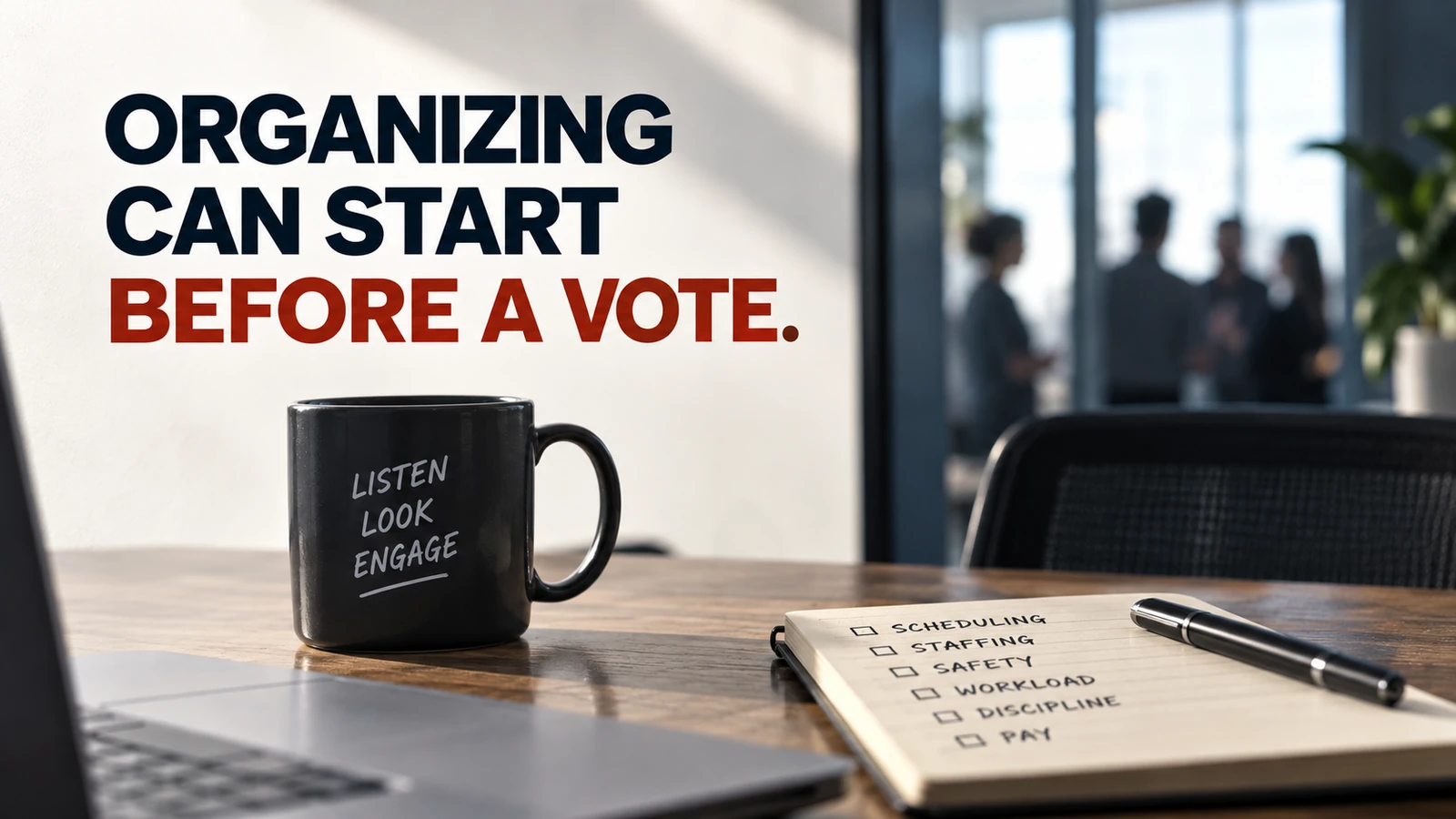
Scheduling. Staffing. Discipline. Safety. Workload. Pay. Supervisor behavior. Communication.


None automatically indicates union activity. But when problems remain unresolved, employees may begin addressing them collectively.

The new early-warning question for employers

That changes the early-warning question. Instead of asking:


Have we heard anything about a union?


Employers may need to ask:


Where are employees beginning to solve workplace problems collectively because they do not believe management will solve them?

Where pre-majority organizing stalls

Pre-majority organizing has limitations, and EWOC's guide acknowledges them. Without an election, bargaining process, or contract, maintaining momentum can be difficult. Turnover can reduce support. Leaders can burn out. Employees may become frustrated if organizing produces few tangible results.


The tradeoff is time.

Why the absence of an NLRB petition is not the absence of organizing

Without an election deadline driving the campaign, organizers can spend longer developing relationships, building support, and deciding whether or when to pursue recognition.


The idea is also circulating beyond EWOC. It is appearing on labor activist websites and in union-oriented Reddit communities.


For employers, the takeaway is straightforward. The absence of an NLRB petition does not necessarily mean the absence of organizing.


About Labor Relations INK

Labor Relations INK is published weekly and is edited by LRI Consulting Services, Inc. Feel free to pass this newsletter on to anyone you think might enjoy it. New subscribers can sign up by visiting here.


If you use content from this newsletter, please attribute it to LRI Consulting Services, Inc. and include our website: http://www.LRIonline.com 


Contributing editors for this issue: Greg Kittinger, Michael VanDervort, and Kimberly Ricci.


You are receiving this email because you subscribed to receive our labor relations newsletters and updates. You can manage your email preferences by clicking the link at the bottom of any of our email communications.


About LRI Consulting Services, Inc.

LRI Consulting Services, Inc. exists to help our clients thrive and become extraordinary workplaces. We improve the lives of working people by strengthening relationships with their leaders and each other. For over 40 years, LRI Consulting Services, Inc. has led the labor and employee relations industry, driven by our core values and our proven process, the LRI Way.


Share