Subject: LRI Ink: Happy 4th! Big Court Rulings Handed Down, AI and Organizing

July 1, 2026

To visit the blog post, click on the link below the article.

The Warning Signs are Public. Almost Nobody Reads Them.

by Kimberly Ricci

John and Cynthia, both regional leaders of national retail chains, are catching up at a local business networking event, when Cynthia asks John how he’s handling the increase of union organizing activity – if he’s checking in on his area locations or planning any communications to his employees. John is stunned – he has no idea what “increase” she’s referring to, and knowing what his company will think about being caught by surprise by a union petition, starts peppering her with questions.


By the time an RC petition shows up in your inbox, the campaign is months old.

Most employers get one thing wrong about organizing. They see the RC petition as the START of something. Today it's usually the END. Once a union gets to an election, that company is unionized nearly 8 out of 10 times.


Think about what that quiet, pre-petition phase looks like from the outside. Unions often run campaigns in waves, by sector and by region. The same organizers move from one employer to the next. When a distribution center nearby gets a petition, that's not just news about them. It's a signal about everyone in your labor market.

The trouble is that the signal is scattered. 

NLRB filings are public, but they land in a national database keyed to the filer, not to you. Nobody sends you an alert when an organizer starts working the employer down the highway. The activity that should function as your early-warning system (petitions, elections, and unfair labor practice charges happening in your area and your industry) sits in plain sight, unread, until one of them is yours.


The employers who handle organizing well aren't lucky. They're not necessarily better at running a campaign. They're proactive. They see the sector heating up. They've already trained their supervisors, tightened up their communication, and fixed the obvious grievances before anyone shows up passing out cards.


The companies who struggle are almost always the ones who got surprised — not because the warning signs weren't there, but because no one was watching for them.


You can't prepare for a campaign you don't know is coming. But you can watch the activity around you, and the window that gives you is the difference between leading the conversation and reacting to it.


See who's organizing near you →

The Supreme Court Overturned Humphrey’s Executor: What It Means For The NLRB

by Kimberly Ricci

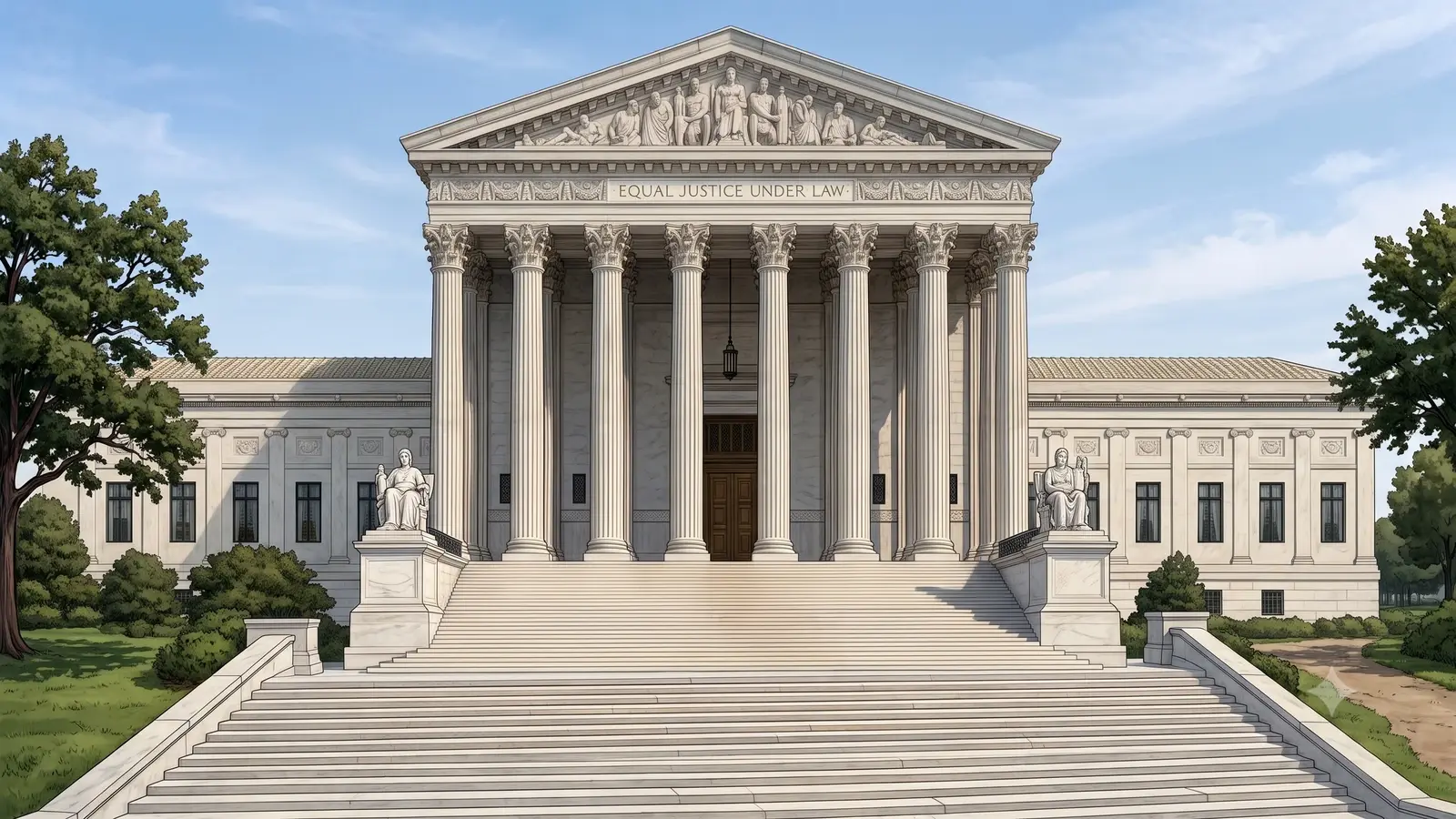
The Supreme Court has issued two major separation-of-powers decisions involving independent federal agencies. One case, Trump v. Slaughter, dismantles the removal protections that have kept federal agencies like the NLRB insulated from presidential control for almost a century. In the other case, Trump v. Cook, the Court carved out a narrow exception for the Federal Reserve.


Together, these cases suggest that the days of a truly independent National Labor Relations Board are finished. Gwynne Wilcox’s merry-go-round of removal, reinstatement, and removal could also finally be over.

Humphrey’s Executor Is Gone

For 91 years, Humphrey’s Executor v. United States provided certain protections for independent agencies. The Court had held that Congress could shield agency members from presidential removal without cause, at least when those agencies performed “quasi-legislative” and “quasi-judicial” functions rather than purely executive ones. This led to more stability for the NLRB, the FTC, and similar agencies.


Yet in Trump v. Slaughter, which concerns Trump’s firing of FTC commissioner Rebecca Slaughter, the Court overturned Humphrey’s Executor and held that the FTC’s for-cause removal protections are unconstitutional. In the majority opinion, Chief Justice Roberts wrote that when an agency “executes a congressional mandate against private parties, it exercises executive power — no ifs, ands, or quasis about it.”


Roberts was equally dismissive of Humphrey’s staying power while pointing out that the Court had applied it only once since 1935, and “since then, we have undermined Humphrey’s premises at every turn.” He concluded that Humphrey’s “would require us to depart from almost every case on the subject we have decided since” and that “no one knows how to apply Humphrey’s in practice.” The majority viewed that case as precedent that had already collapsed on its own.


Meanwhile, the NLRB carries out federal labor law against private parties. It processes unfair labor practice charges, handles representation elections, and issues binding orders upon employers. Under Slaughter, there’s no doubt that this is executive power.


Furthermore, Slaughter does not address the status of dismissed NLRB member Gwynne Wilcox, but Justice Sotomayor's dissent makes mention of how the Board received its own removal protections “[w]ithin weeks of Humphrey’s being decided.” Roberts specified that “our opinion today should not be read” to apply to other agencies, making it hard to see how NLRB member removal protections could survive this ruling.

The Federal Reserve Got A Carveout That The NLRB Did Not

In Trump v. Cook, the Court ruled that the Federal Reserve’s for-cause removal protection is constitutional, so member Lisa Cook gets to keep her job. Roberts explained the Fed’s protected status as owing to a “distinct historical tradition,” which goes back to the late 1700s and protects monetary policy from political interference.


Whereas the NLRB was created in 1935 to govern private-sector labor relations through the NLRA, so the Board simply can’t claim to have a historical tradition similar to the Federal Reserve.

What This Means for Gwynne Wilcox

Former NLRB member Wilcox has been in legal limbo since early 2025, when President Trump fired her without citing a reason. The Supreme Court issued a temporary stay in Trump v. Wilcox, which allowed her removal to stand during ongoing litigation about whether the NLRB’s statutory removal protection would stand.


Although the Supreme Court hasn’t explicitly answered that question with Slaughter, there does not appear to be a realistic path for Gwynne Wilcox’s reinstatement to the NLRB.

Instability Ahead For Employers

The Supreme Court’s rulings about at-will removal do more than address the current makeup of the FTC, NLRB, and other agencies that don’t have the Federal Reserve carveout. By eliminating removal protections, the Court has made it just as easy for a future Democratic administration to oust Board members.


So although the Federal Reserve gets to keep its independence, the NLRB does not. For that reason, employers cannot assume that complying with current Board policies will protect against future liability, or that labor law will hold steady. These rulings tell us nothing about what the current Board will do next and plenty about how unpredictable a future Board could be.


AI at Work Is Officially a Union Organizing Issue

by Michael VanDervort

What's in their feed: Artificial Intelligence (AI) at work has become an organizing issue, and it is showing up in different ways.

For a couple of years, AI in the workplace was an IT story and an efficiency story. Now it is a union organizing story. Two examples of that shift crossed my desk this week, and side by side they tell you where this is going.

The campaign: a face and a grievance

The first example is a call to sign a petition. It comes from United for Respect, a worker advocacy group, under the banner Tech for Respect. (The page is an advocacy campaign and the worker accounts on it are unverified.)


The featured employee is an overnight associate in North Spokane named Ava. She says a scheduling algorithm now runs her shifts, assigning eight hours of work in four, and that when she asks how the numbers get set, nobody can tell her.


They have a name for the issue: Robot Bosses. Set aside whether Ava's math checks out and look at the build instead. A real worker. A concrete grievance. A phrase that sticks. A pledge to sign. That is the oldest organizing formula there is, and it is pointed straight at AI. The complaint is the algorithm itself, the productivity tool the employer chose to implement.

The research: a script for the conversation

The second piece sits underneath campaigns like Ava's and hands them information and words for their argument. It comes from the Luddite Lab, a project of the Distributed Artificial Intelligence Research Institute (DAIR), a group by ex-Google people openly on a mission to help workers fight AI at work.


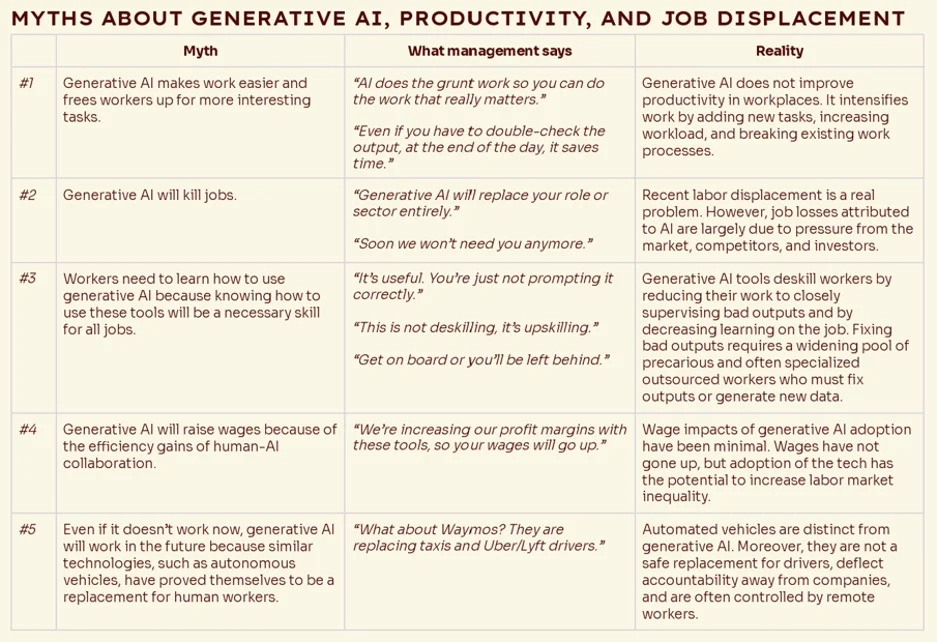
The method is simple and effective. They take the things management often says about how AI will affect the job, then walk through each one and reframe it as a myth. Here is the core of it:

From the Luddite Lab primer, “Myths About Generative AI, Productivity, and Job Displacement.”

Read the middle column again. Those are not strawmen. They are the lines that a lot of us might use and mean sincerely when walking a team through a new tool implementation. The primer reframes each as a myth to be punctured, and the answers in the third column are doing legit argumentative work, but they lean into the fear factor. Job losses get pinned on market greed. Productivity gains are waved off as hype. Each rebuttal picks the reading that is least flattering to the employer and presents it as a settled fact.


The management lines are not dishonest, but they have been cast as the villain and play on employee concerns with an eye towards organizing. (Read the whole thing: full version, executive summary.)

Why the two together matter

The campaign brings the face and the feeling, Ava and her Robot Boss. The research brings the language and the rebuttals. So, the worker who walks in angry about the algorithm now walks in with an answer ready for whatever reassurance you have prepared.


And the grievance they picked is shrewd. Control over implementation: who decides which technology runs the floor. Watch for organizing in shops without a union. If you have a union, expect a union request for a worker-led technology committee, seeking a joint say in how and which tools are deployed and language in the contract.

What you do about it

Almost none of this gets won with a rebuttal memo. Some of what the worker side says is just true, and the employer who denies that reality risks forfeiting credibility on the rest.


You earn worker credibility most effectively by being transparent. Explain the impact of technology in plain language, to the people working under it.

Listen to your own rollout language and ask, honestly, whether it sounds like their script. Get ahead of the control question before it shows up as a demand or a campaign.


Read the case studies on the Luddite Lab site. They make three key arguments:

  1. The fight begins long before the bargaining agreement and does not end when it is signed.

  2. It's about AI, but it's not about AI.

  3. It's about bringing back control and oversight to workers.

Let's keep this going

This is the heart of the session Patricia Garland and I are hosting July 15, AI and Trust in Labor Relations, inside the empowER™ community, the free peer employee relations network run by HR Acuity, where I run the labor relations forum. Join at hracuity.com/empower-community; session details and RSVP are here. Please join us.


The Seven Red Flags of Collective Bargaining

by Michael VanDervort

In this episode of the Left of Boom Show, host Phil Wilson sits down with Doug Hessinger, aka "Data Doug" a veteran labor and employee relations professional with over two decades of experience across retail, distribution, and financial tech services, to discuss red flags employers should be aware of during collective bargaining.


Hessinger draws on his time as a labor relations department of one, managing six represented units across the US and Canada, to share hard-won lessons on contract administration, building relationships with union reps and frontline supervisors, and spotting the contract clauses most likely to cause headaches down the road.


Whether you're new to a unionized environment or a seasoned pro, this episode is packed with practical, real-world guidance.


Topics
00:03 -- Introduction to Labor Relations and Contract Administration
02:14 -- Navigating Unionized Environments
06:05 -- Building Relationships with Unions and Management
11:52 -- Understanding Contract Language and Administration
13:17 -- Common Pitfalls in Contract Management
17:38 -- The Importance of Proactive Communication
24:35 -- Red Flag Clauses to Watch Out For
33:53 -- Key Takeaways for Labor Relations Professionals


The DOL's New Form Aimed At Union Corruption Survived A Legal Challenge

by Kimberly Ricci

We do enjoy reporting on union corruption--see those recent Boilermakers convictions. However, we truly don't like seeing Big Labor taking members' hard-earned dues money and spending it on luxury goods and travel. So it was welcome news that the Department of Labor, now led by Acting Secretary (and nominee) Keith Sonderling, decided that union financials should meet higher accountability standards. To meet that goal, the DOL issued a final rule requiring the Long LM-2 form for those labor organizations taking in $40 million or more in annual receipts.


The new LM-2 form will feature 32 schedules, up from 24, and strict itemization including more scrutiny of travel costs and the like. Also crucially, the Representational Activities category will contain separate schedules for organizing campaigns and contract administration, so unions can't simply state vague total amounts without explanation.


Unsurprisingly, the AFL-CIO expressed its displeasure while accusing the DOL of "blindsiding" unions and violating the Administrative Procedures Act by not providing a notice and comment period. A federal judge disagreed.


In the U.S. District Court for D.C., Chief Judge James E. Boasberg declined to issue an injunction and found that the AFL-CIO failed to show “irreparable injury” from this new form. Further, "[a]s Plaintiff concedes, the only injury that the effective date will inflict is the burden of later recoding payments that it enters using its current software." Boasberg added that a lengthier opinion would be forthcoming.


The DOL's new Long LM-2 form will be effective on July 1, 2026 with first filings due on June 30, 2027. This is the first substantial LM-2 form revision since 2003. Given that OLMS used LM data to convict 255 individuals for fraud and embezzlement between 2021 and 2025, the rule suggests Sonderling's DOL won't be going easy on union financials.


Friday Five: Shawn Fain Feels The Heat, And A Pharmacy Guild Founder Feels Rejection

by Kimberly Ricci

A Pharmacy Guild-related non-mystery:

A Pharmacy Guild co-founder, Shane Jerominski, recently took to his “Accidental Pharmacist” Facebook page with a telling revelation. Recently, he “almost got a normal pharmacist job again,” which suggests that he was scoping out chain pharmacies that he has a habit of regularly trashing.


Well, Jerominski went through the interview phases and received an offer that was later rescinded, and he theorized that since “this company is partially unionized,” maybe “they figured hiring me might inspire the rest of their locations to organize.” He further imagined it could be related to a “public letter of reprimand” housed by the Board of Pharmacy website, although he insists that “I had nothing to do with those issues.”


Ultimately, Jerominski didn’t reveal where that offer came from, but it sounds like he’s sticking with his indie pharmacy job, and perhaps his next stand-up comedy show will include more theories on why he wasn’t hired by a company that he likely railed against. This sounds like a common sense decision on an employer’s part, regardless of whether any union discussion was involved.

The UAW monitor’s newest report is impeccably timed:

Earlier this week, we looked at union President Shawn Fain’s most prominent challenger, Rich Boyer, who revealed that Fain won’t talk to him after federal monitor Neil Barofsky ordered Boyer’s reinstatement. Well, Barofsky just dropped his latest report, which happens to detail his investigative findings about Fain’s removal of Boyer after he refused to approve questionable spending requests tied to Fain’s fiancée.


The new 51-page report leaves no doubt from Barofsky that Fain’s removal of Boyer was not only “retaliatory” but part of Fain’s “pattern” of retaliatory conduct “that should be familiar” (to the U.S. district court in Michigan that’s receiving these reports) since this dismissal is similar to Fain’s retaliatory conduct in ousting Secretary-Treasurer Margaret Mock. In other words, this isn’t over for Fain as he attempts to cruise through union election season. We have our popcorn ready for more.

Meanwhile, the other Sean is having a better month:

What happens in Vegas with the Teamsters, did not stay in Vegas. Last week, Sean O’Brien secured enough delegate support to remain union president without an election. While in Sin City, O’Brien spoke with the New York Times about the union’s recent proposal to the Justice Department for ending their government monitoring after 35 years.


O’Brien brushed off talk of his union’s previous mob ties while calling himself “an alpha personality” but insisted, “I do have a tremendous amount of integrity.” He also believes that his reelection is evidence of his “inclusive and transparent” treatment of union members, but this likely has more to do with O’Brien managing to sway some GOP senators into supporting the Faster Labor Contracts Act.


O’Brien is benefiting from that “celebrity”-type attention now, but if the FLCA passes in the Senate, workers will find out that putting contracts in the hands of arbitrators is good for no one, other than Sean O’Brien.

An ongoing push for gig driver unionization in California:

Last year, California Gov. Gavin Newsom signed legislation that gave 800,000 rideshare drivers a path to unionize. The effort to organize gig drivers went quicker in Minnesota, where the Machinists and SEIU recently announced their so-called “App Drivers union,” which won’t change the drivers’ classification as independent contractors but will push them into life under a union constitution. How long that lasts before these drivers feel buyers’ remorse remains to be seen, but the California effort persists.


The SEIU-affiliated California Gig Workers’ Union has reached 10% support of active drivers in the state, and if they reach 30%, then the organization can petition California’s Public Employee Relations Board to certify the union without winning election. As Littler attorney Alex MacDonald recently pointed out about the Minnesota-based union, the term “active driver” is dicey and something that unions are allowed to work to their advantage in these states and tie drivers into membership without gaining nearly as much support as the unions claim.

Somehow, there’s more Sixth Circuit news on Cemex:

There’s little doubt that the Abruzzo-era’s draconian Cemex decision will be overturned by the NLRB after James Macy is confirmed as the third GOP member. However, it might be a while before that happens because a relevant case will need to come before the Board, and until that time, Cemex cases are still bouncing around federal appeals courts.


This week, the Sixth Circuit rejected the Board’s petition for an en banc hearing following the court’s finding that the NLRB should have engaged in notice-and-comment rulemaking when pursuing its Cemex framework for bargaining orders. Instead, as the Sixth Circuit found, the Abruzzo-era Board “exceeded its adjudicatory authority” while putting a punitive standard into place against employers. Accordingly, the Sixth Circuit declined to enforce a Cemex bargaining order.


A court declining to enforce bargaining orders is a positive result for employers. Yet buried in this discussion is how the current NLRB--as revealed in its en banc petition to the Sixth Circuit--is concerned that Cemex pushback could lead to the Board being confined only to notice-and-comment rulemaking. To that point, the Board argued that the Sixth Circuit majority opinion is “improperly impinging on the Board’s adjudicative authority, the primary procedure it uses to announce policies under the” NLRA. That was also the argument taken by the Sixth Circuit dissent.


This is getting tricky for the Board. Granted, placing clearer limits on the Board’s ability to adjudicate would also be a positive outcome for employers with a left-leaning Board. However, the current Board has taken a more business-friendly stance, so right now, there’s not much danger of these members going rogue against employers like the Abruzzo board did.


Ultimately, Cemex has led to a circuit split and consequences for the Board that stretch well beyond the issue of bargaining orders. The Board is also seeing its very existence questioned by other court cases, so it’s safe to say that the current NLRB members are having some headaches. And overall, the Abruzzo Board’s legacy sure is a messy one.

About Labor Relations INK

Labor Relations INK is published weekly and is edited by LRI Consulting Services, Inc. Feel free to pass this newsletter on to anyone you think might enjoy it. New subscribers can sign up by visiting here.


If you use content from this newsletter, please attribute it to LRI Consulting Services, Inc. and include our website: http://www.LRIonline.com 


Contributing editors for this issue: Greg Kittinger, Michael VanDervort, and Kimberly Ricci.


You are receiving this email because you subscribed to receive our labor relations newsletters and updates. You can manage your email preferences by clicking the link at the bottom of any of our email communications.


About LRI Consulting Services, Inc.

LRI Consulting Services, Inc. exists to help our clients thrive and become extraordinary workplaces. We improve the lives of working people by strengthening relationships with their leaders and each other. For over 40 years, LRI Consulting Services, Inc. has led the labor and employee relations industry, driven by our core values and our proven process, the LRI Way.


Share