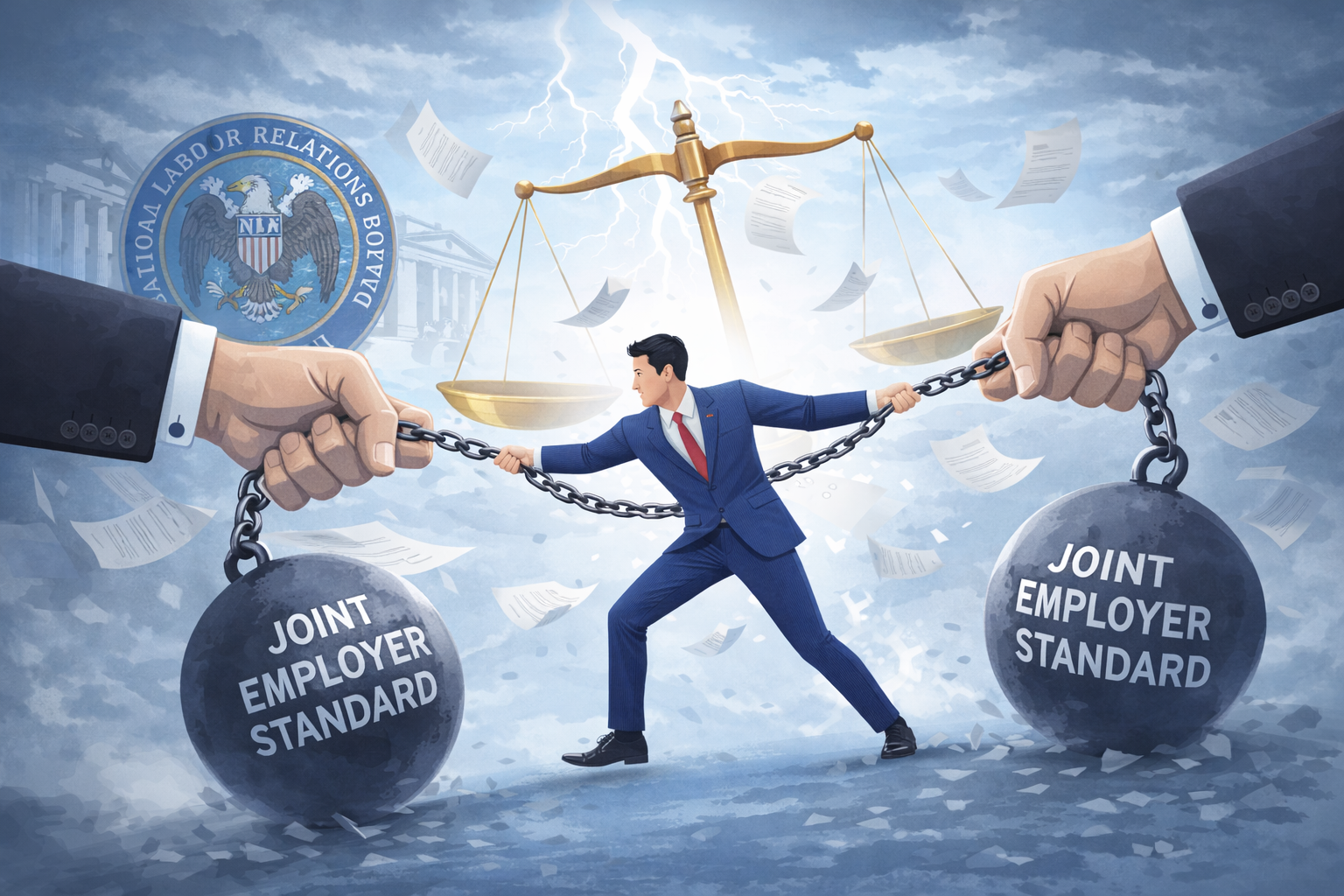
If joint-employer law feels like a bad rerun you never asked for, you are not imagining it.
Last week, the National Labor Relations Board issued yet another decision in the case that refuses to fade out: Browning-Ferris Industries and Leadpoint Business Services, formally docketed as Case 32-CA-160759.
This was not a policy flex. It was not a regulatory reset. It was compliance.
What actually happened
Following instructions from the U.S. Court of Appeals for the D.C. Circuit, the Board reaffirmed that Browning-Ferris Industries was a joint employer of workers supplied by Leadpoint at its California recycling facility.
Why? Because the court told the Board to apply the Browning-Ferris framework on remand. Full stop.
That framework allows joint-employer status to be found based on reserved authority or indirect control over essential terms and conditions of employment. The Board did not voluntarily revive this standard. It applied it as the law of the case.
Why this case still matters
This is the case that blew the joint-employer door open in 2015. It is also the case that has been appealed, reversed, rewritten, narrowed, expanded, and remanded more times than most HR teams care to count.
The result is a decade-long reminder that joint-employer exposure is not governed solely by the rule currently posted on the Board’s website. It is shaped by the courts, the facts, and the procedural posture.
Even when the Board changes direction, old cases stay alive.
What this decision does not do
This decision does not replace the 2020 joint-employer rule as the Board’s general standard. Outside this case, the current formal regulation still applies.
But pretending this decision is irrelevant would be a mistake.
When the Board is forced to apply a broader test in the most famous joint-employer case on the books, employers should take note. Courts can and will require a different analysis when the facts demand it.
The practical lesson for employers
If your organization relies on staffing agencies, contractors, franchise relationships, or layered employment models, this decision is not academic.
Joint-employer risk does not hinge only on daily supervision. It turns on contract language, reserved rights, operational influence, and how much control you keep in your back pocket, even if you swear you never use it.
This case is a reminder that “we do not exercise that authority” is not the same thing as “we do not have it.”
Bottom line
Browning-Ferris never really left. It got complicated. It picked up a lot of procedural baggage.
But as this decision shows, the broader joint-employer theory is still very much in play when courts are involved. Employers who assume the issue is settled are betting against a case that has already outlived multiple Boards, multiple rules, and multiple political cycles.
History suggests that it is not a great bet.
Quick Update (2/26/20260): The 2020 Joint-Employer Rule Is Back
Separately from the Browning-Ferris litigation, the National Labor Relations Board has formally reinstated its 2020 joint-employer rule after a federal court vacated the Biden-era 2023 standard.
The move is procedural. Because the 2023 rule was struck down before taking effect, the Board restored the prior regulation as the operative standard.
Bottom line: under the 2020 rule, joint-employer status requires substantial direct and immediate control over essential terms of employment. Indirect or unexercised authority alone is not enough.