Subject: LRI INK | The Ground Is Shifting: Corruption, Strikes, New Union $, and a Court That Blinked

April 23, 2026

To visit the blog post, click on the link below the article.

Big Labor's New Strike Fund Is Open for Business: A Glimpse Inside 'Union Now'

by Kimberly Ricci

Make no mistake, Big Labor is fully aware that union density has been on the downswing for years, so unions have been doing what they can to try to stay relevant by employing new strategies. They’ve been attempting cross-sector organizing and sectoral bargaining, and whether those approaches work out for them remains to be seen. Yet in the meantime, unions will always enjoy seeking political cover from lawmakers.


That’s precisely what is happening with “Union Now,” a new nonprofit launched in early April. This organization professes to make it cheaper and easier for workers to organize and go on strike by establishing a centralized strike fund. Employers will want to pay attention to what could come next.

What This Organization Wants To Do

Union Now has been described as the “brainchild” of Association of Flight Attendants-CWA International President Sara Nelson, who introduced the organization during an April 12 rally showcasing Senator Bernie Sanders and NYC Mayor Zohran Mamdani. The event’s planners claimed to have attracted a crowd full of workers from union-targeted progressive brands like Starbucks, REI, and Whole Foods.


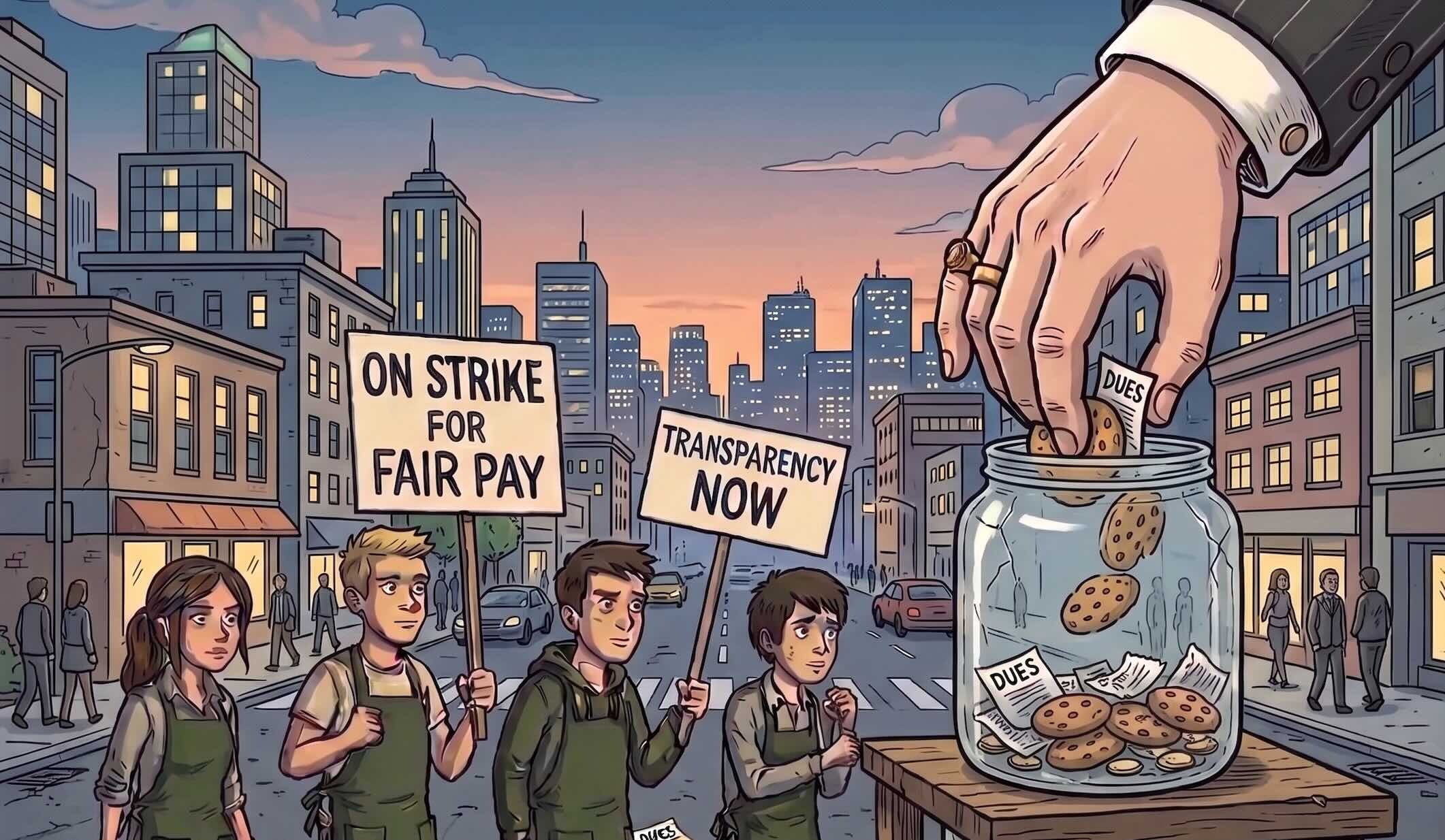
The Union Now mission statement stresses building relationships among unions to share funds and tactical support during major campaigns against large employers. Naturally, the organization is soliciting donations, which they claim will support striking workers, although we can predict what will happen there since Big Labor can't keep their hands out of the cookie jar, and workers might not ever see any of that money.


Nonetheless, employers and labor relations professionals should take note of Union Now’s political backing and its co-founders.

The Names Behind The Organization

First, Sanders and Mamdani are two avowed socialist officials who have openly criticized Starbucks and joined the coffeehouse giant’s workers on the picket lines. Their involvement signals that Union Now intends to draw funding from the progressive political donor universe, which also includes a relationship with Emergency Workplace Organizing Committee, a volunteer network affiliated with the Democratic Socialists of America and United Electrical, Radio and Machine Workers of America.


Secondly, Union Now’s co-founders include not only Nelson but also former AFL-CIO organizing director Richard Bensinger, an early face behind the Starbucks Workers United campaign, and Jon Hiatt, ex-general counsel of the AFL-CIO.


Then there’s a voice with “no formal role” in the organization: Hamilton Nolan, a journalist who publishes pro-Labor articles on Substack and progressive outlets, including In These Times. His pre-launch promotional piece reads more like a fundraising pitch (“We gotta find a way to pay for it. We are growing the pie, baby”) than journalism, although he insists that he’s only “been helping informally with getting Union Now off the ground.”

Much Remains Unknown

Union Now is being deliberate with its targets. By naming Starbucks, Delta, and REI as early priority campaigns, the group is signaling that it aims for long-running, high-visibility campaigns in which employers have already faced sustained pressure from unions.


The organization is four to six weeks into its initial fundraising round, so it’s far too soon to say how deep their pockets will run or how quickly they can divert funds to mobilize organizing campaigns and strikes. For employers in retail, food service, and aviation, the correct time to assess union vulnerability is before Union Now has its footing, not after.


The Ninth Circuit Finally Returned To Cemex... And Punted

by Kimberly Ricci

The time finally arrived for the Ninth Circuit to weigh in on the Biden Board's most aggressive standard. They punted. Yet before we discuss the appeals court’s ruling in Cemex Construction Materials Pacific, LLC v. NLRB, we need to retrace how that standard emerged and the fallout.

The Procedural Path Of A Disruptive Standard

In 2023, the Abruzzo Board’s Cemex decision repudiated the Supreme Court’s 1969 Gissel ruling, putting businesses at risk of a bargaining order over a single ULP charge, even in cases where unions lost an election. At that time, our own Phil Wilson called the Board’s move “a ‘prior restraint’ on employer speech.” Indeed, the Cemex framework sharply contrasts with the Gissel standard, which favor issuing bargaining orders only for extreme employer conduct.


Naturally, multiple court disputes have followed. In March 2026, the Sixth Circuit declined to enforce a Cemex bargaining order in Brown-Forman Corporation v. NLRB and remanded the case for review at the NLRB. Although those judges agreed with the Board’s fact finding regarding ULPs, the Sixth Circuit judges seemed “leery” of using Cemex in a case involving a whiskey-maker’s conduct during a Teamsters election. Ultimately, the court determined that the Board “exceeded its adjudicatory authority” and remanded the case for review at the NLRB.


More recently, in St. John’s College, the Board determined that Cemex’s timeliness rule does not apply to RM petitions, a procedural carve-out that benefits employers seeking to test majority status.


It would seem that more Cemex dominoes were poised to fall, but that didn’t happen with the Ninth Circuit, which handled the employer’s appeal of the pivotal NLRB decision.

Cemex Construction Materials Pacific, LLC v. NLRB

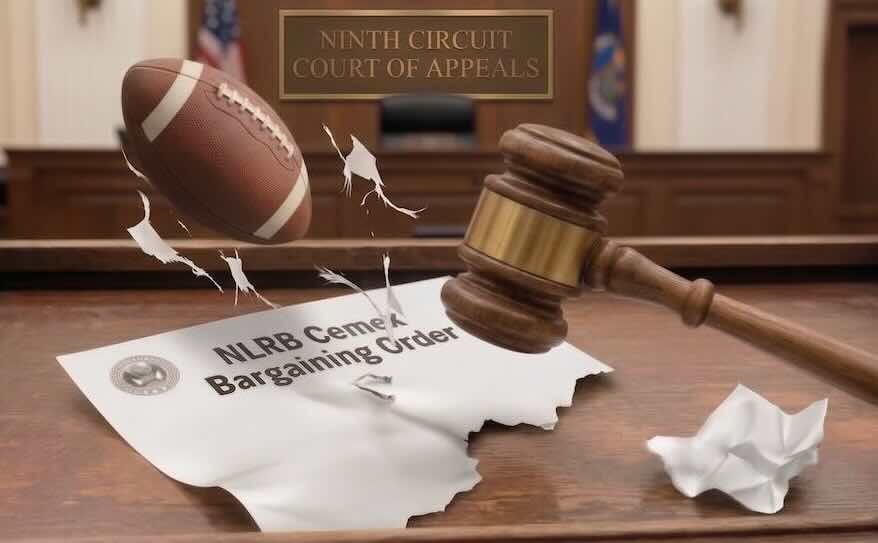
In Oct. 2024, the Ninth Circuit heard oral arguments in this case (also involving an election lost by the Teamsters) and took no further action until this week, when the Ninth Circuit sidestepped the Cemex doctrine and affirmed the Board’s bargaining order under Gissel.


This ruling is “not surprising,” declared Wilson, but “disappointing because the majority completely glosses over both the argument from the dissent and the opportunity to address the recent decision in Brown-Forman.”


Wilson called Judge Richard Clifton's dissent "a great job of explaining why Cemex was so poorly reasoned in the first place." The Board's bargaining order, Wilson noted, rested on a factual finding that never appeared in the ALJ's opinion. The Board "grabbed the word 'slight' out of context" to claim the ALJ had found the chances for a free and fair election were slim. That’s a conclusion that the ALJ explicitly rejected, which is why no bargaining order came out of the original proceeding.


Indeed, Judge Clifton declared that the Abruzzo Board “was prepared to change the rules and applied the new standard to the facts of this case retroactively in order to reach the same result that it had already reached.” Clifton would have preferred to remand to the Board. “Changing the rules in the middle of a game,” he wrote, “implied recognition that the goal could not properly be reached otherwise.”


Wilson also faulted the majority for failing to address the potential circuit conflict with Brown-Forman. “I'm hoping that there is a request for rehearing for this exact reason,” he said.

The Clean-Up To Come

Elsewhere, the D.C. Circuit has yet to rule on pending Cemex litigation in NP Red Rock LLC vs. NLRB with those judges signaling their willingness to apply Gissel rather than Cemex to issue a bargaining order in a case involving a Las Vegas casino.


As for where the current, employer-friendly NLRB stands, look for Cemex to be up for review after Board nominee James Macy is confirmed, which will give the Board a third vote to overturn precedent. Yet the timing of that process will depend on whether a suitable case reaches the Board.


Employers should know that Gissel bargaining orders remain a risk where ULPs occur during organizing campaigns, although re-run elections are the likelier remedy. If Cemex goes away entirely, that's a net win for employer free speech.


The Third Vote Is Coming: Which Cases Are Likely To Be Overturned By The NLRB's Shifting Majority?

by Kimberly Ricci

Labor relations watchers breathed a little easier when NLRB regained quorum. This set up now-Chair James Murphy, new member Scott Mayer, and continuing member David Prouty to hit the ground running in January, and that has been happening. The Board disposed of countless Ex-Cell-O cases after reaffirming that 1970s standard, and the three current members have been chipping away at their backlog. Yet they’ve also been “stuck” in many ways due to lacking a third GOP vote.


That’s about to change.


On April 13, President Trump nominated another member, James Macy, who has four decades of management-side labor and employment law experience under his belt. His confirmation will give the GOP a 3-1 majority, which is necessary to satisfy the Board’s tradition of reversing precedent. The door will then be open for certain Biden-era decisions to begin falling in favor of more employer-friendly versions.


Let’s look at what is likely on that table.

Organizing And Elections

Cemex Construction Materials Pacific: This aggressive Biden-era decision repudiated the Supreme Court’s 1969 Gissel ruling. It was a move intended to chill employer speech during campaigns and put employers at risk of a bargaining order based on a single ULP charge. Recently, the Sixth Circuit declined to enforce a Cemex bargaining order on the grounds that the Board “exceeded its adjudicatory authority,” and the Board determined that Cemex’s timeliness rule does not apply to employers filing RM petitions. Surely, Murphy and Mayer want to make the final Cemex domino fall.


American Steel Construction: As our own Phil Wilson wrote in 2023, the Board issued this decision to “let unions cherry pick a bargaining unit out of any group of employees” and essentially rig unions’ election success by using “micro-units.” Additionally, the Board unfairly burdened employers with proving that other employees belonged in the unit.


Siren Retail Corp. d/b/a Starbucks: In this case, the Biden Board did its best to redefine employer speech by overturning 1985’s Tri-Cast, Inc. This eliminated a safe harbor, allowing employers to openly discuss how unionization changes the employer-employee relationship and inform workers about the realities of union representation.

Handbooks, Severance, Discipline, And Remedies

Stericycle: This case revamped the framework employers had relied on for years with a standard that puts virtually any workplace rule at risk if it could be interpreted as an attempt to prevent protected activity. Recently, General Counsel Crystal Carey’s GC 26-03 guidance memo instructed NLRB regional offices to stop scouring entire handbooks with that goal. Yet it’s up to the Board to issue a decision to solidify that guidance.


Thryv: This groundbreaking case expanded the Board's remedial authority well beyond traditional boundaries in favor of “make whole” remedies, which led to a standard so broad and speculative that there was no clear limit on causation. Recently in Lodi Volunteer Ambulance Rescue Squad, Murphy and Mayer refrained from weighing the legality of these remedies, but a third member will make reconsideration of this case possible.


McLaren Macomb: Earlier this month in Prime Communications, LP, Murphy and Mayer signaled that they were “open to reconsideration” of relevant Biden-era precedent in a “future appropriate proceeding.” At that time, they declined to enforce McLaren Macomb, which bans severance agreements that could be interpreted as restrictive or overly broad.


Lion Elastomers: In this case, the Board effectively told employers to tolerate certain types of misconduct if it could fall under the umbrella of protected activity. Threats and harassment that would get anyone fired on an ordinary workday became a gray area if related to a labor dispute.

Employers, The Third Vote Changes Everything

Every one of the above decisions remains enforceable law today. However, employers can expect to see significant changes for standards on micro-units, handbooks, severance agreements, and employer reactions to organizing campaigns. This process will take months, possibly years, and depend on relevant cases working their way through the NLRB's docket. Yet the third vote is almost here.


Friday 5: Corruption Scrutiny, First Contracts, And Strike Threats From Coast to Coast 

by Michael VanDervort

A UAW member has a question for the federal monitor:

We recently had fun with the UAW’s 2025 financial disclosure (LM-2) form, which illustrated the union’s high cost of corruption. In one year alone, the union wrote $7.06 million in checks to federal watchdog Neil Barofsky’s law firm, Jenner & Block, which contributed to a total cost of around $25 million over five years. Overall, Barofsky’s reports have painted an embarrassing portrait of foul-mouthed international President Shawn Fain, who has fostered a culture of retaliation and fear among his own staffers.


What about badly behaving local officers, though? One retired member, Rick Michael, asked that question of a federal court, particularly in light of Local 6000, where President Rachael Dickenson has been accused of firing several leaders via "a pattern of discrimination towards minority women." Michael’s argument is that $7 million in member dues is a steep price for a monitor, so he’d like to see some of that attention paid locally.


Local 6000, based in Lansing, Michigan, is currently under audit proceedings, so this story will likely have more chapters to come.

Another union contract in the hard-to-crack architecture sector:

In 2022, NYC-based architects at Bernheimer Architecture became the first to unionize at a private firm in their sector. Those who wondered if this would become a trend only saw one other firm, Sage & Coombe (in NYC), also join Architectural Workers United (AWU) under IAM in 2023.

Three years later, the Sage & Coombe unit has ratified a contract after what the union characterized as “countless hours” organizing and bargaining. This news is also more proof that first contracts are hard, and they can be processes that lead to buyers’ remorse regarding what unions falsely promise that they can achieve at the bargaining table. As of now, the terms of the architects’ CBA have not been publicly revealed, although the union did make clear that it was unanimously ratified.

Healthcare workers at University of California are set to strike:

Last week, word dropped that UC averted a strike of 40,000 graduate student workers when they ratified a new UAW contract. However, the university’s medical centers, research facilities, and dining halls are now facing a strike by 42,000 AFSCME members who authorized an open-ended strike scheduled to begin on May 14.


This contract expired two years ago for medical assistants, respiratory therapists, various tech roles, and food service workers with housing allowances being a sticking point. However, a UC representative told Becker’s Hospital Review that the university’s most recent proposal pushed wage boosts from 25% to 32.3% with a $1,000 ratification bonus.


Additionally, the LA Times revealed that this proposal would push senior custodians from $70,789 up to $89,021 by 2029 and lab technicians that currently earn $88,200 up to $111,140. Clearly, those are substantial increases, and the two sides have another three weeks to work this out.

A collision of contract disputes could lead to a Big Apple mess:

On tax day, 32BJ SEIU announced on social media that around 34,000 NYC doormen and maintenance workers authorized a strike ahead of their April 20 contract expiration date. Bargaining continues with Bloomberg reporting that 3,500 residential buildings could see services disappear overnight if the two sides can’t agree on healthcare and pension details.


Meanwhile, two other contract disputes are causing a stir in the NYC area with May 16 being an important date. That’s when Long Island Rail Road workers, who are members of the Brotherhood of Locomotive Engineers and Trainmen, could go on strike. Additionally, that’s the date when the bus and subway employees’ Transport Workers Union contract expires.


All of this is happening shortly after the NYC City Council began its push for a $30 minimum wage by 2030. The Big Apple has always been an expensive place to live, and it could soon become an even harder place for employers to stay in business.

Why will the next WGA contract run longer than usual?

Earlier this month, a Hollywood surprise suggested there likely won’t be a repeat of the 148-day 2023 writers' strike due to WGA and AMPTP quickly reaching a tentative deal at the bargaining table. Although the deal remains shrouded in secrecy pending ratification, it was revealed that this deal will run four years long, rather than the customary three.


What happened? A trade publication noted that the WGA was against the longer term, but this was a concession made in exchange for the AMPTP agreeing to “shore up the health plan,” which has lost “$200 million in four years.” This is an example of how bargaining can be effective sometimes, if parties agree to tradeoffs, but this is also where it gets more complicated for the WGA in the future.


Healthcare costs are rising, but the union plan’s issues surely have something to do with the WGA releasing members from paying percentage-based dues during times when they’re not working. And unfortunately for members, the 148-day strike left the TV landscape with fewer jobs, which has compounded the difficulty of supporting a health plan when not as many members are paying dues. In other words, the WGA’s bylaws might need adjusting, which will also present issues.


Additionally, word on the Hollywood street is that some WGA members have made it known that they're voting against the deal. Stay tuned.


About Labor Relations INK

Labor Relations INK is published weekly and is edited by LRI Consulting Services, Inc. Feel free to pass this newsletter on to anyone you think might enjoy it. New subscribers can sign up by visiting here.


If you use content from this newsletter, please attribute it to LRI Consulting Services, Inc. and include our website: http://www.LRIonline.com 


Contributing editors for this issue: Greg Kittinger, Michael VanDervort, and Kimberly Ricci.


You are receiving this email because you subscribed to receive our labor relations newsletters and updates. You can manage your email preferences by clicking the link at the bottom of any of our email communications.


About LRI Consulting Services, Inc.

LRI Consulting Services, Inc. exists to help our clients thrive and become extraordinary workplaces. We improve the lives of working people by strengthening relationships with their leaders and each other. For over 40 years, LRI Consulting Services, Inc. has led the labor and employee relations industry, driven by our core values and our proven process, the LRI Way.


Share