Subject: LRI INK: Strikes, Corruption, and a Union Blocking Its Own Members

April 9, 2026

To visit the blog post, click on the link below the article.

The High Cost of UAW Corruption Keeps Going Up, And More Financial Findings From The Union’s LM-2

by Kimberly Ricci

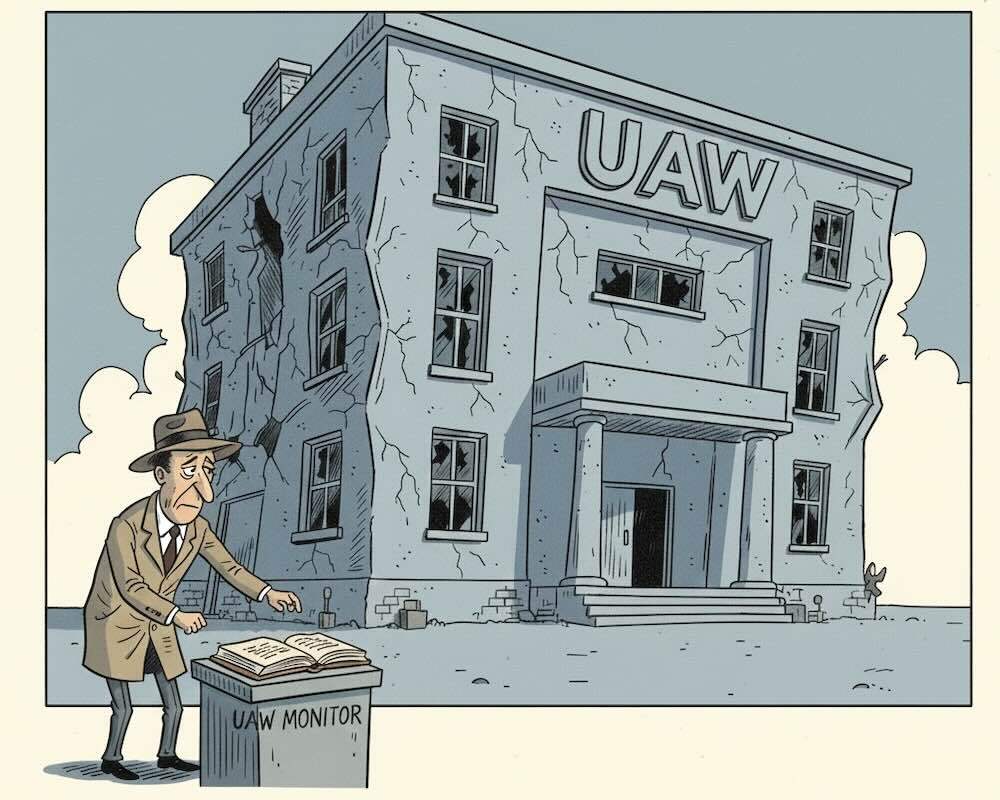
One would be hard-pressed to pinpoint the precise moment when UAW corruption began, but the official clean-up attempt started five years ago. In 2021, Neil Barofsky began a six-year term as the union’s federal monitor with the onerous task of prodding the union toward legitimacy. What has transpired since then is almost a spectator sport, given a dozen monitor reports that painted President Shawn Fain as a fear-inducing leader who makes his own staffers cry and retaliates against those who don’t fall in line with his expenditure demands.


Barofsky was installed as a direct consequence of the UAW corruption scandal, which resulted in the convictions of more than a dozen union officials, including former President Gary Jones and former Vice President Norwood Jewell. We won’t know the monitor’s final recommendations until at least May 2027, but the cost has been mounting, and members are footing the bill through dues payments. The union’s newly released 2025 LM-2, filed with the Department of Labor, tells that tale and much more.

The Federal Monitor’s Price Tag

The U.S. government requires the UAW to pay for its oversight costs as established in the union's Consent Decree with the DOJ. In 2025, that added up to $8.3 million on monitor-related costs, including $7.06 million paid to Barofsky’s law firm, Jenner & Block, where he co-chairs the Monitorship Practice.


Other monitor-related costs included payments totaling $666,252 to risk-management consulting firm StoneTurn Group and $651,936 for data storage services from KLDiscovery. As the Detroit News further notes, the $7.06 million brings the five-year total to over $25 million.

Officer Salaries

In 2025, Fain took home $276,378 in total compensation, including his $245,390 salary. Sure, the UAW chief isn’t the wealthiest union leader out there–SAG-AFTRA National Executive Director Duncan Crabtree-Ireland famously took home over $1 million in 2024–but Fain’s 2025 base salary is comparable to Sean O’Brien’s $258,983 in 2025.

And if you’re wondering how many “Eat The Rich” t-shirts that Fain could buy with his salary, you’re not alone!


Additionally, Schedule 11 of the LM-2 further reveals that 13 of the UAW's 15 listed officers received gross officer disbursements of $200,000 or more, totaling over $3.3 million in gross compensation.

Spending outpaced revenue

The LM-2 reveals that the UAW took in $294.4 million in total receipts and spent $298.8 million. That signals negative operating cash despite the union also reporting $1.2 billion in net assets.


Separately, last year, two members of the Senate HELP Committee asked why the union offloaded $340 million in stocks to cover strike benefits in recent years. Then again, this wouldn’t be the first time that the UAW’s financials have raised questions, which isn’t a good look for a union with an extensive history of embezzlement and other forms of corruption.

Strike Benefits

The union paid $8.5 million in strike benefits during 2025, roughly the same amount it spent on federal oversight of its own leadership. These payments covered multiple disputes, including a three-week strike on GE Aerospace and a month-long counterpart at Lockheed Martin. However, the LM-2 further reveals that reimbursements for 2023 strikes against Big Three automakers were also included in the total.

The writing on the corrupted wall

The UAW’s full LM-2 spans 330 pages, but what stands out most clearly is how the union’s 2025 monitor costs ($8.3 million) are nearly equal to strike benefits costs ($8.5 million). That’s a stark illustration of how the union’s resources, funded by members, are being redirected to investigate those claiming to represent workers’ interests.

When the Union Becomes the Problem: What the UPS Driver Choice Program Dispute Reveals

by Michael VanDervort

Most labor disputes follow a familiar script: management pushes, the union resists, and the fight plays out across bargaining tables, grievances, or worse. This one changed the script.


During the recent UPS/IBT dispute over the Driver Choice Program, the tension wasn’t just between the company and the Teamsters. It also played out between union leadership and its own members, which could create future issues for the IBT.

What Happened

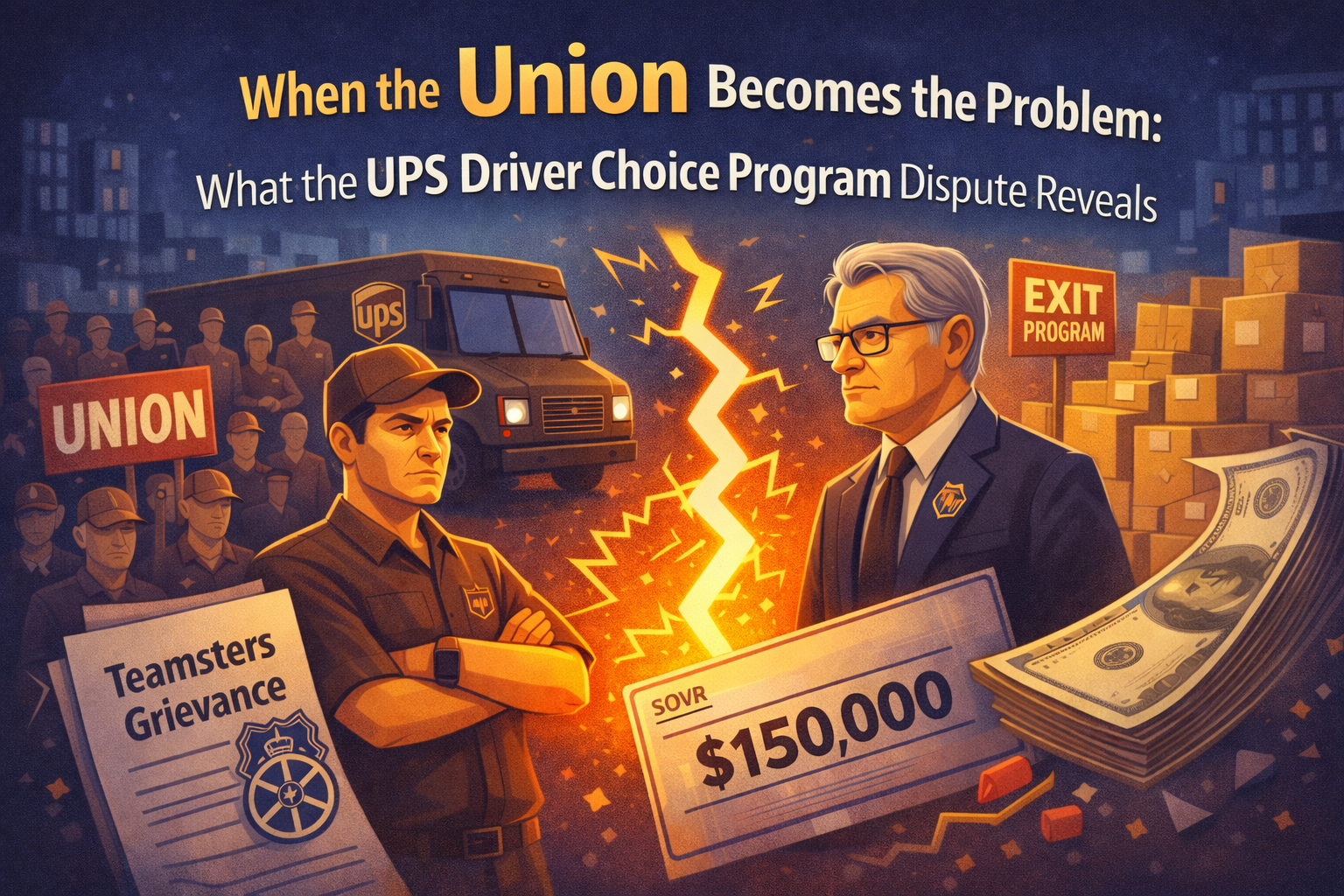
  • UPS and the Teamsters National Negotiating Committee reached a settlement on April 5 on the contentious Driver Choice Program, a voluntary separation offer of $150,000 per driver launched in February by UPS as the company moves to cut up to 30,000 positions in 2026.

  • Under the agreement, UPS may offer the DCP packages to no more than 7,500 long-haul feeder drivers and Regular Package Car Drivers nationwide, to be selected by seniority. The settlement restores the program to all regions, including the Central Region, where UPS had suspended it after union grievances. UPS has agreed not to offer any additional severance programs through the current contract, which expires July 31, 2028.

  • The settlement follows an escalating series of actions: the Teamsters filed an emergency restraining order in February alleging six National Master Agreement violations; a federal judge dismissed it in favor of arbitration; and dozens of Central Region locals filed grievances that forced UPS to suspend the program in 13 states before both sides returned to the table.

  • The dispute exposed a visible rift between union leadership and rank-and-file members. Drivers at a Youngstown, Ohio, facility delivered a letter to Teamsters Local 377 signed by a significant number of drivers, calling the union’s opposition “abhorrent and self-serving” and making clear they would pursue all available remedies to remove and replace local leadership if it did not correct course. Other locals, including Chicago’s Local 710, worked with UPS through a Memorandum of Understanding to keep the program available to their members.

Ink Insight

This wasn’t UPS’s first attempt at voluntary separation. The company’s original Driver Voluntary Separation Program launched in July 2025, offering $1,800 per year of service with a $10,000 minimum. The membership rejected it widely. The Driver Choice Program’s flat $150,000 offer drew considerably stronger interest, making the union’s institutional opposition a harder sell at the local level and helping explain why the Youngstown letter is important.


The settlement restores access to the program to Central Region drivers, but with a nationwide cap of 7,500 slots allocated by seniority, how many of those slots reach buildings like Youngstown remains an open question.


Two pressure points remain for labor and employee relations practitioners to watch.


The first is layoff exposure. UPS anticipated managing excess headcount through attrition and layoffs if voluntary departures fell short. A cap of 7,500 exits across a driver workforce may not generate enough departure volume to avoid that outcome.


The second is the member-leadership fracture that the Central Region dispute made visible. The Youngstown letter is a documented instance of rank-and-file workers publicly breaking with their own local over the practical consequences of a grievance strategy. With the settlement prohibiting any further severance programs through July 2028, drivers who supported the program but fall outside the 7,500-slot cap have no remaining path to a voluntary exit under the current contract. That calculus will not go unnoticed in buildings where layoffs remain a possibility.


The legal fight is settled. The underlying tensions are not.

The Henry Ford Genesys Nursing Strike, 220 Days On: Fact vs. Teamsters Fiction

by Kimberly Ricci

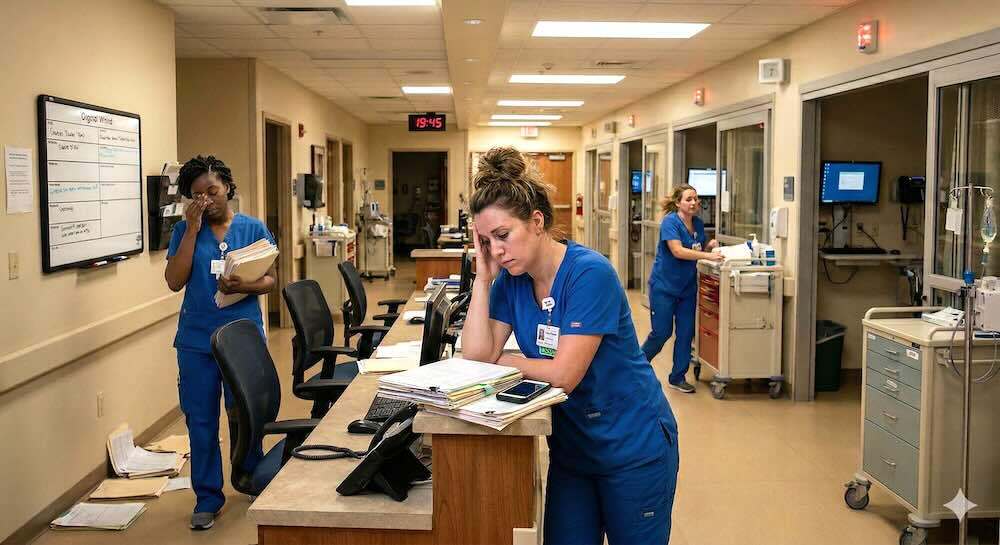
On Sept. 1, 2025, about 750 Teamster-represented nurses and case workers went on strike against Henry Ford Genesys Hospital in Grand Blanc, Michigan.

Seven months later, the conflict shows no signs of resolving, and recently, International Union President Sean O’Brien put in face time on the picket lines for Teamsters Local 332. In doing so, O’Brien called on the NLRB to intervene in several ULP charges filed by the union against the hospital system, mainly alleging refusal to bargain.


As of this writing, 220 days have passed since the strike began, and it’s worth looking at union claims vs. reality:

Union-orchestrated absenteeism exacerbated staffing issues:

The Teamsters claimed that the hospital is intentionally running inadequate nurse-to-patient ratios, and Henry Ford countered that it has stayed fully staffed during the strike and beforehand, too.


Well, scratch that: The hospital planned for full staffing levels, but the union thwarted them.


Henry Ford Genesys revealed that the union manipulated a contract clause that “incentivize[d] coordinated call-outs” by boosting pay for nurses who come to work during heightened absenteeism. The effects sound drastic.


The Teamsters directed members to “take turns calling off scheduled shifts,” and this led to members calling out of work “5,872 times between January and August 2025, averaging 25 absences per day at Genesys compared to just 4 at Henry Ford Rochester and 11 at West Bloomfield."


For this hospital system, 25 nurse call-outs per day is “the equivalent of an entire unit of staff,” and since the strike began, “[W]e've been experiencing fewer call-offs, which has allowed us to consistently maintain our ideal nurse-to-patient ratios.”

The union wants Henry Ford to oust permanent nurses, not just temps:

On the picket line, Sean O’Brien groused, “Management needs to prioritize the experience of Teamsters nurses over temporary workers.”


Henry Ford countered with common sense: They must fill staffing gaps to provide patient care. Further, “Temporary workers are just that, temporary. If Teamsters chose to end their strike, contract nurses would no longer be required to care for the community, and most nurses would return to the positions they held before the strike.”


As well, the hospital system revealed that the union is demanding the bumping of 200 “permanent employees, not temps, with federally protected rights” as part of a return-to-work agreement for striking nurses. According to Henry Ford Genesys, some of these workers are “Teamsters members who continued to work during the strike.”

The hospital’s offered wages exceed market rate:

Henry Ford Genesys’ latest offer, which it’s already partially implemented for salary purposes, increased RN wages by up to 13%. That brings the system’s average annual RN salaries to around $100,000. According to Michigan’s University of Olivet, state salaries for RNs with 5+ years of experience fall within the “$85,000 – $95,000” range.


Henry Ford is exceeding the Michigan state average for nurse pay, and the hospital system further reveals that they agreed to maintain staffing ratios from the expired Teamsters contract. Additionally, the hospital system’s latest proposed offer included premium rates for overnight, holiday, weekend, and critical shifts. Yet the Teamsters aren’t budging, although precisely what salaries they are demanding remains secret.

The union’s motives extend far beyond Genesys:

The Teamsters are one of the hardest-poaching unions in existence.

Beyond freight, logistics, hospitality, Hollywood, this union is intent upon mass-organizing Michigan nurses. In March, Teamsters Local 332 President Kevin Moore boasted, “You think we’re just done with Henry Ford? ... You think there’s not more hospitals in the State of Michigan that want Teamster help? We’re not backing up from any hospital.”


As Henry Ford Genesys points out, keeping their nurses off the job is a means to “advance the union’s broader agenda.” And make no mistake, a prolonged, high-profile strike at a major health system gives the Teamsters what they want for future campaigns: “Proof” of muscle, media attention, and a pre-packaged rallying cry to motivate nursing conflicts elsewhere.


Plain and simple, this strike is mainly a PR move. If the Teamsters really cared about nurses, they wouldn’t have orchestrated widespread absenteeism that created short-staffing conditions at Henry Ford Genesys. That’s a dangerous tactic and self-serving for the union, and it’s not good for workers, patients, or the community served.

Working Lunch Podcast | Wilson On A Major Beef Plant Strike

by Michael VanDervort

What happened

Phil Wilson joined a recent podcast discussion with Joe Kefauver and Franklin Coley of Align Public Strategies on the Working Lunch Podcast to break down a developing labor situation with real implications for the restaurant and food supply chain.


The conversation centers on the work stoppage at the JBS/Swift beef plant in Greeley, Colorado, one of the country's largest processing facilities, and what it signals beyond a single dispute.


Phil also weighs in on the broader organizing environment impacting the restaurant industry, including where pressure is building and where it is not.

The discussion closes with a look at One Fair Wage and its recent string of losses, and whether the group is losing momentum or simply recalibrating its strategy.

Why it matters


For HR, ER, and labor relations professionals, this is not just a headline about one strike.


It highlights several practical risks:

  • Supply chain disruption tied to labor disputes

  • Continued wage pressure in frontline industries

  • Operational exposure when critical facilities are impacted

  • Shifting union strategies outside traditional organizing wins

For operators, especially in food service, these dynamics don’t stay isolated. They show up in pricing, staffing, and long-term planning decisions.


Listen here:
https://open.spotify.com/episode/7gWHoejqgOBQndWd97q8NR

About Labor Relations INK

Labor Relations INK is published weekly and is edited by LRI Consulting Services, Inc. Feel free to pass this newsletter on to anyone you think might enjoy it. New subscribers can sign up by visiting here.


If you use content from this newsletter, please attribute it to LRI Consulting Services, Inc. and include our website: http://www.LRIonline.com 


Contributing editors for this issue: Greg Kittinger, Michael VanDervort, and Kimberly Ricci.


You are receiving this email because you subscribed to receive our labor relations newsletters and updates. You can manage your email preferences by clicking the link at the bottom of any of our email communications.


About LRI Consulting Services, Inc.

LRI Consulting Services, Inc. exists to help our clients thrive and become extraordinary workplaces. We improve the lives of working people by strengthening relationships with their leaders and each other. For over 40 years, LRI Consulting Services, Inc. has led the labor and employee relations industry, driven by our core values and our proven process, the LRI Way.


Share