Subject: LRI INK: NLRB Back in Business, 2026 Upcoming Labor Contract Battles

January 8, 2026

To visit the blog post, click on the link below the article.

The NLRB’s Lost Year Is Over. The Reset Is Just Beginning.

by Michael VanDervort

After nearly a year without a quorum, the National Labor Relations Board is moving again, with Crystal Carey sworn in as the new General Counsel, along with James Murphy and Scott Mayer joining the Board.


With new members sworn in and a Republican majority restored, the real question is no longer whether Biden-era labor policy will be revisited. It is the speed with which the Board chooses to act.


Much of the coverage has described 2025 as a lost year for the agency. Decisions stalled. Backlogs grew. Meaningful policy progress has largely stalled. That assessment is fair.


What comes next is where the picture shifts.


The Board is poised to make major policy changes in 2026, with several Biden-era decisions expected to be reversed or substantially narrowed under the new Trump-appointed majority.


The Pendulum Has Always Swung. This Time Is No Different.

The NLRB has long operated as a pendulum agency. Changes in political control bring changes in Board law and precedent. That is not a breakdown in the system. It is how federal labor law has evolved for decades.

What makes this moment stand out is the scope of doctrinal change under the Biden Board and how directly those changes affected everyday employer decision-making.


Several high-profile rulings and issues now sit squarely in the Board’s sights.


Decisions Most Likely to Be Revisited


  • Stericycle, Inc.
    Stericycle reshaped handbook enforcement by making most workplace rules presumptively unlawful. Employers were required to prove that even neutral policies could not reasonably chill protected activity. A return to a more balanced “reasonably prudent employer” framework is widely expected.

  • Cemex Construction Materials
    Cemex created a new pathway for union recognition without an election if an employer committed any unfair labor practice after declining card-check recognition. It is broadly viewed as the most consequential pro-union decision of the Biden era and one of the most likely to be overturned.

  • Lion Elastomers
    Lion Elastomers altered long-standing misconduct standards, limiting employers' discretion to discipline employees engaged in protected activity, even when behavior crossed lines that had previously been considered legitimate grounds for discipline. A shift back toward clearer misconduct rules is anticipated.

Captive Audience Meetings
Restrictions on mandatory employer meetings about unionization are also expected to be rolled back, restoring long-recognized employer speech protections under Section 8(c) of the Act.


Broader Policy Shifts Taking Shape

Beyond individual cases, reporting and analyst commentary point to movement in several broader areas:


  • Joint Employer Status
    The Biden Board’s expansive 2023 standard is likely to be superseded by the narrower Trump-era 2020 rule, raising the bar for joint-employer findings.

  • Decertification Elections
    Rules that made it more difficult for employees to remove unions, including aggressive blocking-charge doctrines, are expected to be repealed or softened.

  • Section 7 Interpretations
    Broad readings of protected concerted activity are likely to be narrowed, reducing exposure tied to employee speech and conduct claims.

Why the Board May Move Sooner Than Many Expect

Some observers argue that meaningful change must wait until a fully constituted five-member Board is in place. That assumption is increasingly shaky.

With a three-member quorum restored, the Board can already issue decisions. More importantly, it can also pursue rulemaking, which requires only a majority vote of a quorum.


As former NLRB Chair Marvin Kaplan has noted in a Bloomberg article, rulemaking allows the Board to revise policy prospectively, with notice, public comment, and the procedural safeguards required by the Administrative Procedure Act. It is slower than adjudication but more durable, and it does not require five members to begin.


That matters because many of the most controversial Biden-era changes, particularly those affecting representation procedures and employer speech, are better suited to rulemaking than to case-by-case litigation.


What This Means on the Ground

Momentum should not be mistaken for immediacy.


Cemex, Stericycle, and Lion Elastomers remain the controlling law today. Employers should continue to comply fully. Supervisor training, discipline decisions, handbook drafting, and organizing responses must still assume these standards apply.


Expect movement toward fewer restrictions on employer speech, more predictable handbook standards, and a renewed emphasis on elections rather than card-based recognition. For employers and unions alike, the safest assumption is not stability, but change.


At the same time, it is no longer accurate to assume that change is years away.

Between adjudication and rulemaking, the Board now has multiple avenues to unwind or recalibrate the last four years of labor policy. Some shifts will move faster than others.


That is the reality of a pendulum agency restarting after a long pause.


Don't Sleep On 2026's Labor Contract Battles, Even Without UPS Or Big Three Automakers at the Table

by Kimberley Ricci

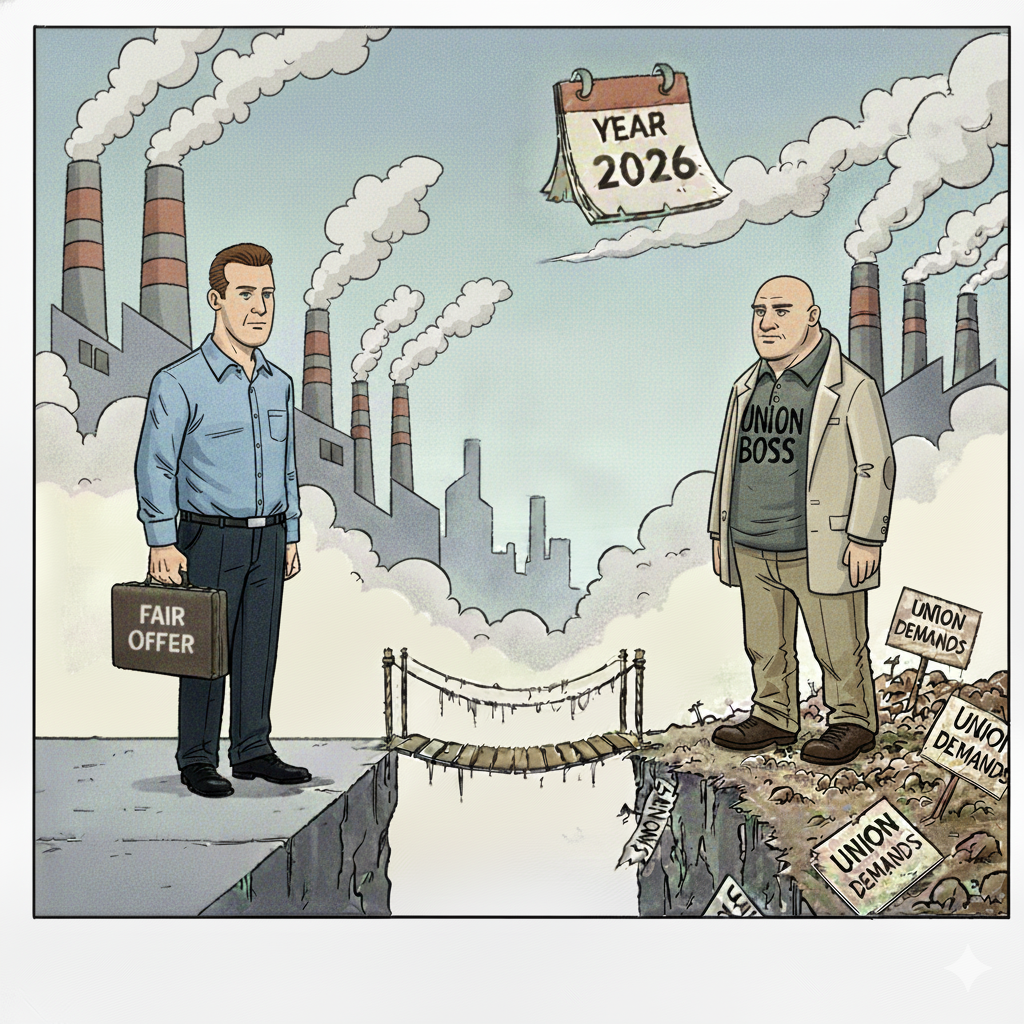
You may have heard UAW President Shawn Fain blustering about how 2028 will be the next big year for contract negotiations. He’s been making that claim to rustle up General Strike interest by coordinating expiration dates across industries. However, it’s never wise to believe Shawn Fain, and this subject is no exception. Indeed, 2026 carries potential for scattered yet pivotal strikes if certain contract talks break down.


Sure, this year’s battles probably won’t match those of 2023, which included high-profile struggles between the Teamsters and UPS and the UAW and Big Three automakers. Nor will this year be quite like 2025, which saw maneuvering from the International Longshoremen’s Association and strikes by UFCW against grocers and IAM against Boeing.


No single 2026 contract renewal is guaranteed to dominate headlines, but this year’s collective bargaining talks will involve hundreds of thousands of workers in a wide swath of industries. Progressive publication Labor Notes has an exhaustive list of even the tiniest contracts up for renewal, but here are the negotiations truly worth watching:

Hospitality

In NYC, the Hotel and Gaming Trades Council’s Industry-Wide Agreement expires on July 1 for a claimed 40,000 members. Notably, this will be this union’s first renewal in over a decade, so we can expect them to push hard on wages, pension contributions, and more.

Retail

UFCW’s Stop & Shop contract for over 30,000 East Coast workers expires on Mar. 1. These negotiations arrive with a combative history: In 2019, UFCW locals put 31,000 workers on strike, partially over healthcare costs, and 2022’s contract hinged on that same theme.

Manufacturing

USW contracts for at least 20,000 U.S. Steel and Cleveland-Cliffs workers expire on Sept. 1, less than a year after Nippon Steel’s acquisition of U.S. Steel. Additionally, Marathon Petroleum will speak for several companies on contracts expiring on Feb. 1 for around 30,000 workers "at refineries that account for over half of national crude oil processing capacity."


On a smaller scale for USW, contracts expire in May for 3,000+ Arconic aluminum processing workers and in July for 6000+ tire, rubber, and plastics workers at Goodyear and Bridgestone-Firestone plants.


Boeing won’t get a break after enduring 2024 and 2025 strikes. An SPEEA contract covering up to 18,000 Pacific Coast engineers expires in October.

Healthcare

Kaiser of Northern California’s contract with over 21,000 National Nurses United members expires in August. Nursing unions are fond of extended strikes against Kaiser Permanente, so another walkout could be on the way.

Media

The Writers Guild of America contract expires on May 1, three years after the union carried out a 148-day strike against the Alliance of Motion Picture and Television Producers. The end result was a contract that didn't attempt an outright AI ban, but we can expect that conversation to continue.


Telecommunications


The AT&T Mobility Orange contract expires on Feb. 13 and covers 14,000 CWA members, including call center and tech workers in California, Illinois, New York, Oregon, and Texas.


Verizon’s CWA contract expires in August after last year’s joint negotiations with IBEW did not end with an extension.

Construction

An IBEW Wiremen’s Agreement expires in June for 12,000 electricians who work on projects in Los Angeles County.

What of the Teamsters and UAW?

Oh, they’re around as usual.


Two Teamsters contracts will expire in March. Those include 17,000 First Student drivers and support staffers across the U.S. and 3,000 DHL drivers in the Boston area.


Meanwhile, Shawn Fain’s heavy investment in higher ed organizing, despite how the UAW has disappointed these workers, means that he’ll soon be shouting again over a recently expired contract for tens of thousands of University of California researchers and grad student workers.

And That’s Not All

We’re almost out of space for this roundup, and we haven’t even touched upcoming talks between Major League Baseball and the MLB Players Association, who will discuss a proposed salary cap with the current CBA expiring in December. And in the public sector, the National Association of Letter Carriers’ contract for 200,000 postal workers expires in November.


In other words, do not expect a dull moment at the bargaining table in 2026.


The NLRB Under Scrutiny by Businesses and States: Where Those Challenges Stand

by Kimberly Ricci

The NLRB hasn’t had a smooth past year, to put things mildly. Not only did the Board spend most of 2025 without a quorum, but other outside forces threatened to intervene. First, multiple companies challenged the constitutionality of the Board’s structure. Second, some states attempted to step into the Board’s role, claiming the agency couldn’t do its job.


2026 is poised to be an extraordinarily busy year for the Board as they clear a case backlog, partially through a new docketing procedure for ULPs. Let’s look at where those outside forces stand.

SpaceX Leads the Way in Challenging the Board’s Structure

The origins of this lawsuit date back to January 2024, when SpaceX filed suit in the Fifth Circuit, alleging that the Board’s structure violates the U.S. Constitution. The Fifth Circuit Court of Appeals sided with SpaceX’s argument that the Board’s structure was likely illegal. More specifically, the court found that a law shielding against presidential removal of Board members and ALJs likely violated Article II’s separation of powers.


As a result, the Board was required to halt ULP cases against SpaceX and two other employers until their lawsuits were resolved. The case also brought regional implications in Texas, Louisiana, and Mississippi, where district courts must now follow suit in blocking ULP cases against other businesses that choose to challenge the Board’s structure.


Fast forward to late December, and surprisingly, the NLRB abandoned its case. Also, recently, the Supreme Court disallowed a motion to intervene from the AFL-CIO and the Office and Professional Employees union, so for now, SpaceX’s position stands, unless a circuit split truly pushes the issue into Supreme Court territory.


Will that happen? It’s shaping up, albeit slowly.


In a case involving a New Jersey nursing home, the Third Circuit Court of Appeals found that federal courts generally cannot grant injunctions in lawsuits “involving or growing out of a labor dispute,” according to the Norris-LaGuardia Act. The Third Circuit also “pause[d] to address” the Fifth Circuit’s reasoning in the SpaceX case and declined to adopt it. Then, in late December, the Ninth Circuit turned a critical eye toward the Fifth Circuit’s analysis while declining to review a lawsuit by a logistics company that challenged the Board’s structure regarding removal protections.


Don’t be shocked if the Supreme Court eventually steps in on the subject.

Meanwhile, States’ Attempts to Step in are Faltering

As the Board’s year without a quorum dragged on, some states attempted to take labor relations matters into their own hands. New York and California passed laws to essentially seize jurisdiction over some labor disputes – certifying union votes, adjudicating ULP charges, and resolving collective bargaining disputes – involving private employers.


These states were testing Garmon preemption, but their power plays now look to be over. A New York federal judge granted an employer’s request for a preliminary injunction barring enforcement of the state’s law. And in a late-breaking update, another federal judge granted the NLRB’s request for a preliminary injunction to block California’s law.

What Comes Next?

State efforts to act in place of the NLRB appear to have been shut down. Yet if the Supreme Court ultimately rules that the Board's structure is unconstitutional, we can expect further chaos in labor relations.


Never say never to this happening. In 2024, the court overturned Chevron v. National Resources Defense Council, ending 40 years of Chevron deference to agencies’ legal interpretations when Congress hadn’t explicitly stated otherwise on a given law. It’s fair to say that the current Supreme Court isn't afraid to diminish agency power, although it’s likely that only portions of the NLRA pertaining to Board structure would be removed, and the Board’s very existence is not in question.


In the year ahead, the NLRB’s focus will be getting back into its groove. General Counsel Crystal Carey and new Board members James Murphy and Scott Mayer won’t have much time to focus on anything else, but we’ll be watching for further updates on these legal challenges.


Next 52 Weeks: Planning Your Calendar After a Union Election

by Michael VanDervort

In this episode of the Left Of Boom Show, Phil Wilson and Ted Glesener discuss the critical components of action planning in employee relations, particularly following union campaigns. They explore the importance of prioritizing action items, understanding campaign dynamics, and executing plans effectively. The conversation emphasizes the need for strong leadership, communication, and a focus on people to ensure successful outcomes in organizational settings. Takeaways

  • Action planning is essential for the effective execution of ideas.

  • Prioritizing people is crucial in both military and labor relations.

  • Communication breakdowns often lead to union campaigns.

  • Supervisors play a key role in the execution of action plans.

  • Identifying low-hanging fruit can create momentum after a campaign.

  • Being present and available to employees fosters trust and communication.

  • Employee feedback is vital for improving workplace relations.

  • Action plans should be specific and tailored to employee needs.

  • Continuous effort is required to maintain a positive workplace culture.

  • Learning from past experiences can prevent future issues.

Chapters

00:00 Introduction to Action Planning

02:28 Prioritizing Action Plans

06:38 Understanding Campaign Dynamics

10:42 Identifying Low-Hanging Fruit

16:00 Executing the Action Plan

17:42 Key Takeaways for Post-Campaign Success

21:19 Final Thoughts and Lessons Learned


Friday Five: Stability At The NLRB, Union Fault Lines, And An Organizing Push (December 2025)

by Kimberly Ricci

This is not a false alarm. The NLRB’s quorum lives:

Although the “it’s almost here” call has come many times before, the NLRB finally has a quorum and can start chipping away at the case backlog. On the final evening before congressional recess, the Senate confirmed Crystal Carey as general counsel along with James Murphy and Scott Mayer as board members. These Trump nominees join Democrat David Prouty, and a quorum exists for the first time since Jan. 2025, but wait, there’s more context to this story.


Prouty’s current term expires on Aug. 27, 2026, so fingers are crossed that at least one more nominee passes muster before that date. Currently, two more vacant seats exist after ex-Chair Marvin Kaplan exited, and Trump fired Gwynne Wilcox, whose fate remains in litigation.


New guidance will likely be coming from Carey early next year. Yet although acting GC William Cowen insisted that the case backlog wouldn’t take long to clear, Littler Mendelson labor attorney and shareholder Alex MacDonald warns that few quick changes will likely be arriving, including any potential overturning of Biden-era precedent.

Some GM workers are criticizing the UAW:

GM workers at Detroit’s Factory Zero are vocally protesting their union’s lack of a public stance on impending layoffs of 1,140 workers at the EV assembly plant amid production cuts. The layoffs are scheduled for early January, and union members aren’t holding back on their disappointment in responses captured by progressive publication WSWS.


Despite Factory Zero’s proximity to the UAW’s international headquarters, President Shawn Fain apparently hasn’t driven five miles to hold one meeting to address worker concerns, and they are understandably miffed. The publication quotes one worker referencing Fain as seeking “celebrity” and media attention only: “We need to get rid of him next year.” Several other workers echoed that sentiment, so we will see what happens next year when Fain is up for reelection.

Not incidentally, Fain’s chief of staff, Chris Brooks, resigned after federal monitor Neil Barofsky’s most recent report showcasing the union’s retaliatory culture.

Video game organizing is having another moment:

Back in January 2023, the first Microsoft union officially came into existence with recognition from the tech conglomerate. At that time, 300 video game testers at subsidiary ZeniMax Studios, makers of The Elder Scrolls, voted to join CWA. This news arrived six months after Microsoft publicized their neutrality agreement, which includes a pledge not to oppose the organizing process, and about a year after we told you about CWA's aggressive initiative to organize tech workers of all stripes.


That ongoing quest is making headlines again.


This month, 165 video game workers at Id Software, a Microsoft subsidiary and the markers of the Quake and Doom franchises, voted to form a wall-to-wall union with CWA. Although the vote was not unanimous, a majority was in favor of pulling every non-supervisory role into the union fold.


The union claims to have unionized almost 1,600 gaming workers this year.

Trader Joe’s United tactics unveiled in congressional testimony:

Trader Joe’s crew member Michael Alcorn worked at the Hadley, MA store that was the first unionized location in the company. Now, he’s a worker advocate and visiting fellow at the Institute for the American Worker.


This week, Alcorn testified in front of the House Committee on Education & Workforce about Trader Joe’s United’s underhanded tactics during and after the organizing drive at the Hadley location. His refreshingly frank and informative testimony can be watched here.


Choice quotes include how Alcorn and his co-workers were “labeled ‘anti-union’ for simply raising concerns” about the union’s deceptive tactics while gathering authorization cards and beyond. He described the union’s wholly un-democratic approach and now urges Congress to pass worker-friendly legislation to “strengthen disclosure requirements” for unions, so that workers have the full picture, not what Big Labor wants them to hear.

The U.S. House voted to overturn an executive order (EO) on federal employee unions:

For the first time in this Trump presidential term, the House voted to nullify one of his EOs. More surprising is how this was a rare bipartisan display for a bill, which was originated by Reps. Jared Golden (D-ME) and Brian Fitzpatrick (R-PA), that is aimed at resuming federal agency workers’ collective bargaining rights.


While citing national security concerns, Trump had previously issued the EO that could have voided collective bargaining agreements for around 700,000 union members working for the federal government. The White House has yet to issue a response to this legislative move, but the House’s 231-195 vote sends the bill onto the Senate.


However, nobody can even begin to guess when that chamber will pick up the topic after recess.


On that note, Happy Holidays! Our Labor Relations INK newsletter will return the week of January 5.

About Labor Relations INK

Labor Relations INK is published weekly and is edited by LRI Consulting Services, Inc. Feel free to pass this newsletter on to anyone you think might enjoy it. New subscribers can sign up by visiting here.


If you use content from this newsletter, please attribute it to LRI Consulting Services, Inc. and include our website: http://www.LRIonline.com 


Contributing editors for this issue: Greg Kittinger, Michael VanDervort, and Kimberly Ricci.


You are receiving this email because you subscribed to receive our labor relations newsletters and updates. You can manage your email preferences by clicking the link at the bottom of any of our email communications.


About LRI Consulting Services, Inc.

LRI Consulting Services, Inc. exists to help our clients thrive and become extraordinary workplaces. We improve the lives of working people by strengthening relationships with their leaders and each other. For over 40 years, LRI Consulting Services, Inc. has led the labor and employee relations industry, driven by our core values and our proven process, the LRI Way.


Share