Subject: Latest: New Edition of West Africa Fertilizer Watch

New West Africa Fertilizer Watch

Fertilizer Watch Launches in East Africa while Prices in West Africa Remain Stable

Current Highlights

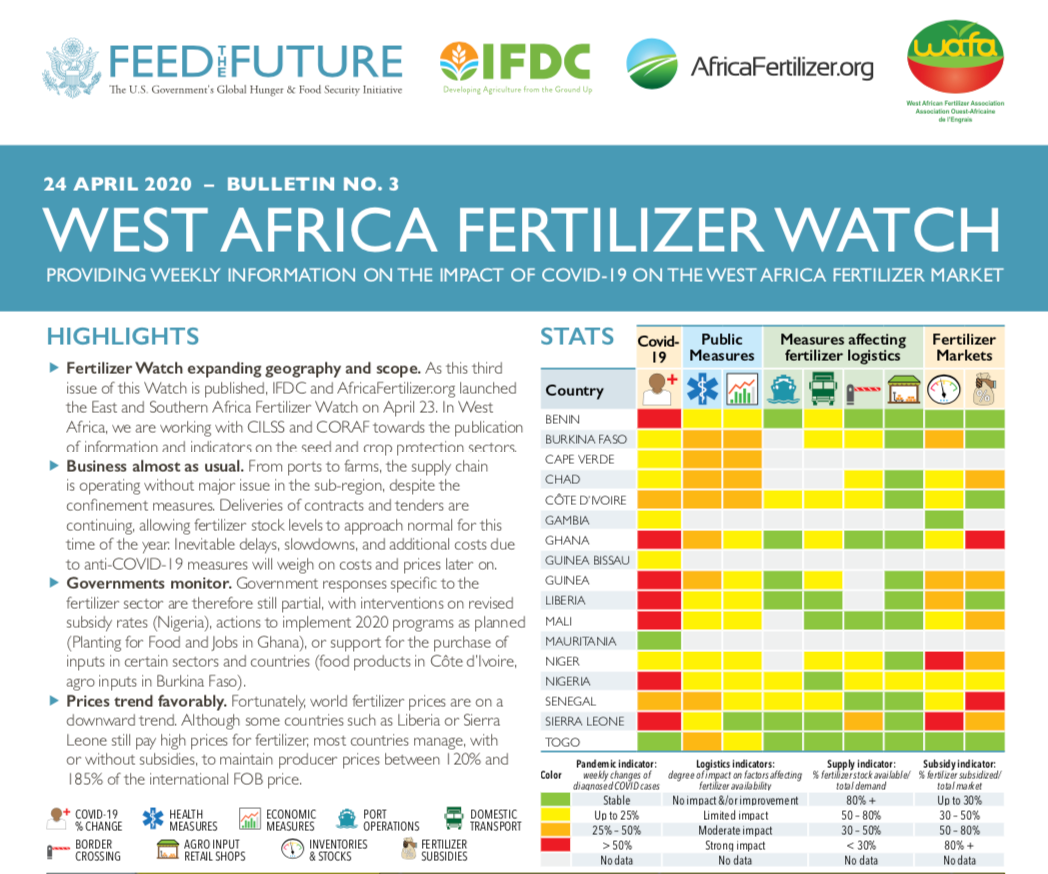
  • Fertilizer Watch expanding geography and scope. As this third issue of this Watch is published, IFDC and AfricaFertilizer.org launched the East and Southern Africa Fertilizer Watch on April 23. In West Africa, we are working with CILSS and CORAF towards the publication of information and indicators on the seed and crop protection sectors.

  • Business almost as usual. From ports to farms, the supply chain is operating without major issue in the sub-region, despite the confinement measures. Deliveries of contracts and tenders are continuing, allowing fertilizer stock levels to approach normal for this time of the year. Inevitable delays, slowdowns, and additional costs due to anti-COVID-19 measures will weigh on costs and prices later on.

  • Governments monitor. Government responses specific to the fertilizer sector are therefore still partial, with interventions on revised subsidy rates (Nigeria), actions to implement 2020 programs as planned (Planting for Food and Jobs in Ghana), or support for the purchase of inputs in certain sectors and countries (food products in Côte d’Ivoire, agro inputs in Burkina Faso).

  • Prices trend favorably. Fortunately, world fertilizer prices are on a downward trend. Although some countries such as Liberia or Sierra Leone still pay high prices for fertilizer, most countries manage, with or without subsidies, to maintain producer prices between 120% and 185% of the international FOB price.

 
Read More
 

What is the West Africa Fertilizer Watch?

The Fertilizer Watch is designed to provide weekly updates to stakeholders throughout ECOWAS countries, including Chad and Mauritania, using data collected around 10 indicators. These indicators are related to a variety of information such as the spread of COVID-19, measures taken by country governments, and logistical constraints that affect fertilizer flows.


The goal is a well-informed and prepared fertilizer supply chain, where actors can use the information to plan accordingly and ensure consistent delivery to farmers.

Subscribe for Updates

256-381-6600 | pdu@ifdc.org


Powered by:
GetResponse