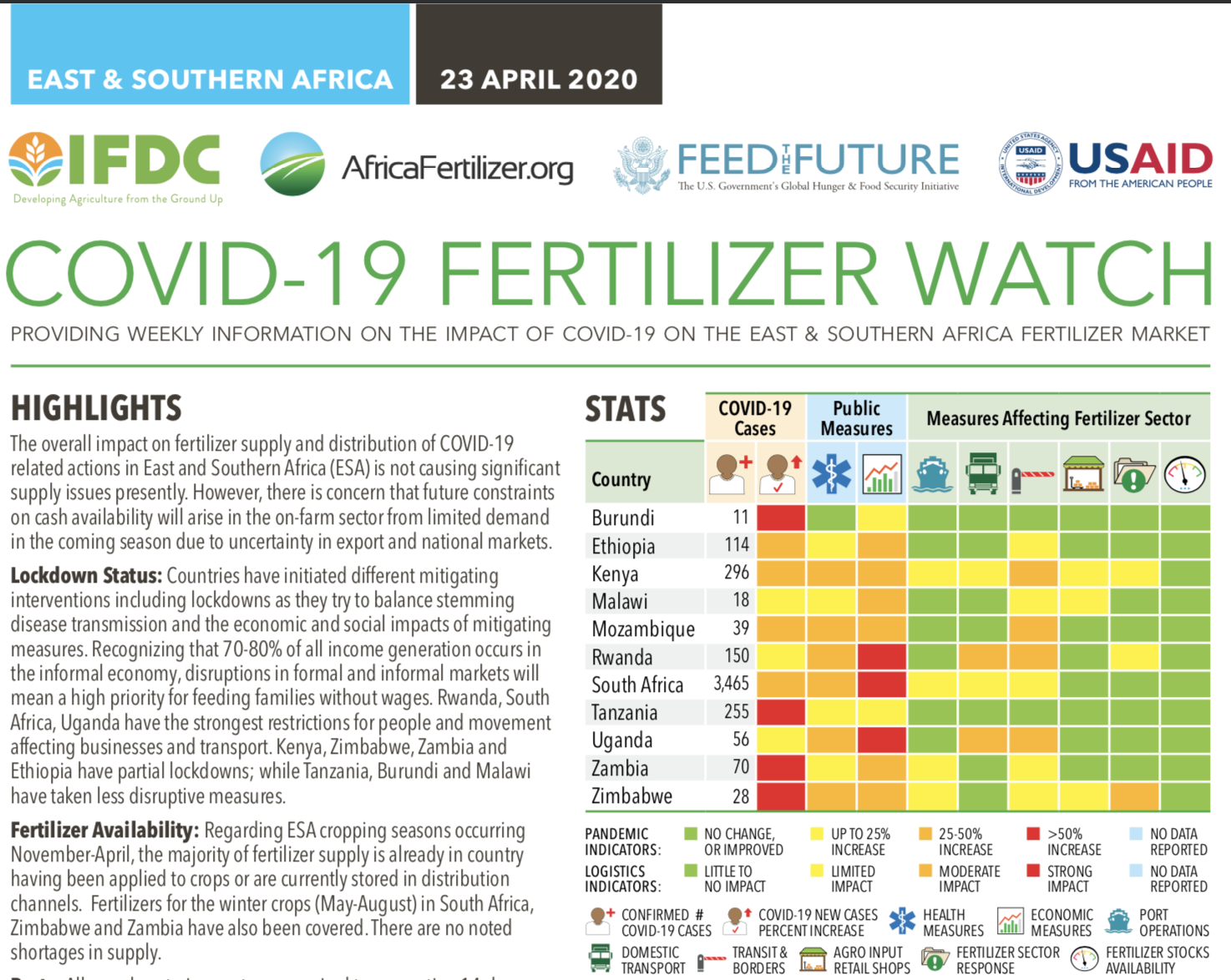
In response to the COVID-19 pandemic, the International Fertilizer Development Center (IFDC) and our AfricaFertilizer.org initiative have launched a weekly update on fertilizer trade information. The East and Southern Africa COVID-19 Fertilizer Watch will be available by subscription, starting Thursday, April 23. This one-page document will specifically track the impact of government-sanctioned COVID-19 interventions on the delivery and use of fertilizers in African countries and, in doing so, will allow public and private sectors to monitor agricultural production and food security in the region.
Please click here to download the one-page Watch, the full Country Status report in English, and subscribe for updates.
Through this weekly Fertilizer Watch, and for the coming months, IFDC seeks to monitor that fertilizers are moving freely across the region – from ports and plants to farms – and that sufficient fertilizers are reaching farmers in time for planting to ensure that productivity and food security needs are met. We expect that, as the agricultural season evolves, other related indicators and data will need to be tracked, and we will update the Watch accordingly.
IFDC has already launched the COVID-19 Fertilizer Watch in West Africa and intends to launch an Africa-wide COVID-19 Fertilizer Watch soon. The West Africa Watch has been greatly appreciated by private sector businesses all along the value chain, as well as public sector and development partners responsible for policy and food security interventions, including Government Ministries, Regional Economic Communities, International Fertilizer Association (IFA), and the African Union, as a valuable tool to analyze data and monitor actions to help in decision making related to fertilizer availability and use.
The AFO team would like to thank the private and public sector partners who have provided input into the Watch. We acknowledge the United States Agency for International Development (USAID) for support through the USAID-funded Bureau of Resilience and Food Security (RFS) Feed the Future project on Soil Fertility Technology Adoption, Policy Reform, and Knowledge Management (RFS-SFT) implemented by IFDC.
To receive the Watch directly, please fill in your details here to sign up.
About IFDC
An independent non-profit organization, IFDC works throughout Africa and Asia to increase soil fertility and develop inclusive market systems. Combining science-backed innovations, an enabling policy environment, holistic market systems development, and strategic partnerships, the organization bridges the gap between identifying and scaling sustainable agricultural solutions, resulting in improved household food security and enriched family livelihoods around the world. Using an inclusive approach, IFDC employs locally driven solutions that are environmentally sound and impact oriented, which bring change at local, regional, and national levels. www.ifdc.org.
About AfricaFertilizer.org
The AfricaFertilizer.org (AFO) initiative is the premier source for fertilizer statistics and information in Africa. It is hosted by IFDC and supported by several partners, key among them IFA, Argus Media, and Development Gateway. Since 2009, AFO has been collecting, processing, and publishing fertilizer production, trade, and consumption statistics for the main fertilizer markets in sub-Saharan Africa. AFO has an extensive network of fertilizer industry players in the main fertilizer trade corridors and maintains key information on the major producers, their production facilities and capacities, importers/suppliers, and various distribution channels.
About USAID RFS-SFT
IFDC is implementing the USAID-funded Bureau of Resilience and Food Security (RFS) Feed the Future project on Soil Fertility Technology Adoption, Policy Reform, and Knowledge Management (RFS-SFT) under a cooperative agreement mechanism with buy-in provisions. The project bridges the gap between scientific research and technology dissemination to smallholder farmers. BFS-SFT conducts research with partners from universities, national and international research and development institutions, and the private sector.