South Africa's Bees Need More Food — Now Beekeepers Can Help Shape the Solution
We talk constantly about protecting honey bees.
But there is a much more basic question:
What are all these bees going to eat?
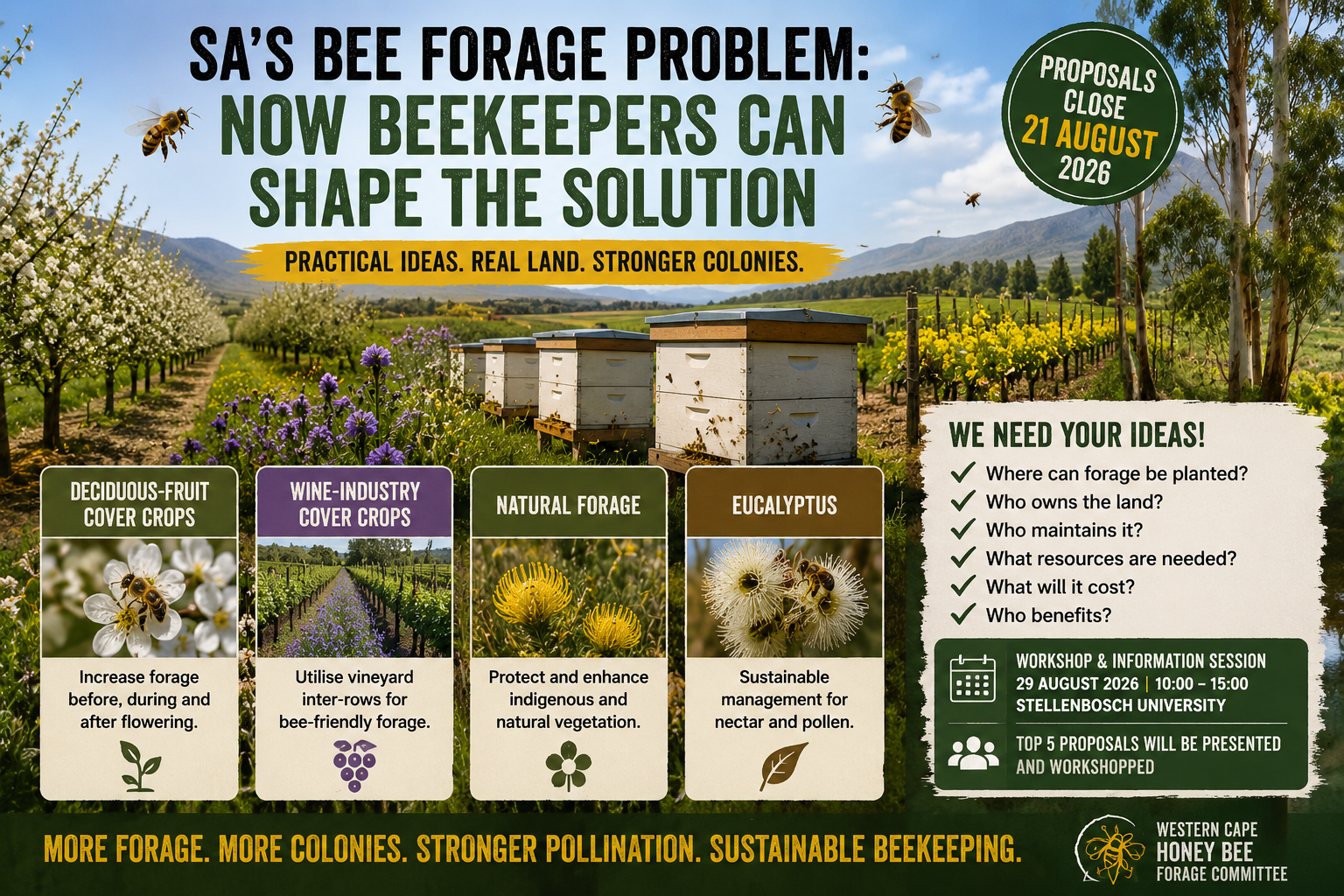
Bee forage has become one of the biggest constraints facing managed beekeeping, and this month beekeepers are being asked to help develop practical solutions.
The Western Cape Honey Bee Forage Committee will hold an information and workshop session at Stellenbosch University on 29 August.
And this isn't simply another discussion about planting flowers.
Beekeepers and forage stakeholders are being invited to submit practical proposals covering:
Ideas should consider where forage can actually be created, who controls the land, what resources will be required, who needs to participate and what it will cost.
Proposal deadline: 21 August 2026.
The five strongest proposals are intended to be presented and workshopped.
Why this matters
Strong pollination colonies cannot simply be produced the day an orchard flowers.
A worker bee takes roughly 18–20 days to develop before emerging and approximately another 20 days before becoming an active field bee.
That means the pollination or strong colony required in spring depends heavily on the forage available weeks beforehand.
This is why bee forage isn't simply an environmental issue.
It is an agricultural production input. It's also not just a question for the Western Cape Beekeeping but has been a HOT topic for us for over two decades for all of South Africa's Honeybee Industry and Beekeepers!
If we want more strong pollination colonies, more honey production and a larger sustainable beekeeping industry, we need to consider where those colonies will feed for the rest of the year.
Proposal deadline: 21 August 2026
Email: forage@wcba.co.za
WORKSHOP MEETING REGISTER HERE:
https://docs.google.com/forms/d/e/1FAIpQLSdzF7rHfqLEOfmO99xdCdpzLctMYjixh-IgEWnJvnbV70gZDQ/viewform