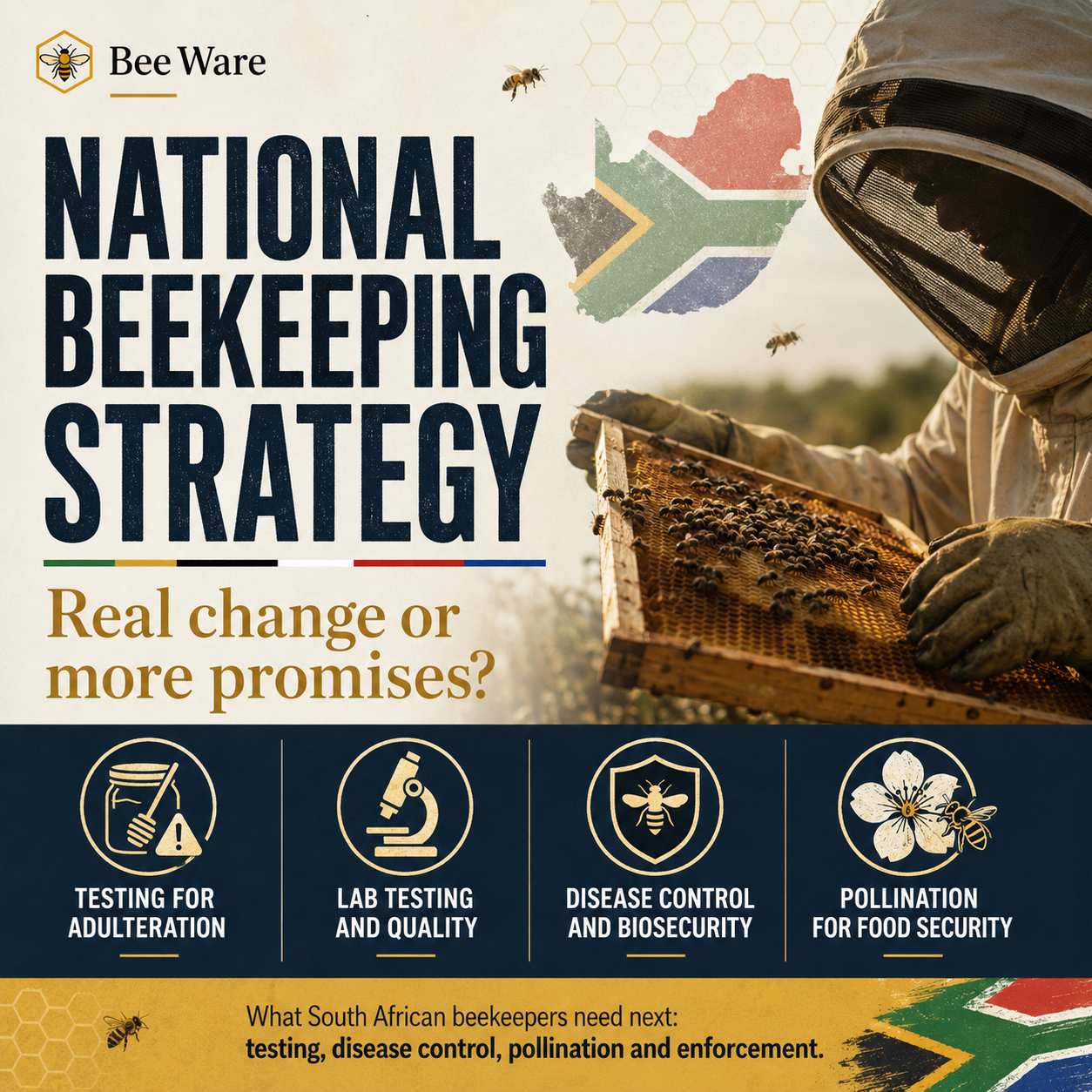
South Africa may finally get a National Beekeeping Strategy—but the bees need more than promises
For decades, South African beekeepers have operated inside a fragmented system.
*Government has finally acknowledged the correct problems. Now the industry must ensure that the solutions are funded, enforceable and measurable.*
Bee diseases sit in one regulatory corner. Honey labelling sits in another. Agricultural chemicals, imports, forage, pollination services and honey testing are handled under separate laws, departments and enforcement structures.
Now, the Department of Agriculture says it is developing a comprehensive National Beekeeping Strategy intended to bring these issues together.
On paper, this could be one of the biggest developments for the South African bee industry in years.
But let us be clear: the strategy has not yet been completed or implemented.
It remains under development and is expected to undergo stakeholder consultation before government aims to finalise it during the 2026/27 financial year.
That distinction matters.
There is a significant difference between announcing what a strategy may contain and establishing funded programmes, accredited laboratories, trained inspectors and enforceable regulations.
What government is proposing
The Department’s plans include:
A clearer legislative framework covering bee diseases and biosecurity
Regulation of honey imports and exports
Stronger honey standards and quality assurance
Measures against honey adulteration
A more formal structure for pollination services
Dedicated bee-sector officials
Improved extension and technical training
An Apicultural Advisory Committee
Better disease diagnostics and pesticide-residue testing
Accredited honey-authenticity testing
A residue-monitoring plan to support exports
A Honey Value Chain Roundtable
Renewed formal engagement between government and SABIO
Government has even indicated that South Africa may need a dedicated National Beekeeping Act or Bee Act.
Government has outlined proposals for a National Beekeeping Strategy that remains under development
That would represent a major shift.
Beekeeping would no longer be treated as an awkward collection of minor agricultural, food and environmental matters scattered across legislation written primarily for other industries.
The fake-honey question
One of the strongest parts of the proposed strategy is the recognition that South Africa needs accredited laboratory capacity for:
This is where many previous campaigns have fallen short.
It is easy to tell consumers to buy “real honey”. It is far more difficult to prove authenticity, trace origin, identify syrup adulteration and take enforceable action against dishonest suppliers.
Without accessible testing and visible enforcement, legitimate beekeepers remain forced to compete against products that may be diluted, mislabelled or sold at prices below the realistic cost of producing genuine honey.
Government’s own proposals now acknowledge that laboratory capacity and adulteration control are central industry requirements.
The industry should welcome this—but should also ask:
Which laboratories will be accredited?
Which honey tests will be recognised?
Who will pay for testing?
Will small beekeepers have affordable access?
How many retail products will be sampled annually?
Will enforcement results be published?
What penalties will apply when a product fails?
A strategy without transparent enforcement will not remove fake honey from shelves.
American foulbrood moves back onto the national agenda
The Department has also confirmed that it commissioned and funded the Agricultural Research Council to conduct a project titled:
“Survey of American Foulbrood in Honeybee Colonies in South Africa: Protecting Beekeeping and Pollination Services.”
The stated purpose is to establish the prevalence and impact of American foulbrood and assist in developing both an AFB management strategy and the
wider National Beekeeping Strategy.
This deserves close attention.
At present, the announcement confirms that the project exists—but it does not yet provide published sampling methods, provincial coverage, laboratory protocols, results or a completion date.
Beekeepers should therefore not interpret this announcement as evidence that AFB prevalence has increased or decreased.
There are no survey results in the published announcement.
The industry needs a national disease picture based on real samples, consistent diagnostics and transparent reporting—not assumptions, rumours or selective cases.
Pollination is finally being discussed as agricultural infrastructure**
The Department stated that honeybees pollinate an estimated 80% of South Africa’s fruit crops and said managed pollination can dramatically increase production in some orchards.
*Editor: There are specific crops, fruits, nuts and vegetables that will fall into the category here most being deciduous fruit, sunflower, citrus, litchi, avocado, watermelon, squashes and pumpkins to name a few. What it does not impact at all would be maize/corn, wheat, barley, bananas, grapes, pineapple and common fig for example.
The 80% figure is an official government statement, but it should be used carefully. It is a broad national estimate and the available speech does not provide the underlying study or calculation.
Likewise, the statement that managed colonies can “often double” yields should not be treated as a universal result.
Editor's note: We regularly share studies and research, both from within South Africa and globally, that shows efficacy and yield impact when conducted under experiment conditions as well as anecdotal findings regarding crop yields when using pollination services.
Pollination response differs substantially between:
The larger and more defensible message is that pollination is not a free by-product of simply having bees somewhere in the district.
It is a managed agricultural input.
Farmers pay for seed, fertiliser, irrigation, pruning and pest control. Pollination quality must be planned and measured with the same seriousness.
[Our exact sentiment for over a decade now... ]
The biggest risk: a change of political ownership
There has already been a major change since the BeeCon commitments were presented.
Willie Aucamp became South Africa’s Minister of Agriculture on 1 July 2026, replacing John Steenhuisen, who had publicly supported stronger recognition of pollination and the bee industry. The Presidency and government directory confirm Aucamp’s appointment.
The strategy was presented by Department Director-General Mooketsa Ramasodi, which gives it administrative continuity beyond one minister. However, ministerial support still matters when legislation, budgets, laboratory funding and interdepartmental cooperation are required.
The bee industry should now ask Minister Aucamp to publicly confirm:
Support for completing the strategy
A timetable for consultation
Funding for the AFB survey
Commitment to honey-authenticity enforcement
Progress towards accredited laboratories
Support for a formal apicultural advisory structure
Whether a dedicated Bee Act will genuinely be investigated
This is not party politics.
It is basic policy accountability.
Bee Ware's editorial commentary:
The proposals are substantial enough to deserve support.
For the first time in years, many of the issues South African beekeepers repeatedly raise—fake honey, forage loss, weak disease systems, limited testing, pesticide residues, theft, pollination recognition and fragmented legislation—appear together in one proposed national framework.
That is progress.
But South Africa does not yet have:
A final strategy
A new Bee Act
Published AFB survey results
A nationwide accredited honey-testing system
A completed residue-monitoring programme
Proof of widespread enforcement against adulteration
The announcement should therefore be treated as an important opening—not a completed victory.
The industry must now move from applause to participation.
Beekeepers need to help shape the consultation, demand measurable deadlines and ensure that the final strategy is built around real apiary conditions—not only conference-room intentions.