Supplemental Info:
SITREP
November 22, 2026
As of Sunday afternoon, November 22, 2026, the U.S. Army still plans a controlled detonation of roughly 9,500 pounds of degraded lead azide at the Iowa Army Ammunition Plant (IAAAP) in Middletown, southeast Iowa, possibly as soon as Monday or Tuesday, despite a federal appeals court stay on the EPA emergency permit.
Current Status
According to a Saturday court filing by the Department of Justice, the Army intends to act by November 24 (Tuesday), citing an “immediate risk” that the material could explode on its own as temperatures drop below 30°F this week. The DOJ argues this allows invocation of an emergency exception under federal regulations, permitting the controlled detonation without the stayed EPA permit. Officials emphasize that “a controlled detonation is by far safer than an uncontrolled explosion” and say they intend to follow the spirit of the permit’s mitigation requirements even if it is not formally in effect.
https://www.stripes.com/branches/army/2026-11-22/army-still-plans-detonation-iowa-23544688.html
The 8th Circuit Court of Appeals issued an administrative stay on the EPA permit late Thursday (November 19) after a lawsuit by the Sierra Club and Iowa Environmental Council. The stay remains in place pending a ruling on the groups’ emergency motion, but the government contends it does not bar action under separate emergency authorities. The situation remains fluid and weather-dependent; precise public timing details have not been fully released.
https://www.marketscreener.com/news/iowa-detonation-of-lead-will-proceed-under-emergency-powers-army-says-bypassing-court-order-ce785ed3d18dfe2d
Background and Rationale
The material consists of 68 drums of lead azide (a primary explosive long used in detonators and blasting caps) that has been stored for more than 20 years in earth-covered magazines at IAAAP, submerged in a water/ethanol mixture intended to keep it stable. A March 2026 inspection found it had degraded and crystallized, making it highly sensitive to movement, friction, or further temperature changes. Army officials say the barrels are too unstable to open or transport safely.
https://arstechnica.com/science/2026/11/outrage-questions-swirl-as-army-delays-blowing-up-stockpile-of-toxic-lead-azide/
The Army previously contracted for chemical neutralization but canceled it over safety concerns. In-place controlled detonation was selected as the only practical way to eliminate the hazard, prevent a possible spontaneous explosion, and restore the site for military use. Lead azide is being phased out in many military applications due to its volatility and toxicity.Stripes
Location and Planned Operation
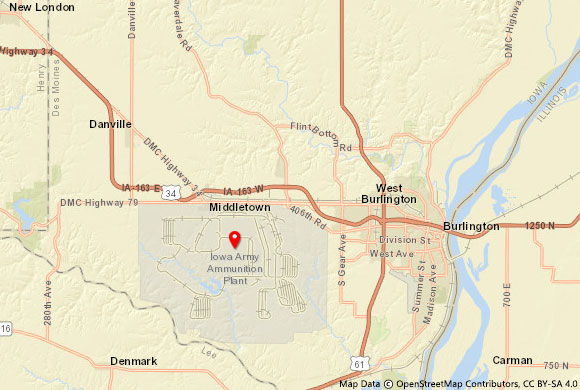
The plant is outside Middletown, less than 8 miles west of the Mississippi River (Iowa–Illinois border). Plans involve detonating the material in place inside the magazines, with mitigation such as earthworks, sand barriers, wetting/misting to suppress dust, and timing for favorable weather (low winds, no inversions). The event could last several hours. Nearby residents have been advised in prior notices to stay indoors, close windows, and set HVAC systems to recirculate air until any plume passes.
Health and Environmental Concerns
Army modeling has indicated a plume of lead-containing particles could travel up to ~100 miles under certain conditions (earlier projections included western Illinois). Lead is a neurotoxin with no known safe exposure level; it is especially hazardous to children and pregnant people and can affect development, learning, and behavior. Additional worries include deposition on soil, crops, livestock, and wildlife (including some endangered bat species). Army officials have described potential exposure as very limited and short-term (comparing it in one statement to “living in a mining town for one hour”) and say extensive measures will minimize risk. Critics, including toxicologists and environmental groups, argue ultrafine particles may linger, public notice was late, and independent monitoring or stronger cleanup standards are needed.
https://www.desmoinesregister.com/story/news/iowa/2026/11/19/lead-azide-explosion-iowa-middleton-toxicologist-risks/92863068007/
Local officials, Iowa and Illinois politicians, and residents have raised questions about communication, plume impacts, and alternatives. The Army maintains destroying the material in place is the only responsible option given the instability.
This remains an evolving situation dependent on weather, any further court orders, and final operational decisions. Official Army, EPA, or court updates should be checked for the latest details.
No new official plume maps have been released as of Sunday, November 22, specifically for a Monday (Nov. 23) or Tuesday (Nov. 24) detonation. The most recent Army maps date to around November 17–18 and were based on weather forecasts for the original Friday, November 20 schedule.