Supplemental Info:
The State of the Union (SOTU) address is designated as a National Special Security Event (NSSE) by the Department of Homeland Security, which means the U.S. Secret Service takes the lead in planning and implementing comprehensive security operations, often in coordination with federal, state, and local agencies like the U.S. Capitol Police and the Metropolitan Police Department.
For the 2026 address on February 24, these measures are expected to follow established protocols with enhancements based on ongoing threat assessments.
Key security elements typically include:
Perimeter and Access Control: Temporary fencing may be erected around the Capitol building to create an inner security perimeter, a practice that has been in place for recent SOTU addresses and other high-profile events. Access to the Capitol complex is restricted to authorized personnel, guests, and media, with mandatory screenings such as metal detectors, bag checks, and credential verification.
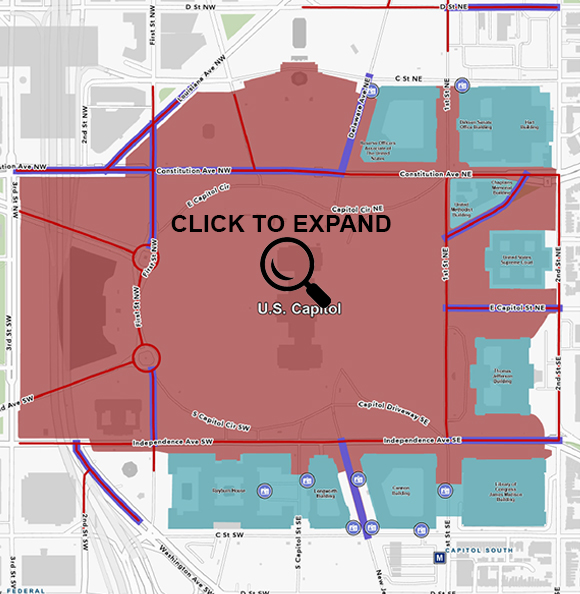
Road Closures and Traffic Management: Extensive road closures around the U.S. Capitol (see the map below) are implemented starting early in the day and lasting until the event concludes. For 2026, closures begin at 12:01 a.m. on February 24 and affect multiple streets in the vicinity to prevent unauthorized vehicle access and ensure safe crowd management.
Personnel Deployment: Additional support from the National Guard and other law enforcement units assists with crowd control, surveillance, and rapid response. This has been a standard augmentation given heightened security concerns in recent years.
Continuity of Government: To ensure governmental continuity in case of an emergency, one Cabinet member is selected as the "designated survivor" and remains at a secure, undisclosed location away from the Capitol during the address.
Airspace and Broader Protections: The FAA imposes temporary flight restrictions over the Capitol area. Cybersecurity monitoring and intelligence sharing among agencies help mitigate potential threats from digital or asymmetric attacks.
These protocols evolve based on intelligence and lessons from past events, but they remain focused on protecting attendees, including the President, Vice President, members of Congress, Supreme Court justices, and invited guests, while minimizing disruptions to the public.
2026 State of the Union Road Closure List
2026 State of the Union Traffic Impact Map (Click here or the map below)