Supplemental Info:
SITREP
November 19, 2026
The U.S. Army plans two controlled detonations at the Iowa Army Ammunition Plant in Middletown, near Burlington, Iowa, at approximately noon Friday, November 20. The operation will destroy 68 drums of degraded lead azide (Pb(N3)2 ), an unstable explosive material. Nearby residents can expect loud blasts, ground vibrations, and a dust plume containing lead particles. The potential for airborne dust and subsequent surface contamination has prompted protective guidance for communities downwind. (Army advisory; EPA incident information)
Why the operation is necessary
According to EPA, the material has recrystallized during storage, increasing its sensitivity to friction and shock and creating a risk of accidental explosion. The Army determined that handling or transporting the containers would be unsafe and selected destruction in place. EPA has authorized the operation through an emergency permit requiring advance notifications, environmental monitoring, sampling, cleanup, and reporting.
Potential impacts
Near the plant: Identified residents near Middletown City Park and Butterfly Park have been asked to vacate their homes from 8 a.m. to 2 p.m. Friday because of potential localized window damage. This instruction applies to the identified nearby households. (Latest Army advisory)
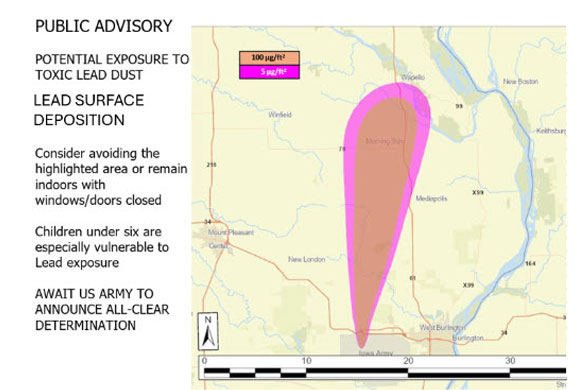
Downwind: The November 17 maps included in the Army's November 18 advisory project a generally northward airborne path through eastern Iowa, west of Muscatine and the Quad Cities. Separate maps show airborne movement and dust deposition on surfaces. The projected footprint remains subject to changes in weather. Illinois officials also identified Mercer County as potentially affected under modeling available November 18. (Army maps - Scroll to bottom)
The Army says modeled airborne lead levels may be elevated but are expected to remain below the level at which EPA would require protective actions. It nevertheless recommends precautions. Post-event monitoring and sampling will be needed to establish actual conditions.
Protective guidance
For people living or working within the projected exposure area, the Army advises:
Consider avoiding the affected area before the operation.
Otherwise, remain indoors during the exposure period with windows and exterior doors closed.
Where safe, reduce outside-air intake and use heating or cooling systems in recirculation mode.
Avoid unnecessary travel through affected areas.
After the Army determines the airborne exposure period has ended, clean potentially exposed surfaces, especially children's play areas and windowsills. (Army protective guidance)
Illinois health officials recommend a longer precaution: Potentially affected Illinois residents should stay indoors and keep windows closed for 24–48 hours after the detonation. Most residential furnaces already recirculate indoor air; systems that actively draw outside air require particular attention. Residents should follow the latest instructions issued for their community. (Illinois EPA and public health guidance)
Lead is particularly hazardous to young children. EPA recommends wet wiping or wet mopping to control dust, washing hands and toys, and removing shoes to reduce tracking contamination indoors. (EPA exposure-reduction guidance)
Monitoring and next updates
The Army is using earthworks and water to reduce airborne dust, with environmental monitoring and sampling planned. Its estimate that visible dust near Middletown may linger for about an hour should not be used as a regional all-clear; downwind residents should follow official clearance and local health instructions.
Updated plume forecasts are due approximately six hours before the detonation and hourly thereafter, followed by an estimate of the affected area after the operation. Subscribers in eastern Iowa and potentially affected western Illinois communities should review the latest maps Friday morning and monitor local emergency-management notices. (Army update schedule)