Subject: LRI Ink: The Bill That Could End First-Contract Bargaining

June 11, 2026

To visit the blog post, click on the link below the article.

What's in Ink this week:

  • The Faster Labor Contracts Act Would Hand Your First Contract to Arbitrators: The House is close to a vote on legislation giving newly unionized employers 90 days to reach a first contract before mandatory arbitration kicks in. Unions run out the clock, put their best agreement on the table, and let an arbitrator split the difference — no employee ratification vote. Phil Wilson and Dave Sapenoff break down why the mechanics don't work and what employers should do now on the Left of Boom Show.

  • Union Convention Season Is Intelligence Work: AFL-CIO, UAW, and Teamsters all convene this summer. What they resolve on AI and automation, who wins contested elections, and what they fight about on the floor tells you where organizing is headed and what's coming to your bargaining table.

  • Most Healthcare Organizing Isn't Happening Where You're Looking: RNs get the attention. The organizing pressure is broader. If your vulnerability assessment is RN-centric, it may be missing the actual risk.

  • Union Financials Are About to Get More Transparent: A new OLMS rule tightens LM-2 reporting. More disclosure is coming — practitioners should know what it surfaces.

  • Friday Five: NLRB Shifts, UAW Strikes, Nurses Push Back: This week's roundup covers the NLRB's current posture, fresh UAW strike activity, and nurse pushback with blocking charge implications worth tracking.

Labor Union Convention Season Is Here. Here’s What Employers Need to Watch.

by Michael VanDervort

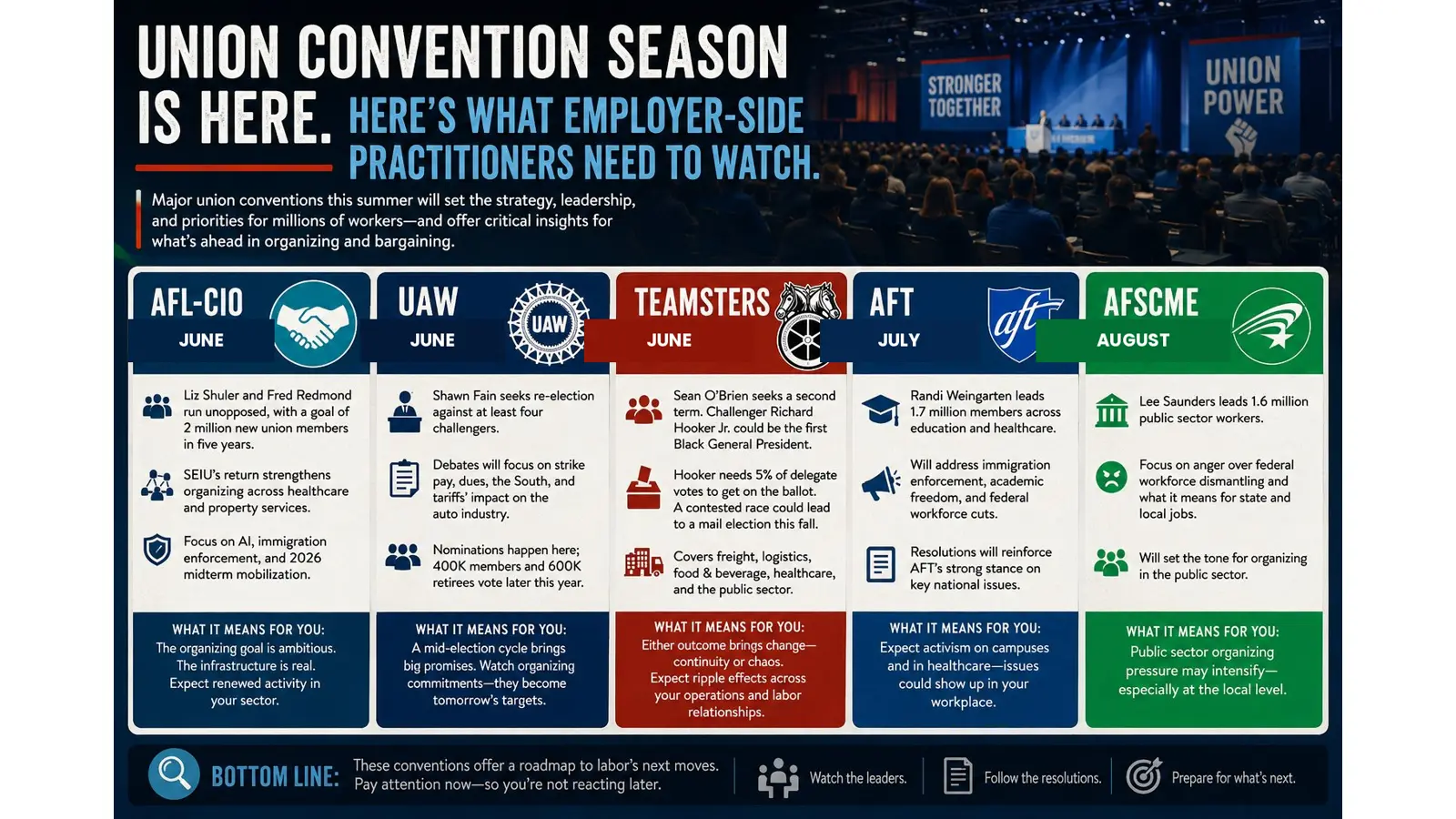
Five of the largest labor union conventions in the United States take place this summer, including the AFL-CIO, the Teamsters, and the UAW.


That is not a coincidence. It is a cycle — constitutional conventions, officer elections, and platform-setting gatherings that collectively define union strategy for the next couple of years. When you add them up, the organizations meeting this summer represent well over 20 million workers, and likely the same number of strongly worded resolutions will be discussed.


Convention season is intelligence work for employer-side practitioners. What unions resolve to do, who they elect, and what they fight about on the floor provide clues to where organizing is headed, which industries are likely targets, and how aggressive the posture on issues like automation and AI will be at the bargaining table. Pay attention now, or you might read about it in a demand letter later.

AFL-CIO: Minneapolis, June

Liz Shuler and Fred Redmond ran unopposed for second terms. No challengers emerged despite multiple appeals from the floor — a sign of either deep unity or a room that knew better than to try. Shuler set the tone fast: two million new union members over the next five years, doubling the previous goal they hit in three years instead of ten. Whether you believe the number or not, they believe the number.


The SEIU’s return to the AFL-CIO after more than two decades away is the structural story underneath the headline. That reunion consolidates significant healthcare and property services organizing capacity under the federation umbrella. Two million workers just got a bigger tent.


The agenda runs through Wednesday: AI, immigration enforcement, and 2026 midterm mobilization. The federation plans to deploy 50,000 trained election protectors to polling places where ICE activity is anticipated. They are not playing small ball.


What it means for you: The organizing target is aspirational. The infrastructure behind it is not. If your sector has been quiet, enjoy it while it lasts. The AI panels deserve your attention — how labor frames automation at convention this week could become what your next negotiating committee puts on the table or drives potential organizing.

UAW: Detroit, June

Shawn Fain is running for re-election on a “Stand Up Slate” of 13 candidates at the 39th Constitutional Convention. He faces at least four challengers, including Brian Keller, a Stellantis worker who built a social media following by being loudly unhappy with Fain, and Will Lehman, a Mack Trucks worker who ran against Fain before and apparently enjoyed it.

The convention nominates but does not elect. The actual vote goes to roughly 400,000 active members and 600,000 retirees later this year. Detroit is where the campaigns launch, not where they land.


Fain’s tenure has been eventful. The 2023 Stand Up Strike. An internal war with former Secretary-Treasurer Margaret Mock that got ugly fast. Organizing promises in the South is still a work in progress. The convention floor will debate strike pay, dues structures, and how the tariff environment is affecting the industry that keeps this union alive.


What it means for you: A union mid-election cycle is a union making promises it must keep. Watch what Fain and his challengers commit to on organizing — those become field priorities. What gets said about non-union Southern facilities in Detroit this week is a preview of who might show up at your gate next year.

Teamsters: Las Vegas, June

The most volatile convention of the summer, and not in a good way if you need predictability from your Teamsters relationships.


Sean O’Brien wants a second term. His first featured the 2023 UPS contract, a turn at the Republican National Convention, and relationships with Josh Hawley and the Trump administration that split his own coalition. A challenger slate called “Fearless,” led by Richard Hooker Jr., who would be the first Black General President in Teamsters history, is trying to get on the ballot. Hooker needs 5% of the delegates, roughly 80 votes. O’Brien’s allies are working the floor to make sure he never gets there.


The fight over the nomination threshold itself is a story. If Hooker clears it, a contested mail ballot election runs through October and November — months of internal warfare across one of the most geographically dispersed unions in the country.


What it means for you: The Teamsters touch freight, logistics, food and beverage, healthcare, and the public sector. O’Brien’s re-election means continuity. A contested race means distraction, unpredictability, and local leadership reading the room for which way the wind is blowing. Neither outcome produces a quieter labor environment.

AFT: Washington D.C., July

The American Federation of Teachers (AFT) holds its 89th biennial convention in Washington. Randi Weingarten leads 1.7 million members across K-12 education, higher education, and healthcare. Those three sectors matter here because the AFT has been the loudest institutional union voice on the issues hitting all three right now: immigration enforcement on campuses, attacks on academic freedom, and federal workforce cuts bleeding into state and local public employment. The convention will put forth resolutions behind that posture.

AFSCME: Chicago, August

Lee Saunders leads the American Federation of State, County and Municipal Employees (AFSCME) into an uncontested convention with 1.6 million public sector members and a lot of anger about the dismantling of the federal workforce that needs to be channeled somewhere. The central question is what the current administration’s assault on federal employment means for organizing density at the state and local level.

The Through-Line

Every one of these conventions operates against the same backdrop: a federal administration showing a mixed response to the interests of organized labor, an NLRB running well behind due to a backlog capacity, and an organizing environment that has produced real gains in a few sectors while overall density hovers near historic lows.


Unions use conventions to set strategy, build internal consensus, and send signals simultaneously. The resolutions passed, the candidates elevated, and the fights on the floor are all data. Convention season is when that data is loudest and cheapest to collect.

Beyond RNs: Most Healthcare Organizing Happens Where Employers Aren't Looking

by Kimberly Ricci

When it comes to union activity in healthcare, registered-nurse organizing campaigns and strikes dominate the headlines. At Chicago's Rush University Medical Center, 1,830 RNs voted to join National Nurses United in May. The Teamsters have made clear their mission to unionize Michigan nurses, so they can wage disruptive strikes like the one at Grand Blanc's Henry Ford Genesys Hospital, where around 600 RNs have been on strike since Sept. 2025. And everyone watching healthcare noticed this year’s NYSNA strike that was costly for workers along with their employers.


So yes, RN-based union activity attracts the most attention, but we couldn't resist digging beyond those headlines. We recently used LRIrightnow data to show why 2025's 88% healthcare union win rate is more complicated than it seems, and how this sector's small-unit trend illustrates a key union strategy.


Now it's time to dispel the media myth that RNs make up the majority of healthcare organizing activity. The data shows that employers have a vulnerability gap worth closing in this industry.

Non-RN Petitions Are The Majority, And This Isn't New

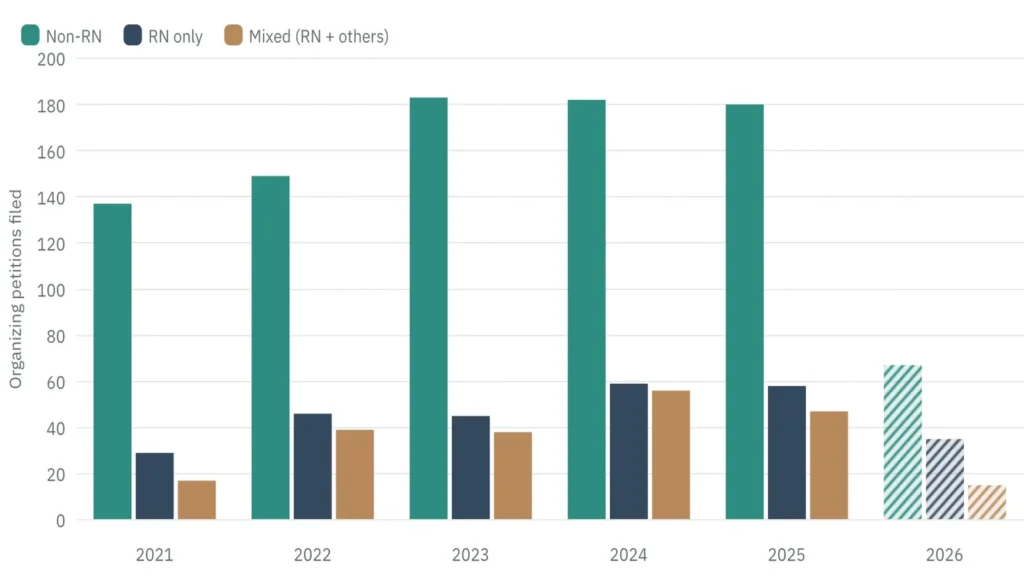
LRIrightnow graph data representation on organizing units that are non-RN, RN-only, and mixed


Looking at the total number of healthcare union petitions is telling. Across 1,843 union-filed organizing petitions in healthcare from January 2021 through early June 2026, RN-only units are consistently outnumbered by non-RN units, and mixed units with some RNs, in every single year. 2026 is shaded out due to being a partial year, but it still follows this same pattern.


These numbers cover hospitals, skilled nursing and residential care, and ambulatory settings, and they exclude decertification petitions and employer-filed cases. For the past five years, non-RN units made up the majority of healthcare organizing petitions, ranging from 57 to 75 percent each year. In the peak year, 2024, 59 petitions were RN-only, 182 were non-RN units, and 56 mixed units combined RNs and other roles.


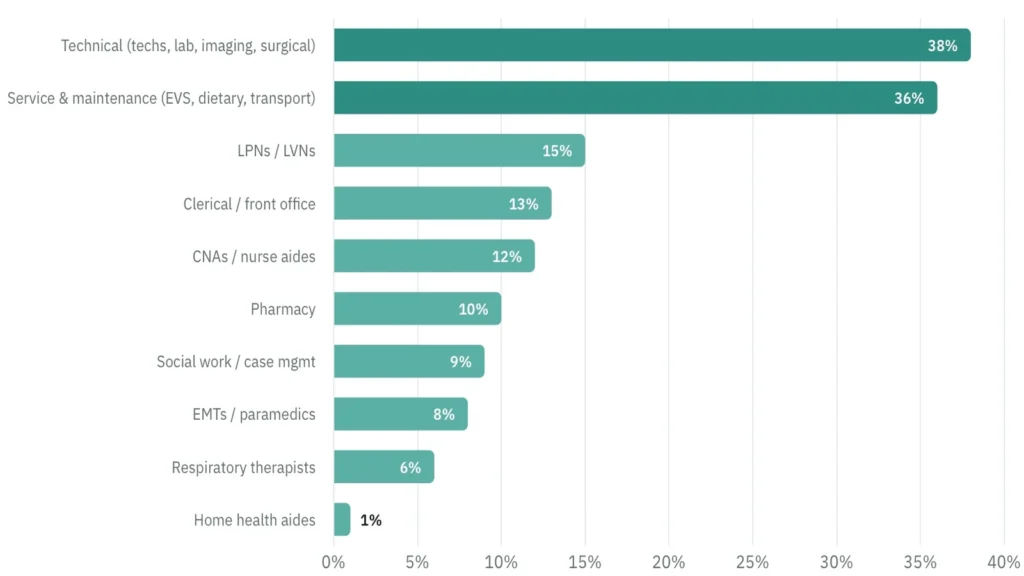
Who are those non-RN workers? Technical staffers, lab workers, clerks, housekeepers, drivers, food-service workers, and other medical professionals. Some nursing aides are also included, but technical and service staff outnumber any nursing-adjacent role.

LRIrightnow data graph on organizing roles in healthcare union petitions

What This Means for Employers

There's a lesson here, which is that labor relations strategies that are geared only toward organizing nurses leave healthcare employers vulnerable to the risk of unions targeting many other roles.


There is also a procedural wrinkle to consider, and it's rarely triggered by RN-only campaigns. Under Section 9(b)(1) of the National Labor Relations Act, the Board cannot include professional and non-professional employees in the same unit unless the professional employees vote to join it first. When a non-RN petition covers a mix of both, a separate vote is necessary, which changes who participates, what the resulting unit looks like, and what arguments the employer can raise during the process. Employers that have only thought through RN-only scenarios tend to get caught flat-footed when those situations come up.


Other blind spots exist, too. In our experience, vulnerability assessments almost always focus on nursing, which means the technical, service, and support staff receive the least attention. And for multi-site healthcare systems, employers should consider every location in addition to flagship hospitals while weighing union exposure for non-RN workforces.


The tech, the aide, the housekeeper, the dietary worker: those campaigns have outnumbered RN filings every year for five years. Big Labor is not limiting its healthcare targets to the nursing station. Preparing for one role in a hospital leaves employers unprepared for the rest.

The Faster Labor Contracts Act – What Employers Need to Know

by Michael VanDervort

Could the Faster Labor Contracts Act fundamentally change how first-time union contracts are negotiated in America?

In this episode of The Left of Boom Show, Phil Wilson is joined by labor relations veteran Dave Sapenoff for a discussion on legislation that could dramatically shorten bargaining timelines and replace negotiations with mandatory mediation and binding arbitration.


They explain how the proposal would require newly organized employers and unions to begin bargaining almost immediately, allow only a limited window to negotiate a first contract, and ultimately place the terms of wages, benefits, scheduling, overtime, and other working conditions into the hands of arbitrators if no agreement is reached.


Phil and Dave examine why first contracts typically take well over a year to negotiate, the unintended consequences of forcing the process into a 90-day timeline, and why both employers and employees could lose control over the final outcome.


Drawing on decades of experience, Dave shares real-world bargaining examples demonstrating how arbitration could dramatically increase labor costs and potentially threaten the viability of businesses operating in competitive industries.


The episode also explores the current political landscape, why this proposal may have a greater chance of advancing than previous efforts, and what employers can do now to educate leadership and engage policymakers before it’s too late.

In this episode you’ll learn:

  • How the Faster Labor Contracts Act would change first-contract negotiations

  • Why mandatory arbitration could eliminate employee ratification votes

  • The risks of compressed bargaining timelines

  • How arbitrators could determine wages, benefits, and work rules

  • Real-world examples of the financial impact on employers

  • Why the proposal could accelerate union organizing campaigns

  • Practical steps employers can take to prepare and respond

Whether you’re an HR leader, labor relations professional, executive, or business owner, this episode explains one of the most significant labor policy proposals currently under discussion and why its implications deserve your attention.


Union Financials Are About to Get a Lot More Transparent

by Michael VanDervort

The federal government thinks union members should know more about where their union dues are spent.  Employers will also benefit from transparent union financials. 

The Department of Labor (DOL) just announced the most significant overhaul of union financial reporting in more than two decades. If you work on the employer side of labor relations, the detailed data you've always wanted to know about the organization across the table is about to become public record.


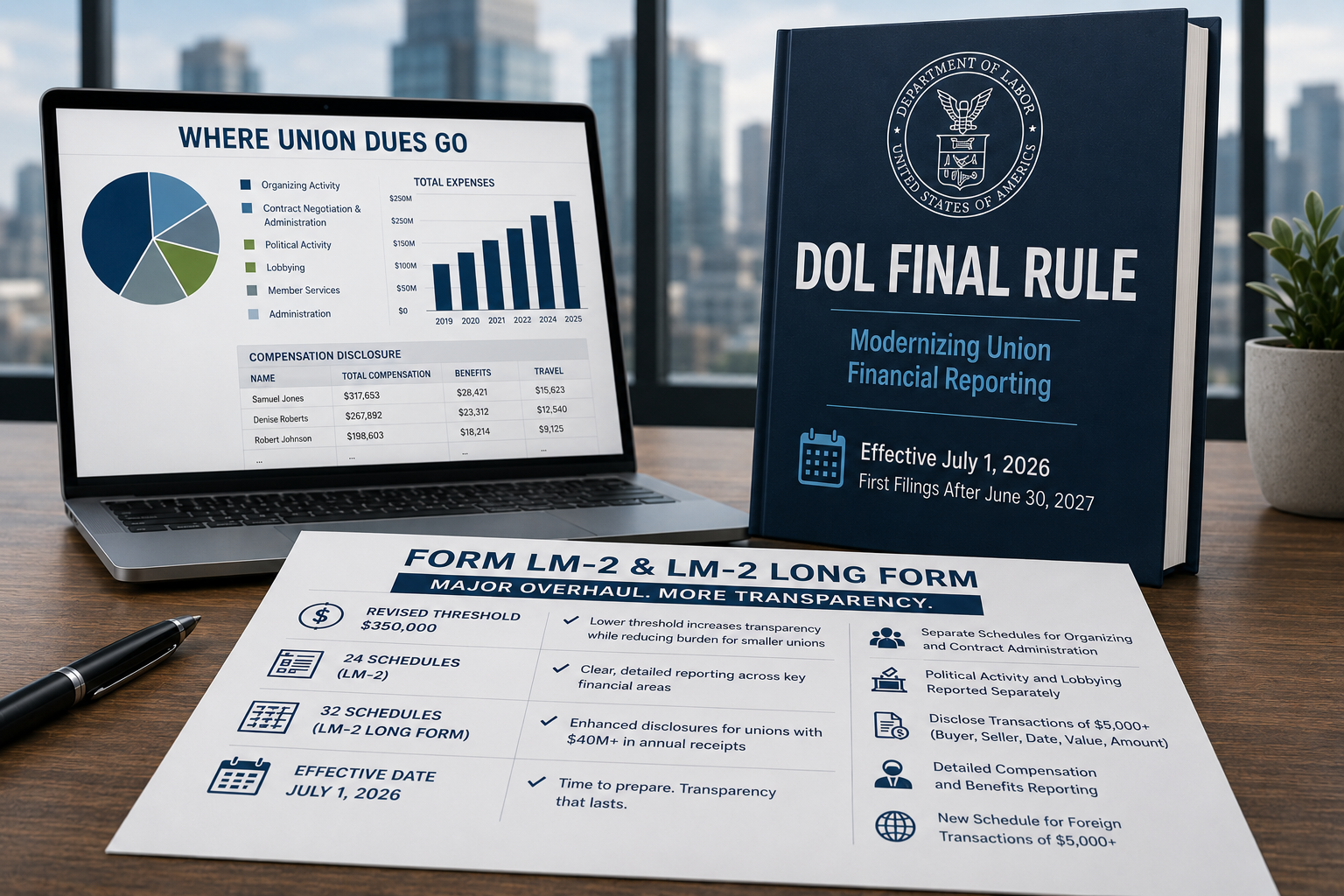
On June 1, 2026, the Office of Labor Management Standards (OLMS) published a final rule that modernizes Form LM-2 and creates a new Form LM-2 Long Form for labor organizations with $40 million or more in annual receipts. The rule is effective July 1, 2026. First filings aren't required until after June 30, 2027.

Why this is happening

OLMS last substantially revised Form LM-2 in 2003. Thresholds for Forms LM-3 and LM-4 hadn't moved since 1992. By fiscal year 2025, three labor organizations reported holding over $1 billion in assets. The fraud record made the reform case more definitive. The UAW-Fiat Chrysler investigation, involving more than $1.5 million in prohibited payments to UAW officials, was part of the explicit record supporting this rule. From October 2020 through September 2025, OLMS used LM reporting data to obtain convictions for 255 individuals for fraud, embezzlement, or other criminal activity involving union funds.

What changes matter most

Spending categories that were previously bundled are now separate. Organizing activity and contract negotiation and administration, previously reported together under Representational Activities, become two distinct schedules. Political activities and lobbying are divided into two: political activity covers candidates, ballot measures, and PAC spending; lobbying covers legislative, executive branch, and regulatory advocacy.


For transactions of $5,000 or more, unions must now identify the buyer or seller, the date, a description of the asset, its value, and the amount paid or received. Compensation reporting is overhauled: travel costs paid directly by the union count as compensation, and health, retirement, and other benefits are given a separate disclosure column. A new schedule covers foreign transactions of $5,000 or more. The strike fund disclosure was proposed but didn't survive public comment.


The threshold adjustments reflect a compromise. The LM-2 filing threshold was set at $350,000 in the final rule, down from the proposed $450,000, to better balance burden reduction and transparency against historic baselines and inflation. The Duane Morris Labor Blog notes that the Long Form alone has 32 schedules. The revised LM-2 carries 24.

Why unions won't love this

Unions have long argued that existing disclosures gave members everything they needed. The Department of Labor just disagreed, in 231 pages.

The old Representational Activities category was a comfortable arrangement for union. Organizing campaigns and contract administration were grouped together, making it difficult for members to see how dues were prioritized. Those two functions now get separate schedules. For the first time, a public filing will show whether a union is spending more on signing up new workplaces than on servicing the members already paying dues. That is information some unions would prefer to stay internal.


Compensation reporting is where things get personal. Travel costs paid directly by the union now count as compensation. Benefits get their own column. What union leadership really earns, when you count everything, will be clearer than it has been under any prior version of this form.


The organizations most affected by the Long Form are those with the most resources, the most sophisticated operations, and, historically, the most complex financial arrangements, such as the UAW and SEIU. Legal challenges are possible. Duane Morris notes that large labor unions opposing the rule may file court challenges to seek a stay of its implementation.


Practitioners who understand the new disclosure framework before 2027 will be better positioned to use it when filings land.

Friday 5: Decertification, Tech Unionizing, And Independent Contractors

by Kimberly Ricci

On May 21, South Sound Inpatient Physicians, PLLC asked the NLRB to throw out a union certification and order a new election for roughly 44 doctors at PeaceHealth facilities in Washington. Those providers had voted to unionize with the Union of American Physicians and Dentists in June 2024. They did so under the assumption that PeaceHealth and South Sound were joint employers, but the Board found otherwise in late April, and PeaceHealth was removed from the certification with South Sound as the sole employer.


Now, South Sound is arguing that converting a joint-employer election into a single-employer certification is a substantive change that warrants a second election or record reopening. The NLRB has not yet ruled on South Sound’s filing, but we’ll be watching to see whether the Board finds that this joint-employer reversal is enough to overturn the union certification.

Sherwin-Williams workers gave the Boilermakers the boot:

A little short but sweet entry here: 83 Sherwin-Williams production workers bid farewell to the International Brotherhood of Boilermakers.


This week, the NLRB certified a vote ejecting the union from the company’s Birmingham factory. The National Right to Work Legal Defense Foundation aided in the effort, which included Jacob Miller filing the decertification petition. Of those who voted, 36 were in favor of ousting the union and 33 against. The union has not responded to press inquiries for a remark, nor has it filed an objection to the vote.

When 'we deserve it' meets the taxpayer's bill

Who gets to decide which occupations "deserve" more money, when virtually everyone feels that way about their own paycheck?


That question runs through this The Atlantic op-ed by Nicholas Bagley, who uses the recent three-day Long Island Rail Road (strike to ask whether public-sector unions truly serve the public interest. The May walkout involved five unions whose work stoppage stranded 300,000+ commuters, and taxpayers foot the bill for compensation packages that already put LIRR workers at average salaries north of $121,000, plus overtime and pensions at age 55.


Bagley points out that politics sets public sector pay, and he questions the deservingness argument. Although some might bristle at that inquiry, he does the legwork on studies involving public sector unions that have prioritized seniority over qualifications and accountability. This has, in some instances, led to worse student outcomes in schools and law enforcement practices that endangered taxpayers' lives rather than increasing safety.


He does offer a solution for those clashes, but for employers watching from the private sector, it is a reminder that the "we deserve it" argument forgets that someone always pays for it.

UC became even more heavily unionized this week:

This week, 2,100+ University of California tech workers voted to join the CWA-affiliated University Professional and Technical Employees (UPTE-CWA). The workers have not been subtle about their overriding reason for organizing, which involves their hopes to shape AI policy at the university amid waves of layoffs throughout the tech industry.


We can also guess that the union promised the moon on this issue, and that those workers will likely be disappointed in their representation. For now, however, California’s Public Employment Relations Board has yet to declare whether this group will be folded into an existing contract.


The AFL-CIO claims that this election win has qualified UPTE-CWA as “the largest tech union in the United States.” This election also means that around 8,400 tech workers are unionized at this university. Additionally, 12,000 more academic and research workers joined UAW, which would add up to at least 60,000 UC workers belonging to Shawn Fain’s union.

News flash for employers: “algorithmic management” was never a thing:

In a Bloomberg Law column, Littler attorney Alex MacDonald put the term “algorithmic management” in its place. That term has been used by critics to argue that digital tools including GPS tracking and performance incentives amount to workforce exploitation. Likewise, the 2024 DOL independent contractor rule treated technological monitoring as a form of "control" that could reclassify a contractor as an employee under the FLSA. Yet MacDonald explained why the term is not the menace it was sold as, and why it doesn’t need a jump-scare treatment.


MacDonald made a compelling case for the current DOL's proposed rule. He argued that the monitoring and incentives described above are not evidence of control over independent contractors. They are necessary mechanisms for businesses navigating the so-called "principal-agent problem" when hiring someone they cannot directly supervise.


The DOL appears to agree, favoring a return to a traditional test: those who control their own work are probably contractors, whereas those who don’t exercise that control are probably employees. Since this is a proposed rule, we'll see how the notice-and-comment period shakes out, but the result for employers should be less uncertainty, including for uses of digital tools.


About Labor Relations INK

Labor Relations INK is published weekly and is edited by LRI Consulting Services, Inc. Feel free to pass this newsletter on to anyone you think might enjoy it. New subscribers can sign up by visiting here.


If you use content from this newsletter, please attribute it to LRI Consulting Services, Inc. and include our website: http://www.LRIonline.com 


Contributing editors for this issue: Greg Kittinger, Michael VanDervort, and Kimberly Ricci.


You are receiving this email because you subscribed to receive our labor relations newsletters and updates. You can manage your email preferences by clicking the link at the bottom of any of our email communications.


About LRI Consulting Services, Inc.

LRI Consulting Services, Inc. exists to help our clients thrive and become extraordinary workplaces. We improve the lives of working people by strengthening relationships with their leaders and each other. For over 40 years, LRI Consulting Services, Inc. has led the labor and employee relations industry, driven by our core values and our proven process, the LRI Way.


Share