Subject: LRI Ink | New Program: LRI Certification in Applied Labor Relations

August 20, 2026

To visit the blog post, click on the link below the article.

When A Healthcare Strike Shrinks The Budget That Workers Are Fighting Over

by Kimberly Ricci

This past year has seen multiple high-profile nursing walkouts, including a New York strike that was costly for workers and the hospitals involved. The Teamsters have drawn out Michigan’s Henry Ford Genesys Hospital strike, which is approaching the one-year mark, and a sizable walkout recently took place in Pennsylvania and isn’t receiving national attention.


A five-day strike by 900+ Service Employees International Union (SEIU) members ended on Aug. 1 at Mount Nittany Medical Center in Centre County, PA. These registered nurses, techs, and respiratory therapists not only returned to work without a new contract, but they walked into a particularly combative aftermath.

A Rare Strike for a Hospital Already being Hit Hard

This was the healthcare system’s first strike in over 20 years, and in a statement, Mount Nittany disclosed that their Fiscal Year 2026 financial results revealed the system’s “first operating loss in more than a decade.” The hospital cited “the cost of the five-day strike” as one contributing factor in a larger picture that “changed our financial outlook and required us to reassess what we can responsibly sustain in a labor agreement” while continuing to serve the community.


What happened to change the situation? In addition to strike costs (explained below), the hospital lost their “Sole Community Hospital” Medicare designation, which has led to reimbursement struggles that have put over a dozen hospitals in jeopardy of closure across Pennsylvania. Further, the hospital confirmed the union’s claims that replacement workers cost at least $6 million over the course of the strike.

Union Math Doesn’t Make Sense

The costs of the strike contributed to Mount Nittany’s financial strain, and the employer reduced what they were offering union members prior to the strike. The proposed wage boost went from 3%/2%/2% to a flat 2%/2%/2% in a three-year contract, meaning that workers not only lost earnings during the strike, but also lost the benefit of the previously offered bargain.


Predictably, the union responded with an unsupportable claim. They insisted that the hospital could have given the striking workers 8% raises rather than spend that $6 million on temporary replacements. An SEIU member spoke with the local CBS affiliate and claimed, “Doing the math shocked me.” She added, “Mount Nittany could have chosen to give us a wage increase that keeps up with inflation this year, and they still would have had half of the money that they spent on temporary workers left over.”


The above quote bypasses an issue illustrated by the strike, which is that temporary healthcare workers are very expensive:

  • Pricey, yes: The “out-of-state temporary” workers typically hired for healthcare strikes are contracted by agencies for a minimum number of days to make their travel worthwhile. On top of agency fees, these workers receive premium rates to account for lodging, travel, food, and for relocating on short notice.

  • A one-time vs. long-term cost: The union does not acknowledge that wage boosts are an ongoing and recurring cost, versus the isolated cost of a 5-day strike. Giving workers an 8% raise is certainly something that employers would love to do if that were sustainable, which Mount Nittany is clearly pointing out is not the case.

Clearly, what happened here isn’t great for workers, but the unfortunate reality is that the hospital system then experienced circumstances that changed what was sustainable to offer, and the original offer had not been ratified. And as mentioned above, Mount Nittany pointed toward multiple contributing factors, including an indisputably expensive strike, for their changed situation.

Tough for Workers, and Tough for the Employer

Mount Nittany is sitting in an unenviable spot. What isn’t up for debate is how hospitals serving rural patients in Pennsylvania are increasingly struggling due to reimbursement cuts. Mount Nittany is not, per se, a “rural” system, but they serve a large percentage of rural patients, and the system recently lost that important Medicare designation, which has hurt their bottom line in an age where everything costs more.


The war of words will surely continue, since the union is claiming that the hospital is withholding raises as a bargaining chip. Mount Nittany has explained that they simply cannot sustain their previous offer, and SEIU’s response claim is a soundbite that doesn’t provide the full picture. Meanwhile, the strike that workers hoped would end in a higher offer instead became a factor that chipped away at what was sitting on the table.


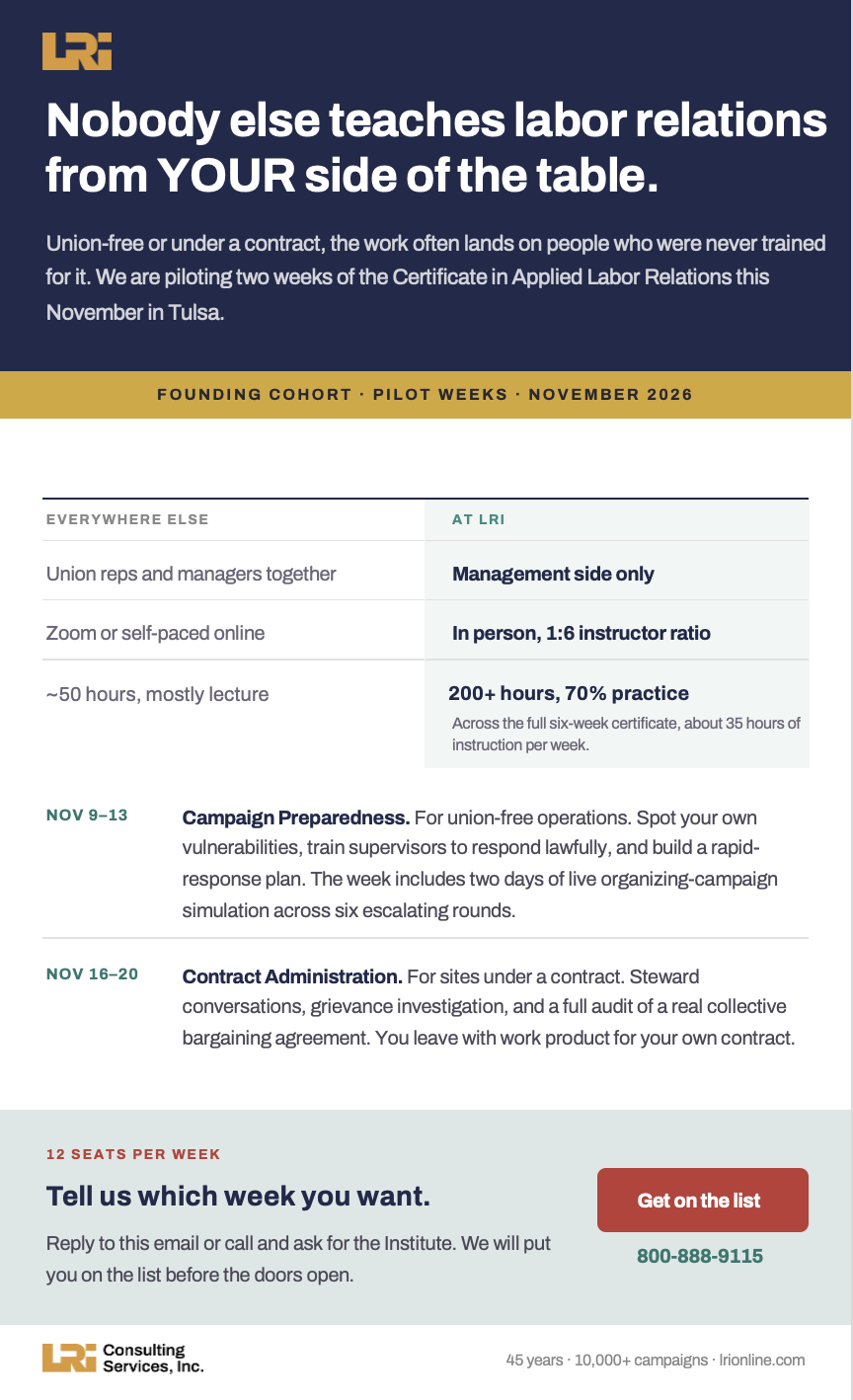
New Program: LRI Certification in Applied Labor Relations

by Michael VanDervort

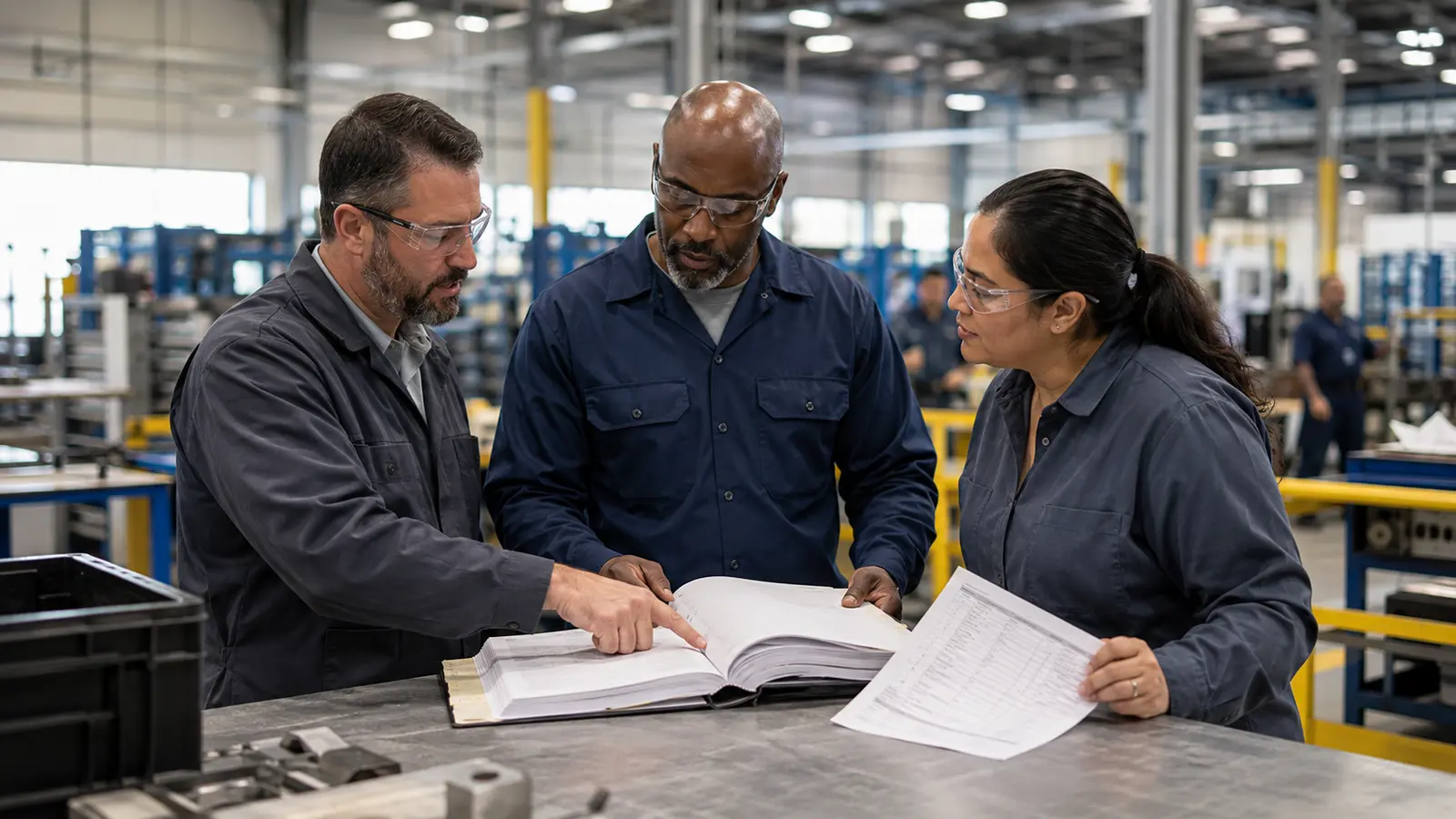
Managing A Union Shop Between Contracts

by Michael VanDervort

What employers can learn about managing a union shop.

This episode of the Left of Boom show features Phil Wilson's discussion with LRI Senior Consultant Dave Sapenoff discussing what employer need to know about effectively managing a union shop.

Why Contracts Erode One Decision at a Time

Union contracts rarely unravel at the bargaining table. More often, it happens one supervisor decision at a time.


An attendance exception gets handled differently on the night shift. A steward’s interpretation goes unchallenged because nobody checks the language.


Management in a department informally adopts and follows a work practice inconsistent with the contract language.


By the time the parties exchange proposals, years of those decisions have shaped the relationship.


On a recent episode of LRI’s the Left of Boom Show podcast, Phil Wilson talked with LRI Senior Consultant Dave Sapenoff about managing a union shop between contracts.


Sapenoff knows both sides of the table. He spent seven years as a Teamsters organizer before moving into management, where he was responsible for 12,000 bargaining unit employees working under 35 agreements in 18 states.

His advice is straightforward. Following it consistently is the hard part.

Firm Beats Hostile: Enforcing the Agreement As Written

Once employees are represented, hostility toward the union is usually not viable. You have to develop a working relationship.


That does not mean management should agree with the union on everything or soften every position. A productive labor relationship is not singing kumbaya. Management still needs to be firm. It also needs to be responsible and predictable.


Turning routine contract disputes into political contests may win an argument today while making the relationship more expensive tomorrow.


Sapenoff’s advice is simpler: “Do what the contract says, not what you think is fair.”


Supervisors cannot replace negotiated language with personal judgment because they dislike the result. The agreement governs the relationship, including the parts management may not particularly enjoy.


Credibility matters too. If management screws up, admit the error and move on. Defending a bad position wastes time and costs the company credibility over the long run.

Why Admitting Mistakes Protects Credibility

Most contract administration does not happen in the labor relations office. The work typically happens on the shop floor and is managed daily by your frontline supervisors.  They need training to do this effectively.


Handing a supervisor a 60-page agreement and saying, “Manage it,” is not training. It is how employers create what Sapenoff calls a grievance machine.

Supervisors do not need to memorize the agreement. They need to understand the provisions they use regularly, know the difference between a gripe and a contractual grievance, and recognize when to ask for help.


When someone alleges a violation, reach for the agreement. The steward may be right. The steward may be wrong. Either way, management should read the language and check the facts before responding.


Consistency across supervisors matters just as much. If two managers handle the same issue differently, the union will lean into that, and employees have a reason to question management. Too many exceptions can also fuel a past-practice argument.


Labor relations should be a regular management conversation, not something dusted off when a grievance reaches arbitration, or the contract is about to expire.

The Three Parties in Every Union Relationship

Collective bargaining is usually described as management versus the union. Sapenoff sees three parties in the relationship: management, union leadership, and the employees the union represents.


The union and its members are not always on the same page.


Union leaders must manage expectations, internal politics, and pressure to produce results. Employers that ignore that reality can leave union leaders with no face-saving option except escalation.


That does not mean giving away the store. It means management does not have to win every disagreement to manage the relationship effectively.


It also means continuing to communicate with employees. Representation changes some legal boundaries, but it does not end management’s responsibility to talk about safety, customer expectations, business conditions, and operational challenges.


If leadership says nothing until bargaining begins, employees will fill in the blanks. Their version probably will not make negotiations easier.

Do the Work Before Bargaining

Employers should understand what a strike or other job action would mean before bargaining begins. They should also know whether supervisors can administer the agreement, whether grievance patterns point to larger problems, and where outside help may be needed.


Most mid-market employers will never have a full-time labor relations department. They still need labor relations capability. Fractional labor relations support can fill the gaps through assisting with supervisor training, grievance advice, arbitration preparation, and bargaining strategy.


The art of negotiation is not confined to the table. It is practiced every day on the shop floor, often by supervisors who do not realize they are helping to set the tone for the next contract.


Employers that understand that arrive at bargaining with something more valuable than a stack of proposals. They arrive at the table with a relationship built on consistency and credibility.

Listen to the Conversation

Watch or listen to Phil Wilson’s complete interview with Dave Sapenoff on Left of Boom: Managing the Union Shop.

The Teamsters' Use Of A Merger As Leverage Is Much More Than A Hollywood Story

by Kimberly Ricci

There’s a bit of a production happening in California right now because Hollywood itself has become a show. Paramount’s pending purchase of Warner Bros Discovery has hit roadblocks after the state’s attorney general filed an antitrust suit that’s holding up proceedings. Paramount then threatened to leave California to resolve the issue, and that threat riled up Big Labor, which threw its own wrench into the merger.


How this madness resolves is anyone’s guess, but the Teamsters are involved with their typical bluster intact. This union asked the Justice Department to halt the merger, and Teamsters Hollywood chief Lindsay Dougherty predictably labeled Paramount’s actions as “corporate greed” that will take jobs out of Los Angeles. The Writers Guild of America further shared the sentiment to apply more pressure, and Paramount is aggressively pushing back in court to counter the financial damage that these halting tactics are causing.


This is all with the goal of pushing Paramount to abandon its plans, and for businesses that don’t touch Hollywood, it’s tempting to write this off as a far-away tale, but this should be a story that every employer watches.


In fact, unions often respond to mergers by forcing employers’ hands through public sentiment and by lobbying the government to do their bidding.

A Familiar Union Tactic In Many Industries

Grocery: In 2024, the Federal Trade Commission (FTC) claimed “victory” after two courts, one at the federal and one at the state level, issued preliminary injunctions to halt a proposed merger between Kroger and Albertsons. Prior to the FTC filing suit in the matter, several UFCW locals formed a "coalition" called "stop the merger" to drum up public sentiment for their views. In doing so, union representatives testified in front of the FTC. After courts issued the injunctions, the grocers abandoned merger plans, and of course, the unions also claimed “victory.”


Healthcare: A trio of examples is coming your way.

  • In 2023, the International Association of Machinists and Aerospace Workers’ Healthcare branch and Minnesota Nurses Association pressured lawmakers into opposing a merger between Sanford Health and Fairview Health Services. After lawmaker scrutiny and public backlash, Fairview backed out of the pending deal.

  • In 2025, merger plans between Oregon Health & Science University and Legacy Health were abandoned after lobbying by the American Federation of State, County and Municipal Employees. This lobbying prompted regulatory scrutiny from the Oregon Health Authority.

  • Currently, Allina Health's pending acquisition of Sutter Health is being opposed by the Service Employees International Union and various nursing unions, which are asking state regulators to shut the deal down before it would take effect in late 2026.

Telecommunications: In this industry, Communications Workers of America (CWA) took a different approach by supporting a merger in exchange for a union neutrality stance. This took place in 2011 during the pending AT&T-DirecTV merger, and AT&T responded by agreeing to voluntarily recognize CWA's unionization of its workforce. At the time, Big Labor viewed CWA’s strategy as controversial, since mergers can lead to job losses, but the CWA’s strategy ultimately stands as another example of how unions can leverage merger proceedings for their own goals, whatever they might be.

A Merger By Any Name Sounds As Sweet For Unions

As the above examples show, a merger isn't simply a merger to unions, which will pounce according to what's best for their own ends. In many of these scenarios, unions were quick to apply leverage geared toward public sentiment to gain their desired results. Whereas with the AT&T example, the union decided that pressuring an employer into a neutrality agreement was worth more bang for their (union dues) bucks.


What the Teamsters are trying to pull with Paramount’s proceedings is nothing new, but it does provide a reminder that Big Labor loves to leverage a merger or acquisition as a bargaining chip, and employers would do well to anticipate that tactic.


Friday Five: Teamsters Gloss Over Contract Details And Shawn Fain Gets Snubbed

by Kimberly Ricci

The Teamsters’ “win” at Breakthru Beverage sure doesn’t look like it was great for workers:

For over 80 days, workers at three Teamsters locals picketed over alleged ULPs at Breakthru Beverage. That strike ended this week, and Sean O’Brien is claiming a contract “win” while adding, “The power of our solidarity is undeniable.” That was part of a vague announcement claiming that “wage increases” are part of the deal. The union didn’t offer details regarding the percentage of those increases, so what gives?


Well, KMOX-AM in St. Louis reported that the deal is for “a 4-percent wage increase over the next 4 years.” Presumably, they meant 4 percent per year, which is higher than 4% spread over 4 years, but neither figure is worth writing home about when the Teamsters took drivers off the job for nearly three months. KMOX added that the two sides agreed to “circle back to negotiations on health and welfare benefits in the next 90 days,” which also doesn’t look like a hard-hitting union victory on any front at all.

Ex-UAW presidents made an endorsement, and it’s not Shawn Fain:

It wouldn’t be a Friday Five in this year’s union convention season without an update on the hot mess of the United Auto Workers’ (UAW) presidential race. That grand jury subpoena for testimony from federal monitor Neil Barofsky likely has plenty to do with ongoing accusations against Shawn Fain, and three former UAW presidents are watching it go down.


To that end, Ray Curry, Rory Gamble, and Ron Gettelfinger issued a joint statement, in which they questioned the 2023 election that installed Fain as president over incumbent Curry. As the trio pointed out, only 11% of the UAW’s eligible membership cast ballots, and they believe the election proceedings had “numerous issues” that could have changed the outcome.


The group also listed their concerns in several bullet points, including, “We’ve seen the infighting, and we’ve read every word in the Monitor’s Report to the Court and listened to the podcasts.” And then they endorsed 20-year UAW organizer Tricia Geiger for president.


As expected, Fain wasn’t pleased. In a response, he declared that the trio only wants to steer the UAW back to “the old, failed ways of doing things.”

Another strike coming from The Pharmacy Guild:

In fall 2023, scattered CVS stores saw pharmacists walk off the job for a short-lived strike that didn't disrupt business all that much. Three years later, The Pharmacy Guild (TPG) is now back for another round after dubbing the previous effort as “pharmageddon.”


In California, Rhode Island, and Arizona, CVS pharmacists, who are TPG members, authorized a strike while citing contract negotiations that have dragged on for two years. The union blames the company for staffing shortages while a CVS spokesperson countered, “We’re committed to ensuring there are appropriate levels of staffing and resources at our pharmacies.” The company further believes that this strike authorization does not pose a threat to their customer service.

California rideshare drivers will be unionized, whether they like it or not:

Earlier this year, Massachusetts one-upped California by certifying the so-called “App Drivers Union,” a joint invention from the Service Employees International Union (SEIU) and the International Association of Machinists (IAM). Now California is catching up with the California Gig Workers Union (CGWU), and a 30-day waiting period has begun, after which the California Public Employment Relations Board will certify the union.


CGWU is a creation of SEIU, and Uber and Lyft stated that they will cooperate with the union, but as with the Massachusetts union, the CGWU also comes with small print. Drivers will remain independent contractors but will be bound to a union constitution, meaning that they will be paying union dues, and to what end? That remains to be seen, but they’ll lose freedoms associated with being contractors and have no guarantee of receiving benefits associated with being employees.


There’s also the whole “active driver” distinction with CGWU from over 30% of that group. However, it’s a misleading term that allowed the Massachusetts App Drivers Union to only gather 12.5% support from the state’s gig drivers while claiming to have reached 25%. If that pattern holds up, only about 15% of California gig drivers signed cards for CGWU, but soon, they’ll all be bound to a union.

Are your workers checked out, via their calendar?

A newish study from Owl Labs is making the rounds and points toward a trend that is worth some pondering by leadership teams. That is, 35% of surveyed workers admit that they use so-called “calendar blocking” to avoid engaging at work. That number is highest among millennials at 61%, followed by Gen X-ers at 22%, Gen Z-ers at 14%, and Boomers at 3%.


Elsewhere in that study, surveyed managers who admit that their main worry is employee engagement feel that way about both in-office (31%) and remote (29%) workers. Are these two sets of data related? Perhaps to some degree, but the calendar-blocking issue likely occurs for multiple reasons, which would differ according to reflections by any given leadership team who reads the survey.

However, surveyed workers averaged 5 in-person and 5 remote meetings per week. That’s a lot of meetings!


About Labor Relations INK

Labor Relations INK is published weekly and is edited by LRI Consulting Services, Inc. Feel free to pass this newsletter on to anyone you think might enjoy it. New subscribers can sign up by visiting here.


If you use content from this newsletter, please attribute it to LRI Consulting Services, Inc. and include our website: http://www.LRIonline.com 


Contributing editors for this issue: Greg Kittinger, Michael VanDervort, and Kimberly Ricci.


You are receiving this email because you subscribed to receive our labor relations newsletters and updates. You can manage your email preferences by clicking the link at the bottom of any of our email communications.


About LRI Consulting Services, Inc.

LRI Consulting Services, Inc. exists to help our clients thrive and become extraordinary workplaces. We improve the lives of working people by strengthening relationships with their leaders and each other. For over 40 years, LRI Consulting Services, Inc. has led the labor and employee relations industry, driven by our core values and our proven process, the LRI Way.


Share