Subject: LRI Ink: New LRI Data Report Drops + The Union Research Edge


October 15, 2026

To visit the blog post, click on the link below the article.


How Union Research Provides A Labor Relations Edge

by Michael VanDervort

What Happens When a Former Union Organizer Starts Digging Into Union Research Data?

Nancy Jowske spent 10 years as an organizer and organizing director for SEIU before moving to the employer side. She's worked with LRI Consulting Services, Inc. (LRI) as a senior consultant for 15 years, now doing labor relations research, and as Phil Wilson knows, she has a knack for finding things buried in union records.


Sometimes those discoveries are surprising. Sometimes they're buried in a collective bargaining agreement. And sometimes they involve a union's finances looking better than anyone expected.


In a recent episode of the Left of Boom Show, titled The Labor Relations Research Edge, Phil and Nancy discussed the value labor relations research can provide, including some of Nancy's more unusual discoveries.

From Site Reports to Following the Data

Nancy's research work began when LRI needed labor relations risk reports for a client expanding into several locations. She hadn't done that kind of work before, but figured she could work it out. Fourteen years and hundreds of reports later, that original client remains her biggest.


Today, her work includes industry and regional research, union profiles, organizing campaigns, and collective bargaining agreements. Her starting point hasn't changed.


"I always start with the data," she told Phil.


Easier said than done.


Government databases can contain multiple copies of the same collective bargaining agreement, sometimes with different expiration dates. NLRB petitions may be withdrawn and refiled, making one organizing effort look like several.

"I'm trying to turn those petitions into events," Nancy explained, rather than simply counting filings.

Following the Money

Nancy spends considerable time examining LM-2 reports, the financial disclosures unions file with the Department of Labor.


She's less interested in total revenue than in dues and per-capita income. She also tracks membership changes, including situations where unions count retirees in reported membership totals.


Then there's organizing spending. A union local might suddenly add organizers or hire contractors whose expenses appear under representational spending rather than payroll.


Those details can tell a different story from the headline numbers.

The Contract Doesn't Always Match the Press Release

Phil and Nancy also revisited the UPS and Big Three auto agreements, which unions promoted aggressively for their wage gains. Nancy enjoys digging into the actual agreements, comparing contract language and wage increases with inflation.


She described research identifying instances in manufacturing, retail, and warehousing where nonunion wages exceeded union wages, sometimes by several dollars.


Her explanation? Union contract terms may have limited wage increases while labor shortages pushed wages higher at nonunion employers.


It's one reason she doesn't take union contract announcements at face value. The actual agreement may tell a different story.

Sometimes There's Nothing to Find

One of Nancy's more interesting observations had nothing to do with uncovering problems. Sometimes a union local's finances look perfectly sound.


When that happens, she tells the client not to challenge the union's finances. As Phil agreed, making claims that won't withstand scrutiny can backfire.


That's an important distinction. Research isn't particularly useful if you're only looking for information that confirms what you already believe.


Whether an employer is considering a new location, preparing for bargaining, or investigating organizing activity, knowing what's happening beats guessing.

But Nancy's interest in the truth goes beyond employer decisions. She began her career believing she was helping union members. Her experiences as an organizer left her determined to hold unions accountable for their claims about representation, democracy, and how members' dues are spent.


"I want to hold them to their own standards," she told Phil.


After years of digging through the records, that's still what motivates her.


Listen to the full conversation:The Left of Boom Show: The Labor Relations Research Edge, featuring Phillip Wilson and Nancy Jowske.



LRIrightnow Third Quarter 2026 NLRB Election Review Now Available

by Michael VanDervort

Featuring key NLRB Election and Petition trend data from the newly released LRI RightNow Third Quarter 2026 NLRB Elections and Petitions Review, covering RC, RD, and employer-filed RM elections and petitions, broken down by union, NLRB region, state, industry, and unit size.

Petitions Are Running Ahead of NLRB Elections

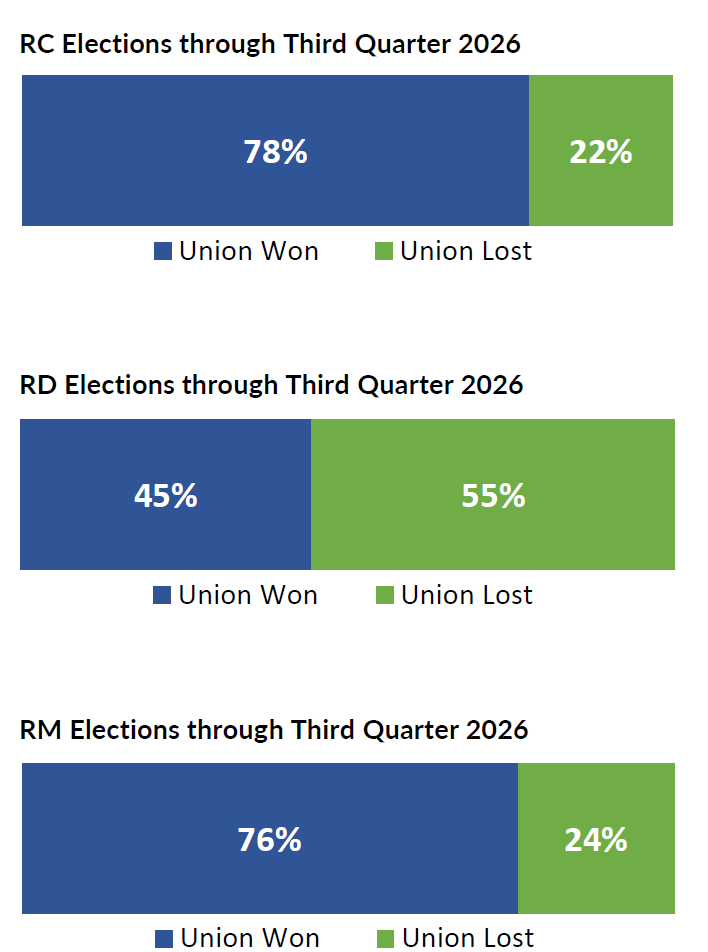
Representation (RC) elections are down 5% through the first nine months of 2026, to 1,120, and unions won 78% of them. RC petitions filed from July through September ran 12% ahead of last year in the third quarter.  Decertification (RD) elections are up 12% for the year.


RC petitions totaled 1,584 through September, down 1% for the year. The third quarter ran the other way: 560 petitions against 499 a year earlier, up 12%, while certified RC elections fell 8%, to 360 from 393. Only 70.7% of petitions have produced a certified election, down from 73.9%. Services filed the most petitions, 327, and 28% were withdrawn, compared with 17% of the 305 filed in Healthcare and Social Assistance.


Workers in targeted units reached 267,578, up 196%. One valid petition for a roughly 190,000-worker unit in New York accounts for most of that increase. Without it, the total would be about 77,600, down about 14%.

Decertification Elections Rise as Petitions Fall

Certified RD elections totaled 112, while RD petitions fell 3%. In the third quarter alone, RD petitions fell 21% and certified RD elections rose 54%. Unions won 44.6% of RD elections, and workers in units where the union lost rose 45%, to 3,045.

The Teamsters Lead on Volume

The International Brotherhood of Teamsters (Teamsters) appeared in 258 RC elections, more than two and a half times the next most active union, and won 73%, against 78% for all unions. They won 9 of 21 RD elections (43%) and 9 of 12 employer-filed (RM) elections (75%). SEIU and Workers United (SEIU affiliate) were the next most active with a combined 179 RC election wins (83%).

Industry Results Differ Between Organizing and Decertification

Healthcare and Social Assistance produced the most certified RC elections, 230, with an 86% union win rate. Utilities had the highest RC win rate of any sector, 90% (45 of 50), and the lowest RD win rate among sectors with at least five decertification elections, 2 of 9. Construction (54% across 41 elections) and Wholesale Trade (66% across 70) were the weakest sectors for unions among those with at least 40 RC elections.

Employer-Filed Activity Keeps Contracting

RM petitions fell 29%, and certified RM elections fell 30%, to 50. Workers covered by RM petitions fell 55%, to 3,065. Unions won 76% of RM elections.

Where Activity and Union Success Are Concentrated

Region 19, covering the Pacific Northwest, led all NLRB regions with 123 certified RC elections, and unions won 84%. Among regions with at least 31 RC elections, Region 29 (Brooklyn) had the highest union win rate at 91%, and Region 31 (Los Angeles) the lowest at 62%. California had the most RC elections of any state, 174, with a 75% union win rate. Among states with at least 44 RC elections, New York was highest at 86%, and Pennsylvania and Ohio were lowest at 72%.

Get the Full Petitions and Elections Report

The LRI RightNow Third Quarter 2026 NLRB Elections and Petitions Review covers RC, RD, and employer-filed elections and petitions, broken down by union, NLRB region, state, industry, and unit size. Purchase the full Q3 2026 report for $150.


Friday Five: More Nurses Vs. Teamsters, UAW Election Subplots, And New Jersey's ABC Test

by Kimberly Ricci

More Henry Ford Genesys nurses want to boot the Teamsters:

Last month, we told you about the decertification (RD) petition filed by a group of 80 acute-care registered nurses at Henry Ford Genesys Hospital in Grand Blanc, MI. That news followed the Teamsters strike reaching the one-year mark with no signs of a contract in sight. Those nurses stayed quiet about the petition, but clearly, some of them are more than finished with the union.


Now, a second RD petition covering 385 Henry Ford nurses has been filed with legal aid from the National Right to Work (NRTW) Foundation, and nurse Kristen Cox is publicly leading that effort. The new petition was signed by 264 of those nurses, and the NRTW Foundation is also representing Genesys nurses who filed ULPs against the Teamsters for retaliation if they went back to work. We’ll be watching how these petitions fare, and whether the Teamsters play dirty (as they often do) by filing blocking charges to continue representing nurses who don’t want them.

UAW election results are rolling in, but Shawn Fain has fewer fans near home:

(UPDATE 5:30 EST: Shawn Fain's campaign has claimed victory in the UAW election.)


Let’s get real... Shawn Fain will almost certainly keep his presidential gig. The union’s officer election results are still being tabulated under the oversight of federal monitor Neil Barofsky, and in some regions, Fain received around 70% of the vote. However, Region 1, based in Warren, MI, doesn’t have as many Fain fans on hand. There, he received a lukewarm 57.7% of the vote, which seems like a telling development to be happening in Solidarity House's backyard.


So, Fain will probably be blustering for years to come with his general strike plans lingering in the distance. It’s very difficult to oust a sitting union president unless there are criminal charges in the mix, but hey, that could still happen after a grand jury subpoenaed Barofsky over his reports, which are full of allegations against Fain.


Meanwhile, a UAW International official has been terminated for posting an AI-generated image that many considered to be a death threat against Fain rival Will Lehman. Raymond Jensen said goodbye to his $202,000-a-year job, and although Lehman didn’t have much of a chance in the election, at least he had the pleasure of grilling Fain over the image during a debate.

Another state bans so-called “captive audience meetings”:

Delaware joined a list of at least 13 other states that have barred employers from requiring workers to attend meetings that include views on unionization. House Bill 84, which was signed into law by Gov. Matt Meyer, prohibits employers from disciplining or firing employees who don’t attend such meetings.


Delaware’s law does not provide for specific penalties for employers who violate the ban, but other states do. Under Illinois’ law, a $1,000 fine per worker, per violation, is on the table, and Maryland’s law (which went into effect on Oct. 1) authorizes the state labor commissioner to assess $10,000 penalties for first violations and $25,000 for subsequent violations.


Whether these laws survive long term is anyone’s guess, since business groups have been challenging them on First Amendment grounds. Currently, California’s law is blocked by an injunction on free speech and NLRA preemption grounds. That state’s officials have appealed the decision to the Ninth Circuit Court of Appeals.

New Jersey’s independent contractor test is now law:

Decades of New Jersey case law on independent contractor classification have been codified, and those controversial regulations took effect on Oct. 1.


Officially, the three-pronged ABC test must now be satisfied before workers will be considered independent contractors: workers must be free from an employer’s control, the work they perform must be outside of the employer’s usual course of business, and they must be customarily engaged in an independently established business or occupation.


Gov. Mikie Sherrill has insisted that nothing will change for these workers, and that those who are currently classified as independent contractors will stay that way. Yet some freelancers and business groups question why workers in 2026 are subject to a test that began popping up in judicial opinions in the 1930s. Requests to postpone the law’s effective date went unheeded, and Senate President Nicholas Scutari seeks a fix that can smooth out rough spots.

The Wizards of the Coast Union could be growing:

Only a few months after the first union election at Wizards of the Coast, more groups are following suit to join Communication Workers of America. Two new representation petitions were filed, this time by the company’s Dungeons & Dragons and Magic: The Gathering workers, who want assurances on the use of generative AI. We’re keeping our eyes on this story.


About Labor Relations INK

Labor Relations INK is published weekly and is edited by LRI Consulting Services, Inc. Feel free to pass this newsletter on to anyone you think might enjoy it. New subscribers can sign up by visiting here.


If you use content from this newsletter, please attribute it to LRI Consulting Services, Inc. and include our website: http://www.LRIonline.com 


Contributing editors for this issue: Greg Kittinger, Michael VanDervort, and Kimberly Ricci.


You are receiving this email because you subscribed to receive our labor relations newsletters and updates. You can manage your email preferences by clicking the link at the bottom of any of our email communications.


About LRI Consulting Services, Inc.

LRI Consulting Services, Inc. exists to help our clients thrive and become extraordinary workplaces. We improve the lives of working people by strengthening relationships with their leaders and each other. For over 40 years, LRI Consulting Services, Inc. has led the labor and employee relations industry, driven by our core values and our proven process, the LRI Way.


Share