Subject: LRI Ink: NLRB Twist, Starbucks, Strike Prep & Rand Paul Move


November 19, 2026

To visit the blog post, click on the link below the article.


The NLRB’s 10(j) Injunction Saga Just Got Messier

by Kimberly Ricci

As of this month, the courts are still battling over the 10(j) injunction headache wrought by the Biden-era NLRB. Under former General Counsel Jennifer Abruzzo’s oversight, the Board abused this mechanism in 2022 by using alleged, unproven ULPs against Starbucks to request a nationwide injunction through its Buffalo, NY regional office. These ULP charges were tied to Starbucks Workers United’s organizing drive, and the Board was effectively pressuring Starbucks to roll over.


Separately, a 10(j) fight over a Memphis Starbucks store reached the Supreme Court. The resulting ruling, Starbucks v. McKinney, resolved a circuit split but somehow didn’t end the saga. Now, a subsequent circuit split is widening. Let’s look at where the highest U.S. court landed, followed by the latest appeals court interpretation and where other circuits sit.

Starbucks v. McKinney: A Supreme Court ruling without finality

The 10(j) injunction was meant as an “in case of emergency, break glass”-level tool and extraordinary remedy to prevent irreparable harm. The Abruzzo Board felt differently, and Starbucks challenged one of the resulting injunctions all the way to the Supreme Court.


In 2024, the high court resolved a circuit split in McKinney by rejecting the lenient “reasonable cause” standard for 10(j) injunctions in favor of Winter v. Natural Resources Defense Council’s four-factor test, which requires a higher threshold. Now, appeals courts are coming to different conclusions on what the Supreme Court’s ruling means in practice.

The Seventh Circuit picks a side

This month, the full Seventh Circuit denied a petition to rehear Hamada v. Laborforce, a Sept. 2026 ruling from a divided Seventh Circuit panel. That decision affirmed the denial of an injunction that the Board sought after an Illinois truck dealership withdrew recognition of the International Association of Machinists and Aerospace Workers (IAM) following a pair of employee petitions circulated to build support for ousting IAM.


The Seventh Circuit panel had found, without deciding whether the withdrawal was legal, that “generic claims about erosion of union support” aren’t enough to establish irreparable harm and that courts must also weigh workers’ “right to refrain” from unionizing.


With this ruling, the Seventh Circuit aligned with the Sixth Circuit and disagreed with the Second Circuit’s approach, both discussed below:


- The Sixth Circuit reversed a district court decision granting an injunction against a Michigan hospital, which had withdrawn recognition from a union. In doing so, the Sixth Circuit’s GOP majority found that McKinney requires the Board to show likely irreparable harm rather than rely on speculative arguments to obtain an injunction.


- The Second Circuit went the other way by reversing the denial of an injunction petition and ordering a parking management company to immediately recognize and bargain with its valet attendants’ union. The court’s Democratic majority cited McKinney but gave the Supreme Court’s opinion little consideration while weighing irreparable harm and likelihood of success on the merits of the underlying ULP case.


Also previously: An unpublished Ninth Circuit decision didn’t cite McKinney while affirming an injunction under Winter’s four-factor test.

More cleanup to come, courtesy of the circuits

Where does this dispute go now, since there’s a circuit split over how to interpret a Supreme Court ruling that was meant to resolve a circuit split? If you guessed that the interpretation of “irreparable harm” could one day make it back to the Supreme Court for clarification, well, it could happen after more bumps along the road.


There’s also a procedural angle to this that can make 10(j) injunctions even more frustrating. They only last until the Board decides the underlying case, so a Board ruling can make an injunction fight moot while it’s still in appeals.

Employers still must operate under an injunction in the meantime, which is about as convenient as one can imagine.


McKinney still made it to the Supreme Court, yet the ruling left lower courts to interpret the meaning of “irreparable harm,” which isn’t going smoothly. The Seventh Circuit flat-out acknowledged the split in a footnote, but that doesn’t mean much unless a losing party in a case like Hamada asks the Supreme Court to resolve the split, and the court decides to hear the case.


Strike Planning Starts Long Before the Picket Line

by Michael VanDervort

Every collective bargaining negotiation comes with the need to conduct strike planning and preparation. Unions decide to strike, and the employer must decide how to respond. This requires careful planning and preparation.


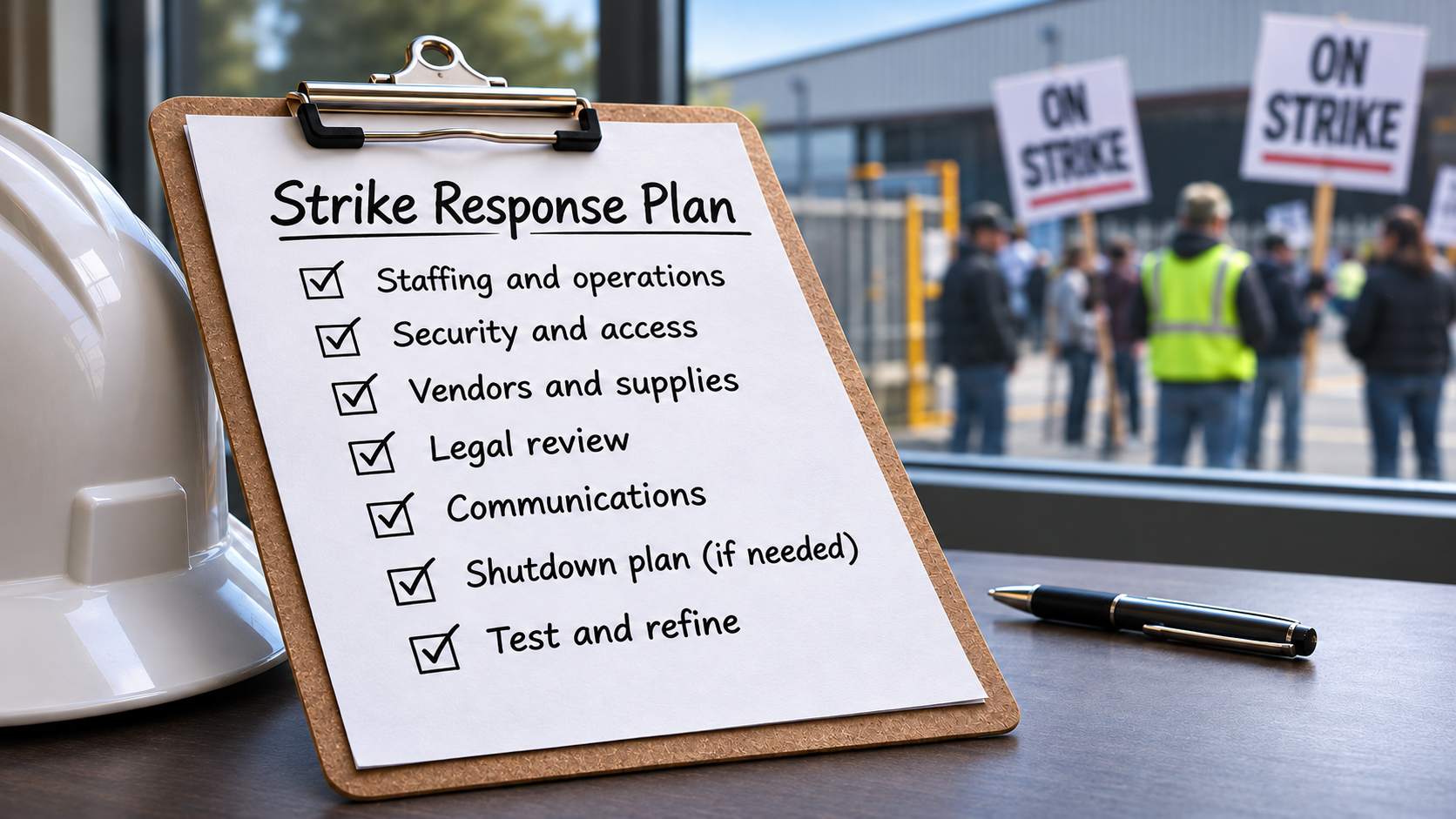
Strike planning involves more than lining up replacement workers. Security, vendors, legal review, and communications require organization-wide coordination while bargaining continues.


The tactics below come from a Left of Boom Show episode, Strike Response Planning and Preparation, where experts from LRI Consulting Services (LRI) discuss what employers need in place before a strike. The episode is part of Managing During Status Quo, LRI's series for employers heading into first-contract bargaining.

Start a year out

In one first-contract case discussed on the show, planning began the week the union was certified. The strike came about a year later, and replacement staff arrived in time to keep operations running. Agency contracts and security arrangements alone can take months to put in place.

Decide how you will run the place

Start with the worst-case scenario, and everyone walks. Then model a situation where some employees cross the picket line. Most plans combine agency replacements, managers and non-union staff covering work, production shifted to another site, or inventory built ahead of a potential stoppage. Identify who can make staffing and operating decisions as conditions change.


The law matters here. Employers may hire permanent replacements in an economic strike, but not in an unfair labor practice (ULP) strike. Economic strikers who have been permanently replaced retain reinstatement rights when positions become available. Temporary agency staffing may be more practical, sometimes alongside permanent recruiting. Have labor counsel review the approach before committing to it.


Replacement workers need appropriate licenses, orientation, and somewhere to stay. One employer lined up its replacements only to discover every hotel in town was booked for a local event that weekend. Check the calendar. A union may choose a strike date that puts maximum pressure on the operation, including peak season or a major local event.

Protect the operation

Include the possibility of sabotage and disruption in your plan. Employers have reported missing equipment, clogged toilets, and flooded entryways during strikes. Audit cameras, gates, access points, and consistent badging practices. Duplicate keys for critical vehicles and machinery and have maintenance check HVAC and mechanical systems as a potential stoppage approaches.

Include your IT and security teams. They should:

  • Confirm who can enter facilities and use essential systems,

  • How their staffing rosters will be maintained,

  • How access decisions will be implemented.

Review any strike-related restrictions with labor counsel rather than imposing them automatically.

Know which trucks will cross

Identify critical vendors and have legal review their contracts. Some drivers may be covered by agreements allowing them to decline crossing a picket line. Explore alternative drivers or delivery points and line up backup suppliers. The episode recommends stocking two weeks to 30 days of essential materials and topping off fuel tanks where feasible.

Put a lawyer in the room on day one

Counsel should review replacement staffing agreements, picket-line rules, and response procedures. Write an escalation chart that identifies who has authority to act and when to call for legal advice. The supervisor on site at 2 a.m. should not have to guess. Run a tabletop exercise to find out whether the plan works before anyone needs it. (We can help run a tabletop if need be).


Pay attention to allegations that an employer's unfair labor practice caused or prolonged a strike. That can affect whether it is treated as an economic or ULP strike, and therefore what replacement and reinstatement rules apply. A union allegation alone does not settle the question. In healthcare, special notice requirements apply, including advance written notice under Section 8(g). Strike law is technical, so keep labor counsel involved throughout.

Tell your side first

Employees who intend to work need clear information about entry points and workplace safety. Managers need talking points, and call centers need scripts. Community leaders and elected officials should be able to hear the employer’s position directly, not only through public accounts of the dispute.


Keep the message consistent and accurate by explaining the employer’s bargaining position and telling customers and non-union employees what operational arrangements are in place. Avoid promising employees or the community more than the plan can deliver.

Strike Planning if you cannot operate

Some employers cannot replace a striking workforce, regardless of the preparation. For them, readiness means building cash reserves and sellable inventory, working through shutdown scenarios with finance and operations, and planning for restart conditions. Communications should explain the likely effects on operations and, where accurately established, on employees’ pay and benefits.

Strikes are difficult

A strike plan does not guarantee uninterrupted operations. It helps management identify what the organization can sustain, where vulnerabilities lie, and who will make decisions if bargaining breaks down. For some employers, that means keeping the business running. For others, it means managing a shutdown and preparing to restart. Both require intense preparation and planning.

Go deeper

Watch the full episode and the rest of the Managing During Status Quo series at lrionline.com/bargaining, or call LRI at 800-888-9115 to discuss a strike plan for your operation.


Red Cup Day 2026: No Starbucks Contract, but Baristas Keep Organizing

by Michael VanDervort

As Red Cup Day 2026 approaches, organizing petitions in the coffee sector have slowed down. The fight over contracts, staffing, and working conditions has not.


Starbucks' Red Cup Day returns November 17, nearly five years after baristas in Buffalo won the company's first union election. Starbucks and Workers United still have no national framework agreement. Last year's holiday promotion was met with a strike; this year the union is asking consumers to boycott the company and universities to reconsider their Starbucks business arrangements.


Starbucks remains the biggest story in the sector, but it isn't the only one. Employees at independent coffee shops are still organizing, and several smaller companies have moved further than Starbucks, reaching their first labor contracts.

Starbucks shifts from strike to boycott

Workers United began an unfair labor practice strike on November 13, 2025, with more than 1,000 baristas at 65 stores. The union says participation eventually peaked at 4,500 workers at roughly 230 locations. The strike wound down in early 2026 without a contract.


The parties returned to bargaining in April. Workers United has proposed a $17 starting wage, 4% annual increases, and minimum staffing requirements. Starbucks says its current compensation is competitive and values its hourly pay and benefits package at more than $30 an hour. Pay, staffing, scheduling, and workplace protections remain in dispute.


Starbucks recently announced new stock grants for nearly 200,000 employees worldwide and quarterly performance rewards of up to $300 for eligible baristas and shift supervisors. KIRO 7 reported that the company expected more than 80% of eligible North American hourly employees to receive a November payout. Starbucks says expanded digital tipping has generated more than $22 million in additional tips since July. At union-represented U.S. stores, the company says bonuses, weekly pay, and expanded tipping options remain subject to bargaining.


Workers United called for a consumer boycott in August, backed by the AFL-CIO and other labor groups. On November 12, supporters demonstrated at more than 40 campuses. At the University of Pittsburgh, about 20 demonstrators, including representatives from Workers United and SEIU, delivered a petition urging the university to end its contract with Starbucks.


In a November 12 Current Affairs essay, Starbucks barista and union member Jason Woods described pressure to meet service targets and staffing concerns as reasons for supporting the boycott. Starbucks says it does not expect the campaign to cause meaningful holiday disruption. Unlike a strike, the boycott lets workers sustain public pressure without sacrificing their own wages. The latest tactics seem unlikely to have much impact on bargaining. In New York City, the union is offering coffee from a “Boycott Starbucks” coffee truck touring around various locations

New votes, different results

Starbucks employees filed election petitions at 71 stores in March 2022 alone. By June 2026, Workers United had announced its 700th election victory, claiming to represent thousands of workers. Starbucks' 2026 annual filing says union representation covers only about 6% of its U.S. company-operated coffeehouses.


Election activity continues, though store outcomes vary. In November, baristas at a Starbucks in Wayne, New Jersey, voted 16-0 for Workers United. Another store in Wayne voted 9-8 against representation in June. The two results remind us that a national campaign does not decide what happens in every store.


There is movement in the other direction, too. As LRI Ink reported in October, employees had filed at least 47 petitions to decertify Workers United. None had reached an election at that point; some were dismissed, and others held pending unfair labor practice allegations.

First contracts and new campaigns beyond Starbucks

At Verve Coffee Roasters in California, employees reached a tentative first agreement in September after roughly ten months of bargaining. The proposal addresses guaranteed hours, advance scheduling, sick pay, and limits on employment decisions made solely from AI-generated assessments.


Blue Bottle Independent Union announced its first contract in September. The agreement covers unionized cafes near Boston and in California's East Bay and runs from October 1, 2026, through September 30, 2029. The union's August bargaining update described a company offer of nearly 7% in wage increases over the term. Reported contract terms also include scheduling rules, just-cause protections, and safeguards against customer harassment. Quills Coffee employees in Indianapolis organized with SEIU Local 32BJ and joined a contract already covering their Louisville coworkers. It includes scheduling protections, paid family leave, and neutrality language for organizing at other Quills locations.


Other shops are still at the election stage. Commonplace Coffee employees in Pittsburgh voted to join UFCW Local 1776 in June. At Austin's Coffee in Winter Park, Florida, at least 11 of 17 employees signed union cards, according to an article in Orlando Weekly. After management declined voluntary recognition, the employees filed an NLRB election petition on November 12. Workers cited schedules, late paychecks, and overnight security concerns as reasons for wanting a union.

What matters for employers

Operators in the service industry are all too familiar with the major issues: staffing, schedules, pay practices, and whether management responds when employees raise problems. None automatically produces a union election. But the campaigns show how routine operating decisions can become organizing issues when employees believe their concerns are going nowhere.


The contract language deserves attention, too. Guaranteed hours, neutrality provisions, and limits on AI-based employment decisions are raised in agreements or proposals at coffee businesses. Employers should consider what these provisions would mean for staffing flexibility, supervisor discretion, and day-to-day operations, and how they can be addressed before a petition drops, not just the wage numbers.


Friday Five: A Harvard Strike Twist, And Rand Paul Makes His Move

by Kimberly Ricci

Rand Paul throws his hat in the ring for a crucial committee position:

The midterm elections could bring big changes for labor law, including the likely passage of the Faster Labor Contracts Act. It’s been about a year since Sen. Josh Hawley welcomed his unlikely BFF, Teamsters President Sean O’Brien, for testimony about that legislation in front of the Senate Health, Education, Labor and Pensions (HELP) Committee. Yet Hawley might not be his party’s leader on that same committee next year.


Sen. Rand Paul announced that he's seeking to become the HELP Committee’s Ranking Member, a spot currently occupied by Sen. Bernie Sanders, but next year, this position would go to a GOP member.


If successful, Paul would lead the GOP’s side of the committee, and he’s got support where it matters. Institute for the American Worker President Vincent Vernuccio declared, "We look forward to Senator Paul’s leadership and principled stand against Senator Bernie Sanders' forced-unionism agenda.”


Likewise, the Coalition for a Democratic Workplace (CDW) emphasized that Paul has never supported the Faster Labor Contracts Act or the PRO Act. CDW added, “We expect he’ll be a strong advocate for pro-worker legislation and commonsense labor policy.”


Additionally, Paul is the lead sponsor of the Senate’s version of the National Right to Work Act, and he’s authored dozens of other bills relating to labor, education, and healthcare.

A new twist in the ongoing Harvard strike:

We recently discussed the increasingly messy strike being waged by the Harvard Graduate Students Union-United Auto Workers (HGSU-UAW). Thousands of workers, including teaching fellows, are in their second week on strike. Last weekend, after the union asked Stephen Colbert not to cross the picket line, Colbert was evacuated from an event after someone pulled a fire alarm. HGSU-UAW stated that it has “no knowledge of its cause.”


The strike support among Harvard teaching fellows isn’t unanimous. In the Harvard Crimson, opinion writer (and teaching fellow) C.J. Passarella penned a column titled, “A Paid Strike Is Unserious.” Within this column, Passarella wrote of monitoring the strike “closely” and stated, “What I have seen has led me to doubt the integrity of the strike entirely.”


According to Passarella, “I was alarmed to learn that some HGSU members are encouraging striking workers to not report hours not worked to the University — and to thereby continue collecting their pay.” Not great!


Passarella added that “some of the fault lies with Harvard for implementing a payroll procedure that puts the onus on striking workers to report that they are indeed on strike. Such a system rewards nonaction on the part of striking workers.” Still, it’s not a good look for the union.

A nurse takes aim at blocking charges during her long decertification quest:

Six months ago, Spectrum Health Systems nurse Julie Reno filed a decertification petition to remove the American Federation of State, County and Municipal Employees (AFSCME). A vote hasn’t happened yet for the unit of 50 workers, and the union’s digging in its heels to stick around.


First, AFSCME invoked the contract bar, but Reno and her employer both argued that the union never produced a contract with the necessary effective and termination dates. Then the union filed two ULPs as blocking charges, and a regional director (RD) blocked the election in early October. Reno is now receiving legal assistance from the National Right to Work Foundation (NRTW Foundation) while arguing that the RD skipped a necessary hearing on the matter.


Ultimately, Reno argues that this case can be a vehicle for revisiting the blocking charge policy itself and cites NLRA Section 9(c), which mandates that the NLRB “shall direct an election.” Reno further points toward Board Member Scott Mayer’s Everon, LLC concurrence, in which Mayer criticized a blocking letter for neglecting to explain which ULP allegations support blocking a decertification vote. Mayer also stated, “I would be willing to reconsider this issue in a future appropriate case.” Reno hopes that her case will provide that opportunity.

A strike averted at Brigham and Women’s Hospital:

In early July, around 4,000 Brigham nurses went on a one-day strike that turned into a weeklong lockout, and two weeks ago, the Massachusetts Nurses Association (MNA) postponed an open-ended strike after the nurses rejected their employer’s “last, best, and final” offer. This week, as of Wednesday evening, the strike was officially called off. The nurses still must ratify the two-year contract, which includes a $1,000 ratification bonus for nurses below top scale.


This week, the hospital announced that the tentative agreement was “reached within the financial limits of the hospital’s last, best and final offer presented on Oct. 10.” Previously, the hospital said that the offer gave top-scale nurses a new 2.5% raise each year and kept the existing 5% annual increases for nurses still on the 20-step scale. On Oct. 8, the Boston Globe reported that the union had “significantly reduced their wage proposal” from what they originally asked when this dispute began.

How long can the BP Whiting refinery lockout last?

Since Mar. 19, BP has kept about 800 United Steelworkers (USW) members locked out of its Whiting, Ind. refinery. This followed the workers rejecting the company’s final offer, and since that time, the company has kept operations going with supervisors, replacement workers, and contractors at the refinery that supplies about a quarter of Midwest fuel.


BP says it must have a ratified agreement in hand before allowing the workers to return, and the company also wants a longer notice period going forward before another strike, rather than the current policy providing for only a few hours of notice. In late October, the local Fox affiliate reported that locked-out workers have grown weary and are ready for an end to the conflict, but no new bargaining dates have been scheduled.


This isn’t the longest refinery lockout, though. In 2021, Exxon kept union members locked out for 10 months in Beaumont, Texas.


About Labor Relations INK

Labor Relations INK is published weekly and is edited by LRI Consulting Services, Inc. Feel free to pass this newsletter on to anyone you think might enjoy it. New subscribers can sign up by visiting here.


If you use content from this newsletter, please attribute it to LRI Consulting Services, Inc. and include our website: http://www.LRIonline.com 


Contributing editors for this issue: Greg Kittinger, Michael VanDervort, and Kimberly Ricci.


You are receiving this email because you subscribed to receive our labor relations newsletters and updates. You can manage your email preferences by clicking the link at the bottom of any of our email communications.


About LRI Consulting Services, Inc.

LRI Consulting Services, Inc. exists to help our clients thrive and become extraordinary workplaces. We improve the lives of working people by strengthening relationships with their leaders and each other. For over 40 years, LRI Consulting Services, Inc. has led the labor and employee relations industry, driven by our core values and our proven process, the LRI Way.


Share