Subject: LRI Ink: Congress is Wrong on FLCA, 5th Circuit to NLRB: Not So Fast on Starbucks

June 4, 2026

To visit the blog post, click on the link below the article.

What's in Ink this week:

  • New research report on NLRB backlog, out this morning: we analyzed 190,743 ULP charges filed from 2016 through May 2026, pinpointed the exact quarter the backlog began, and traced it directly to the prior administration's enforcement push. Full report here if you missed our email earlier today.

  • The Fifth Circuit vacated an NLRB ruling against Starbucks, finding that the Board had ignored evidence that the organizer was fired for misconduct rather than protected activity. It goes back to a GOP-majority Board that may flip the outcome.

  • The Faster Labor Contracts Act has a path to a vote on the House floor this month. A discharge petition bypassed the committee. Phil Wilson's SHRM quote is the short version: mandatory arbitration doesn't get workers a better deal faster, it just replaces bargaining with a contract that workers never vote on.

  • Friday Five: a joint-employer reversal threatens the underlying election at a Washington healthcare group; Sherwin-Williams workers ousted the Boilermakers; 2,100+ UC tech workers unionized over AI policy; and more.

  • The Senate HELP Committee holds a hearing next Wednesday on two NLRB nominations: James Macy and David Prouty. Macy is the third Republican vote. That's the majority needed to start rolling back Biden-era decisions.

The Faster Labor Contracts Act Is Back: What Employers Should Know

by Michael VanDervort

An update on recent developments around the Faster Labor Contracts Act (FLCA), including details on binding arbitration.


This is how we described the bill when we first covered its introduction last year:

"The FLCA purports to expedite union contract negotiations, but it poses significant constitutional, logistical, and economic risks to businesses. This bill would guarantee union wins, strip employers of bargaining power, and hand unprecedented control to government arbitrators."


That was March 2025. Since then, Rep. Donald Norcross (D-New Jersey) has led a successful discharge petition in the House that bypassed the committee entirely and put the FLCA on a path toward a floor vote as early as June. Fisher Phillips describes the FLCA as a major amendment to the National Labor Relations Act, the first in over 50 years. For labor practitioners who have been watching this bill from a safe distance, that distance just closed.

What the Bill Does

Under current NLRA law, there is no deadline for reaching a first contract after a union election. The parties must only negotiate in good faith. Data cited by bill supporters puts the average wait at 458 days.


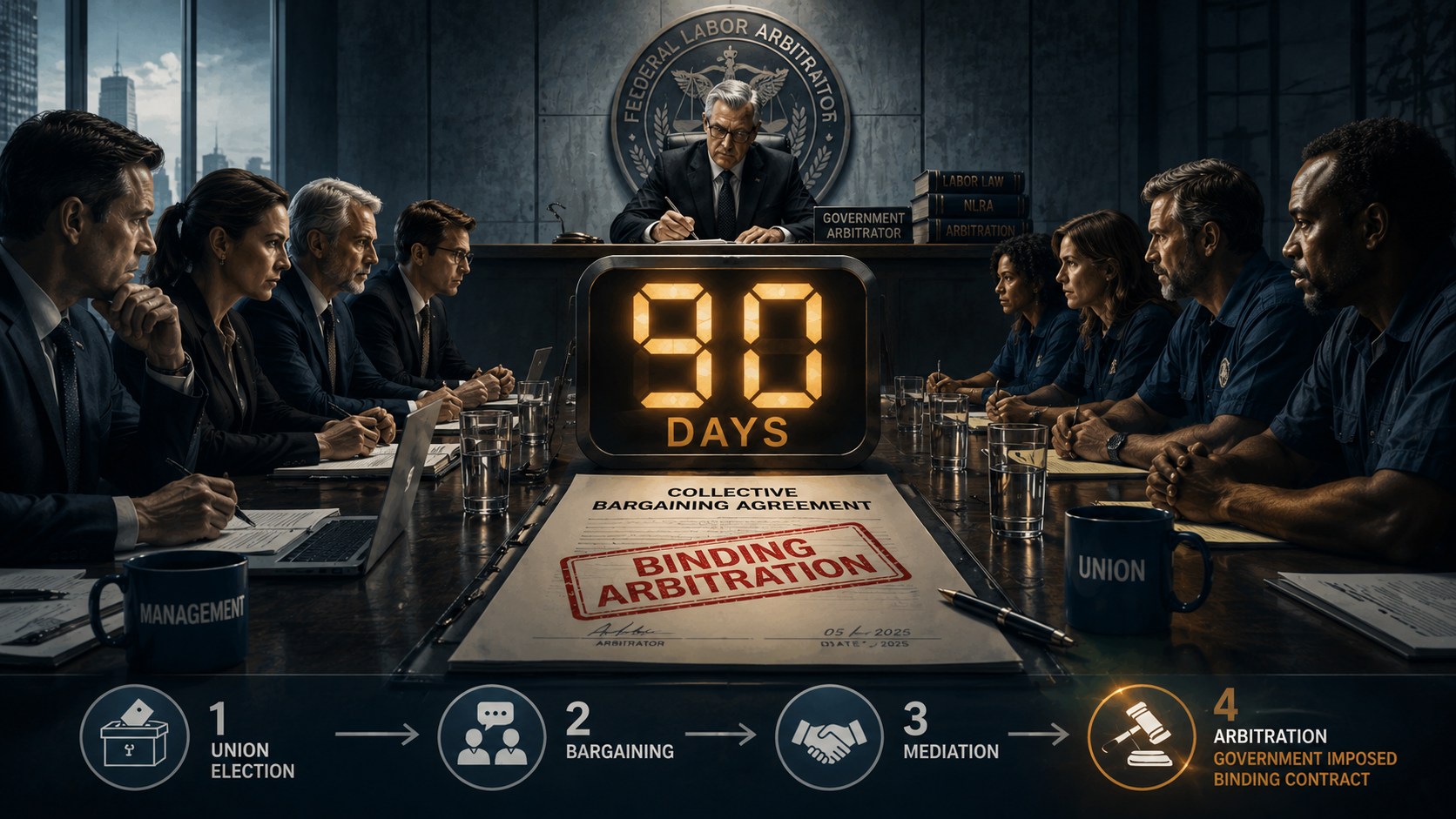
The FLCA imposes a hard timeline. Bargaining must begin within 10 days of a union election win. No agreement within 90 days triggers mandatory government mediation. If mediation fails after 30 days, a government-appointed arbitrator imposes a binding two-year contract on both parties. No ratification vote for employees. No further appeals.


Sponsors in the Senate include Sen. Josh Hawley (R-Missouri), along with Democrats Cory Booker, Gary Peters, and Jeff Merkley, as well as Sen. Bernie Moreno (R-Ohio). The Hawley angle has context employers should know: his pro-labor framework was developed in partnership with Teamsters President Sean O'Brien, a collaboration we covered in depth.


Norcross introduced the House companion bill in September 2025. The Teamsters called the discharge petition milestone one of the most significant labor votes in a generation. Potential 2028 candidates for President are working hard to curry favor with O’Brien as well. The bill mirrors the first-contract arbitration language from the PRO Act, which is why employer-side groups call it “PRO Act Lite”. The Institute for the American Worker describes it as the first piece of Hawley's broader labor framework.

The Case Against the Faster Labor Contracts Act

Employer objections here are not procedural complaints. They go to the bill's core requirements.


The U.S. Chamber of Commerce argues that without any member ratification vote, the federal government could dictate workplace rules, pay, and benefits, replacing negotiation with government-written contracts. The Fifth Amendment question follows directly: imposing contract terms without consent looks like a taking of private property without compensation. Bill supporters have not resolved that question cleanly, and it will be litigated if the bill passes.


The bad-faith bargaining concern is equally serious. When an arbitrator can potentially deliver a better deal than the employer will offer at the table, a union has incentive to run off the 90-day clock rather than reach agreement.  Labor attorney Grant Pecor discussed this on the Left of Boom Show recently, arguing the FLCA could reward delay over good-faith negotiations to the union’s advantage. That is not a theoretical risk. It is a predictable response to the incentive the bill creates, with speed of the process preventing a reasonable and comprehensive negotiation.


A recent opinion piece in The Hill argued the bill undercuts the very workers it claims to help: those who voted for union representation lose the right to ratify the contract that results from it. Supporters have not had a clean answer to that either.

What Employers Should Do Now

Contact your legislators. This bill is no longer something to track on a watch list. It has a viable path to a House vote, and if it clears the House, the Senate and a presidential signature become the next live questions. The window to engage congressional representatives is short, and that window is the first thing to act on.


Brief your management team on what the FLCA does and what it means for your organization. Start preparing if you haven’t already.


How exposed is your organization to union organizing? If you do not have a current, honest answer to that, find one. The FLCA's 10-day clock to begin bargaining starts the moment an election goes against you. That is not the time to build a response plan from scratch.


Do you have competent labor counsel? Do they have first-contract bargaining experience, or are they general employment attorneys who handle labor work occasionally? That distinction matters under this bill. Know the answer before you need to.


The same question applies to your internal HR and ER leadership. If your team has never sat across a bargaining table for a first contract, start to close that gap now, through training, outside support, or both.


The employers least exposed to the FLCA's worst outcomes are the ones who never get to a union election in the first place. Positive Employee Relations (PER) programs, ones built on genuine trust are the most durable protection available. If your PER programs are thin or have not been refreshed in years, this bill is the reason for changing that.

The Fifth Circuit Vacates For Starbucks: Profanity, Final Warnings, And A Board That Looked Away

by Kimberly Ricci

A follow-up fight for a joint employer healthcare win:

The NLRB already has enough leftover headaches from the Abruzzo era working through the courts, but an extra little punch has emerged with a side of profanity. Starbucks Corp. v. NLRB has made its way through the Fifth Circuit, which ruled that the Board failed to consider (i.e., “ignored”) relevant employer evidence that a union activist was fired for reasons other than organizing. The court also remanded the case to the Board.


This case is worth monitoring as a still-developing matter for employers because it involves disciplining workers who happen to be organizing.

The Procedural Background

Amid a Spring 2022 organizing campaign in Latham, NY, Starbucks placed a shift supervisor on final warning and fired him following several offenses. As recapped by the Fifth Circuit, those offenses included posting “obscene” messages involving “extreme profanity” in a group chat as well as failing to complete closing duties. This supervisor also opened a letter that was addressed to the company “because he did not believe that Starbucks would share its contents with employees.” That letter came from the NLRB.


Later, an ALJ found that Starbucks did not illegally fire this supervisor, but the Board disagreed. In doing so, the Democratic majority applied the Wright Line dual-motive analysis and concluded that this worker wouldn’t have been fired if not for his organizing activity.

The Fifth Circuit’s Holding And An Equally Important Concurrence

For the court’s majority, Obama-appointed Judge James Graves wrote that the court was “not convinced the Board adequately considered contradictory evidence,” which included the following:


The extreme nature of the supervisor’s profanity: Although other Starbucks employees swore in the workplace, the Board failed to distinguish the severe and repeated qualities of this supervisor’s outbursts. Additionally, “an earlier discipline also involved profanity in the workplace, so the Board should at least consider whether Starbucks would have seen this as an escalating issue.”


The supervisor’s failure to complete closing tasks while on final warning: The court noted no other shift supervisors at this Starbucks location had similarly failed at these tasks.


Opening the NLRB letter: Although supervisors did regularly open packages that arrived at the store, the court noted that “a reasonable employer would have responded much differently” to an employee opening official Board mail addressed to the company.

The majority’s decision also cited the Supreme Court’s Universal Camera Corp. v. NLRB (1951) ruling, which requires the Board to weigh contradictory evidence. It’s a holding that the Fifth Circuit has followed multiple times, including in Entergy Mississippi, Inc. v. NLRB (2015).


Here’s where things get interesting. The Fifth Circuit’s reversal and remand included a concurrence from Judge Andrew Oldham, who believes that the remand was the wrong move. As he put it, "I would not give the Board a second chance to do the right thing." That sentiment sums up the judicial tide that the current Board is swimming against as it works through a historic backlog built up under Abruzzo's enforcement push.


Additionally, Oldham recounted the supervisor’s string of profanity, which included labeling a female coworker a “dumb f***ing b**ch” and his store manager a “f***ing stupid” “lizard brain,” and “chicken s**t,” among other things. Oldham wrote, “If a company in this country cannot choose to fire someone for this sort of unhinged abuse, then Heaven help us.”


Oldham further pointed to SpaceX’s 2025 constitutional challenge to the Board’s structure as evidence of deepening distrust of the Board’s mechanisms, including under Abruzzo’s tenure as General Counsel.

Where The Case Goes From Here

This Starbucks case isn't over, and the company didn't technically “win.” The decision heads back to the Board, which should soon have a third GOP member and has a more employer-friendly posture than the one that ruled against Starbucks the first time. The likely twist to come: the same Board that found a violation may now reach the opposite result on remand.


In the News | Phil Wilson Tells SHRM Why the Faster Labor Contracts Act Gets It Wrong

by Michael VanDervort

As quoted in a recent SHRM article, Labor Reform Bill Seeks to Shorten Contract Negotiations, Phil Wilson, LRI's CEO and General Counsel, provided his insights on why the Faster Labor Contracts Act gets the problem wrong.

Employers will want to take note of these highlights:

Concerns about bargaining time can be legitimate

The proposed remedy is not. "Mandatory arbitration doesn't get workers a better deal faster — it replaces bargaining with a government-imposed contract that workers themselves never get to approve."

The bill rewards bad-faith bargaining

A union that holds firm and runs out the 90-day clock gets a government arbitrator who looks at the most aggressive comparable contracts in the industry. "The employer wouldn't be able to walk away from terms it could not afford."

Mandatory arbitration requirement provides no appeal

Arbitrators could force newly organized employers into underfunded multiemployer pension plans with no exit, potentially bankrupting the company. Employees have no voice as they never get a chance to have a ratification vote.

The long game is the more durable concern

"This proposal has now been introduced in three consecutive Congresses, each time with broader co-sponsorship and more effective framing. Republicans are increasingly looking at vehicles like this as ways to prove their populist bona fides. Once you head into the presidential primaries, a number of contenders, on both sides of the aisle, could use this as a way to prove their alignment with organized labor."


Read the full article on SHRM (membership required): Labor Reform Bill Seeks to Shorten Contract Negotiations


Friday 5: Decertification, Tech Unionizing, And Independent Contractors

by Kimberly Ricci

On May 21, South Sound Inpatient Physicians, PLLC asked the NLRB to throw out a union certification and order a new election for roughly 44 doctors at PeaceHealth facilities in Washington. Those providers had voted to unionize with the Union of American Physicians and Dentists in June 2024. They did so under the assumption that PeaceHealth and South Sound were joint employers, but the Board found otherwise in late April, and PeaceHealth was removed from the certification with South Sound as the sole employer.


Now, South Sound is arguing that converting a joint-employer election into a single-employer certification is a substantive change that warrants a second election or record reopening. The NLRB has not yet ruled on South Sound’s filing, but we’ll be watching to see whether the Board finds that this joint-employer reversal is enough to overturn the union certification.

Sherwin-Williams workers gave the Boilermakers the boot:

A little short but sweet entry here: 83 Sherwin-Williams production workers bid farewell to the International Brotherhood of Boilermakers.


This week, the NLRB certified a vote ejecting the union from the company’s Birmingham factory. The National Right to Work Legal Defense Foundation aided in the effort, which included Jacob Miller filing the decertification petition. Of those who voted, 36 were in favor of ousting the union and 33 against. The union has not responded to press inquiries for a remark, nor has it filed an objection to the vote.

When 'we deserve it' meets the taxpayer's bill

Who gets to decide which occupations "deserve" more money, when virtually everyone feels that way about their own paycheck?


That question runs through this The Atlantic op-ed by Nicholas Bagley, who uses the recent three-day Long Island Rail Road (strike to ask whether public-sector unions truly serve the public interest. The May walkout involved five unions whose work stoppage stranded 300,000+ commuters, and taxpayers foot the bill for compensation packages that already put LIRR workers at average salaries north of $121,000, plus overtime and pensions at age 55.


Bagley points out that politics sets public sector pay, and he questions the deservingness argument. Although some might bristle at that inquiry, he does the legwork on studies involving public sector unions that have prioritized seniority over qualifications and accountability. This has, in some instances, led to worse student outcomes in schools and law enforcement practices that endangered taxpayers' lives rather than increasing safety.


He does offer a solution for those clashes, but for employers watching from the private sector, it is a reminder that the "we deserve it" argument forgets that someone always pays for it.

UC became even more heavily unionized this week:

This week, 2,100+ University of California tech workers voted to join the CWA-affiliated University Professional and Technical Employees (UPTE-CWA). The workers have not been subtle about their overriding reason for organizing, which involves their hopes to shape AI policy at the university amid waves of layoffs throughout the tech industry.


We can also guess that the union promised the moon on this issue, and that those workers will likely be disappointed in their representation. For now, however, California’s Public Employment Relations Board has yet to declare whether this group will be folded into an existing contract.


The AFL-CIO claims that this election win has qualified UPTE-CWA as “the largest tech union in the United States.” This election also means that around 8,400 tech workers are unionized at this university. Additionally, 12,000 more academic and research workers joined UAW, which would add up to at least 60,000 UC workers belonging to Shawn Fain’s union.

News flash for employers: “algorithmic management” was never a thing:

In a Bloomberg Law column, Littler attorney Alex MacDonald put the term “algorithmic management” in its place. That term has been used by critics to argue that digital tools including GPS tracking and performance incentives amount to workforce exploitation. Likewise, the 2024 DOL independent contractor rule treated technological monitoring as a form of "control" that could reclassify a contractor as an employee under the FLSA. Yet MacDonald explained why the term is not the menace it was sold as, and why it doesn’t need a jump-scare treatment.


MacDonald made a compelling case for the current DOL's proposed rule. He argued that the monitoring and incentives described above are not evidence of control over independent contractors. They are necessary mechanisms for businesses navigating the so-called "principal-agent problem" when hiring someone they cannot directly supervise.


The DOL appears to agree, favoring a return to a traditional test: those who control their own work are probably contractors, whereas those who don’t exercise that control are probably employees. Since this is a proposed rule, we'll see how the notice-and-comment period shakes out, but the result for employers should be less uncertainty, including for uses of digital tools.


About Labor Relations INK

Labor Relations INK is published weekly and is edited by LRI Consulting Services, Inc. Feel free to pass this newsletter on to anyone you think might enjoy it. New subscribers can sign up by visiting here.


If you use content from this newsletter, please attribute it to LRI Consulting Services, Inc. and include our website: http://www.LRIonline.com 


Contributing editors for this issue: Greg Kittinger, Michael VanDervort, and Kimberly Ricci.


You are receiving this email because you subscribed to receive our labor relations newsletters and updates. You can manage your email preferences by clicking the link at the bottom of any of our email communications.


About LRI Consulting Services, Inc.

LRI Consulting Services, Inc. exists to help our clients thrive and become extraordinary workplaces. We improve the lives of working people by strengthening relationships with their leaders and each other. For over 40 years, LRI Consulting Services, Inc. has led the labor and employee relations industry, driven by our core values and our proven process, the LRI Way.


Share