Subject: LRI Ink: Board Rules, Union Leaders, AI: Credibility Is the Test

July 9, 2026

To visit the blog post, click on the link below the article.

What's In Ink This Week:

  • Blocking charges may be headed for another fix. A new rulemaking petition asks the NLRB to end policies that let unproven ULP allegations delay decertification elections.

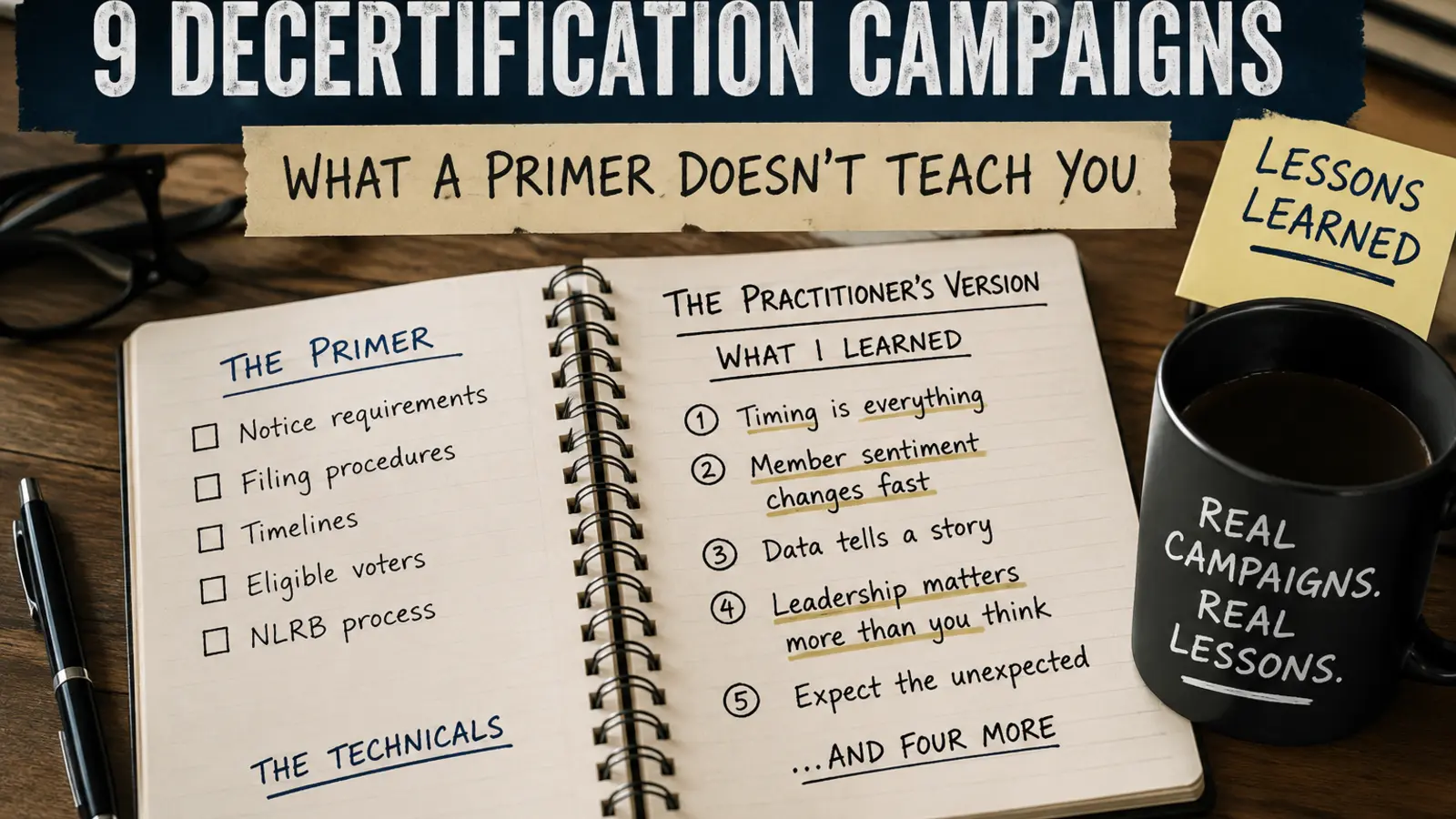
  • Decertification is a campaign, not a form. Lessons from nine real cases show why preparation, documentation, headcount discipline, and message clarity matter.

  • The UAW monitor report adds pressure on Shawn Fain. The report found Fain’s stated reasons for removing Rich Boyer from Stellantis oversight were unsupported, exaggerated, false, or retaliatory.

  • AI communication is now a labor relations issue. Join Michael VanDervort and Patricia Garland on July 15 in the empowER™ Community to discuss how AI messaging can build trust or create organizing and bargaining risk.

  • Bottom line: This week’s INK is about credibility. Whether the issue is Board process, decertification, union leadership, or AI, employees are watching whether words and actions line up.


The NLRB’s Blocking Charge Problem Now Has A Proposed Fix

by Kimberly Ricci

Unions attempting to block decertification petitions with ULPs is nothing new. They’ve done so for at least eighty years, but the Biden-era NLRB made it easier to do so. And as with many other Board policies, the pendulum has been swinging wildly here, to the detriment of workers.


The first Trump NLRB eliminated the so-called “blocking charge” policy, but the Abruzzo-era Board brought it back, allowing unions to file unproven charges to halt the decertification process. That can lead to an indefinite delay or even a dismissal of the election, which allows unions to buy time to regain a majority and keep taking dues from workers’ paychecks.


Is it time for the pendulum to swing back? Momentum is building.

Workers And A Former NLRB Chair Weigh In

In January, labor attorneys greeted news of an NLRB quorum with predictions of a rulemaking session that would once again make blocking charges a thing of the past. Then the National Right to Work Legal Defense Foundation began showcasing frustrated union members who had filed Requests for Review with the NLRB:

  • One manufacturing worker argued that the policy “does not just contravene a clear Congressional command, but also offends the entire structure and purpose of the Act: employee free choice.”

  • A group of nurses, whose election was suspended, “point[ed] out that the NLRA does not grant the NLRB the authority to invent rules to stymie worker-requested decertification elections.” One of those nurses further alleged that NLRB regional offices’ acceptance of unfounded union claims violated workers’ due process rights by not allowing for a public hearing or worker review of the charges.

A similar argument is also coming from a former NLRB official who watched this union maneuvering happen. Ex-Chair Marvin Kaplan penned a Bloomberg Law column, in which he wrote, “After participating in more than 900 decisions and multiple rulemakings over eight years as a member and chair of the National Labor Relations Board, one issue still nags me—blocking charges.”


Kaplan wasn’t subtle in calling out the “misuse of the policy by unions seeking to block decertification.” He singled out a case of one workplace where votes were thrown out without a count. In another, workers filed their decertification petition and waited almost a year, only to “overwhelmingly” vote to boot their union when this could have happened much quicker.


He urged the Board to “learn from our mistakes and fix this once and for all” while suggesting multiple reform measures. Meanwhile, the NRTW Legal Defense Foundation is still on the case.

A Rulemaking Petition Has Landed

On June 12, the NRTW Legal Defense Foundation filed a petition for the Board to formally open a rulemaking process to undo the Biden Board’s blocking charge policy. The Foundation didn’t stop there and requested the repeal of several other Abruzzo Board “bars” to decertification that are not based in the NLRA’s statutory authority. The petition further relies on the plain text of the NLRA’s Section 9(a) and 9(c) to make its case for reinstating workers’ free choice regarding union representation.


If the blocking charge policy is rescinded, we can certainly expect it to happen through rulemaking rather than a case decision. The Sixth Circuit’s recent ruling in Brown-Forman v. NLRB reinforces that preference. In doing so, that court found the Abruzzo Board overstepped during its Cemex decision by creating policy through adjudication. That court later denied the Board’s bid, which it made via an en banc petition, to restore its policymaking ability via case decisions. So rulemaking it will be.

Don’t Expect This To Happen Quickly

The NLRB is still digging through its inherited case backlog, and there’s also no guarantee that its current quorum will last. The Senate HELP Committee postponed its consideration of William Macy’s nomination as well as the re-nomination of David Prouty, whose current term ends on Aug. 27. As of now, that hearing has been rescheduled for July 15.


That’s a roundabout way of saying that it could be a while before the NLRB could begin notice-and-comment rulemaking to rescind the current Blocking Charge policy, and then a 60-day comment period would begin. The good news for both workers and employers, though, is that the momentum is in motion to motivate this to happen. Tick tock.


Decertification Field Notes: Insights For HR Practitioners

by Michael VanDervort

I recently wrote about decertification for SHRM, covering the technical mechanics HR needs to know. This is the practitioner's version: what nine decertification campaigns actually taught me that a primer doesn't cover.

I worked on nine decertification campaigns over three years. Eight were employee-driven petitions that resulted in elections. One was a withdrawal of recognition, in Chicago. That was the one that started the entire chain of events.

Bargaining Issues

Here's the part of that story that belongs in field notes. Great legal advice and good documentation were critical in dealing the union reaction to our withdrawal of recognition of a long standing Teamster unit, and the ensuing fallout.

A renewal negotiation with a Teamsters local turned combative faster than the situation called for. The union took a very aggressive stance at the table from day one. We bargained for several weeks with little success, and eventually the contract expiration date arrived. We offered a 30-day extension, which the Teamsters refused, stating, "We want to be able to hold your feet to the fire," and let the contract lapse.


The unit we were bargaining over was small, eight drivers making job-site deliveries in and around Chicago. The union bargaining committee consisted of the bargaining lead, our local business agent, and the shop steward for our drivers, which meant he was absorbing the hard line at the table along with everyone else.


Dave, the shop steward, was the one who finally asked me directly, out of sheer frustration, whether there was a way to get the union out. I didn't have an answer for him on the spot. I told him I'd find one, called our labor attorney, and twenty-four hours later had an information script in hand. After explaining their rights under the process, Dave broached the topic of decertifying with his colleagues. At the end of that workday, seven of eight drivers signed a petition rejecting the union. Based on that showing, and with the contract expired, we withdrew recognition by fax to the union at 3 a.m the next day.


At 4 a.m. that same day, we shared information about the wages and benefits available to the non-union drivers. They were ecstatic. As you might expect, the Teamsters were not. A handful of business agents and officials from the local union arrived at our office around 10 a.m., demanding to speak with employees and management, a request we declined. They left and immediately filed an unfair labor practice (ULP) charge with the National Labor Relations Board (NLRB).


The eighth driver, the one who didn't sign the petition, became the focus of the NLRB investigation that followed. He was conflicted over the decision. He also had a frozen pension from an earlier job where the same local had represented him for a different employer. That history made him genuinely conflicted rather than simply reluctant. The NLRB board agent investigating the union's unfair labor practice charge spent about four hours interviewing him directly, and ended by asking us to provide some additional information.


What ultimately led to the charge being dismissed was good documentation and legal work.


Our attorneys collected affidavits from all the drivers after giving a Johnnie's Poultry explanation. They presented our own contemporaneous notes, which documented that at no point had we promised or guaranteed anything to obtain those signatures. A withdrawal of recognition places the burden on the employer and draws a level of NLRB scrutiny that an employee-driven petition doesn't.


We carried the same documentation habit into the eight campaigns that followed, but it was never as critical in petition-driven cases as it was here. Involve your labor counsel at every step if you are dealing with decertification.

What Surprised Me Across The Eight Elections

The strength of feeling, pro-union or anti-union, that employees developed once faced with the choice surprised me every time. Some of our best workers, with the best attitudes, wanted the union to stay. Some employees whose performance wasn't as strong as others, who you might expect to rely on the union to protect their interests, were staunchly anti-union. I found that confusing at first. You have to lean into each group's emotions because they're all unique. Leaning in meant doing your best to answer their questions honestly, with the facts as the company saw them, and letting them make their own free choice. Not manipulation, not obfuscation. Empathy and honest answers, within what the law allowed.

Regional differences

The eight petition campaigns were spread across the country, mostly in the Midwest and along the Atlantic seaboard. The ones in the southern Midwest, Missouri, Kansas, and Kentucky, were much more anxious to get rid of the union. The ones further north, in places like Michigan, Pennsylvania, and Ohio, were more conflicted about getting rid of the union. That tracked the historical reach and regional strength of labor unions in those areas.

How the process evolved

Chicago was hurrying up and get stuff done on the fly. As we moved through the nine campaigns over those next three years, we built a stronger playbook, especially around FAQs. After two or three campaigns, you start to realize employees on the floor tend to ask the same questions. We built an FAQ document and tweaked it for regional variation. Several different unions were involved across the nine- Teamsters, UFCW, others- and the questions and styles varied by union, so we learned to anticipate those differences as best we could. I can't point to specific examples of exactly how the process changed campaign to campaign. It was evolving the whole way through.

A close call in Michigan

We were successful in all nine decertification efforts. We ran headcounts throughout each campaign, the same way you'd track sentiment in a union organizing drive. In the last one, in Michigan, our count was a bit more favorable to the company than the final election results were. The result came down to four votes, something like 65 to 61. It was the largest unit of the nine, well over a hundred people voting, and the strongest union support we faced.


That's a lot more uncertainty and a lot more hearts and minds to win than with eight drivers and a petition. During the NLRB's vote count, the first 14 ballots drawn from the box all favored retaining the union before the count turned in the company's favor. There was no campaign after Michigan to apply that lesson to. It stands on its own.

AI and Trust In Labor Relations

by Michael VanDervort

Can Employees Trust What You Say About AI? Live Chat, July 15 In The empowER™ Community

How your organization communicates about AI policies and usage can either build or erode trust with employees. Missteps determine how employees respond and can lead to organizing exposure or increased bargaining risk.


On July 15, join Michael VanDervort and Patricia Garland for an interactive discussion on the trust dynamics at the center of AI adoption in both unionized and union-free workplaces. You must be a member of the empowER™ community to attend. Membership is free:  https://empower-er.org/


We’ll share and discuss:

  • Real examples of AI communications and how it employee trust 

  • How employees interpret and respond to organizations talking about AI

  • What happens when AI use becomes a labor relations issue and unions become involved

Please come prepared to participate in the conversation - ask questions, share insights, and leave with a practical framework for how to strengthen your own communications around using AI.  


The UAW Monitor's Latest Report Confirmed Everything Rich Boyer Has Been Saying About Shawn Fain

by Kimberly Ricci

Let's get real. UAW President Shawn Fain has his sights set on staying in office and continuing to threaten his May Day 2028 general strike plans. However, Fain cannot wave off the attention that challenger Rich Boyer is receiving as mere campaign noise.


As we recently discussed, Boyer is the current VP who Fain previously removed from Stellantis oversight duties, allegedly because Fain was steamed over how Boyer "refus[ed] to divert benefits to his fiancée" and her sister. The union's federal monitor, Neil Barofsky, later ordered Boyer to be reinstated, and now Boyer has come for Fain's position. It’s no wonder that Detroit news publications are describing him as the most "prominent" rival.

The Report's Timing Isn't Great For Fain

This is where things get juicier for this union drama. Not that they weren’t already that way with Barofsky's reports detailing Fain's conduct toward his own staffers. Yet Barofsky has dropped his sixteenth report, which makes swift work of dismantling Fain's reasons for removing Boyer. The monitor affirms that Fain “acted improperly and abused the authority of his office in connection with matters involving his fiancée and her sister,” but there’s much more within Barofsky’s findings, as discussed below.


The report’s timing puts a federal investigator’s findings in the public record while Boyer's campaign is underway, and unlike Boyer's own public statements, this isn't something Fain can dismiss as one man's grievance. Barofsky previously devoted a different report to Fain's failed ousting of Secretary Treasurer Margaret Mock, and this new report backs up Boyer's public assertions over how Fain's alleged vendetta against him went down.

The Federal Monitor Dismantled Fain's Reasons For Firing Boyer

As Barofsky recounts in his report, Fain removed Boyer via a letter containing "seven separate allegations of dereliction of duty and misconduct." Among those accusations are Fain alleging that Boyer failed Stellantis workers by having no plan on the Kokomo plants and staying silent on Belvidere plant delays. As Barofsky painstakingly details in his report, the evidence does not support these accusations, and Fain's own statements to federal investigators contradicted the claims in his letter.


Regarding Belvidere, Fain acknowledged to Barofsky that he and Boyer regularly communicated throughout the plant's delays, which negated his claim of Boyer's inaction. And concerning Kokomo, Fain admitted that Stellantis had sent him written confirmation of how Boyer had secured an agreement with the company, contrary to Fain's assertions.


Barofsky's report further revealed a major reason why Fain dismissed Boyer, and it's a subject that didn't appear in his seven-point letter. Boyer had settled around 200 grievances at the Warren Stamping plant, but Fain wanted to leave them open as "leverage." The report details, as Boyer has previously mentioned, that Fain issued an "ultimatum" to Boyer for firing multiple staffers, and when Boyer refused, Fain pushed him out.


Barofsky concluded that Fain's stated reasons for ousting Boyer were false and/or exaggerated, that Fain made these seven allegations in bad faith to conceal his real motives, including those settled grievances and Boyer's refusal to obey the ultimatum.

Now, Onto The Election

The lengthy report also explores Fain's apparent habit of deleting text messages that could later be used as evidence and how, as Boyer has mentioned, Fain won't talk to him after the firing and reinstatement. Boyer's candidacy highlights issues that might otherwise go unnoticed, and this report adds a federal finding to back some of them up.


Those subjects include Boyer's desire to bring accountability to UAW finances and lower members' dues rather than raise the strike fund up to $1.3 billion from its existing $850 million. Indeed, Boyer believes that "they're taking that money out of the strike fund to run the day-to-day operations," which is a serious allegation that we likely haven't heard the end of. Heck, we might even see that accusation surface in a future federal monitor report. Yet for now, it's onto UAW officer elections, which will begin through mail ballot in August and wrap up in early October. Stay tuned! There's sure to be more mudslinging to come.


About Labor Relations INK

Labor Relations INK is published weekly and is edited by LRI Consulting Services, Inc. Feel free to pass this newsletter on to anyone you think might enjoy it. New subscribers can sign up by visiting here.


If you use content from this newsletter, please attribute it to LRI Consulting Services, Inc. and include our website: http://www.LRIonline.com 


Contributing editors for this issue: Greg Kittinger, Michael VanDervort, and Kimberly Ricci.


You are receiving this email because you subscribed to receive our labor relations newsletters and updates. You can manage your email preferences by clicking the link at the bottom of any of our email communications.


About LRI Consulting Services, Inc.

LRI Consulting Services, Inc. exists to help our clients thrive and become extraordinary workplaces. We improve the lives of working people by strengthening relationships with their leaders and each other. For over 40 years, LRI Consulting Services, Inc. has led the labor and employee relations industry, driven by our core values and our proven process, the LRI Way.


Share