Subject: LRI Ink:

September 3, 2026

To visit the blog post, click on the link below the article.

Happy Labor Day From LRI Consulting Services, Inc.

Happy Labor Day from all of us at LRI Consulting Services, Inc.


To our wonderful clients, and to everyone who shows up, pitches in, solves problems, serves others, builds things, and gets the work done, thank you. We celebrate you.


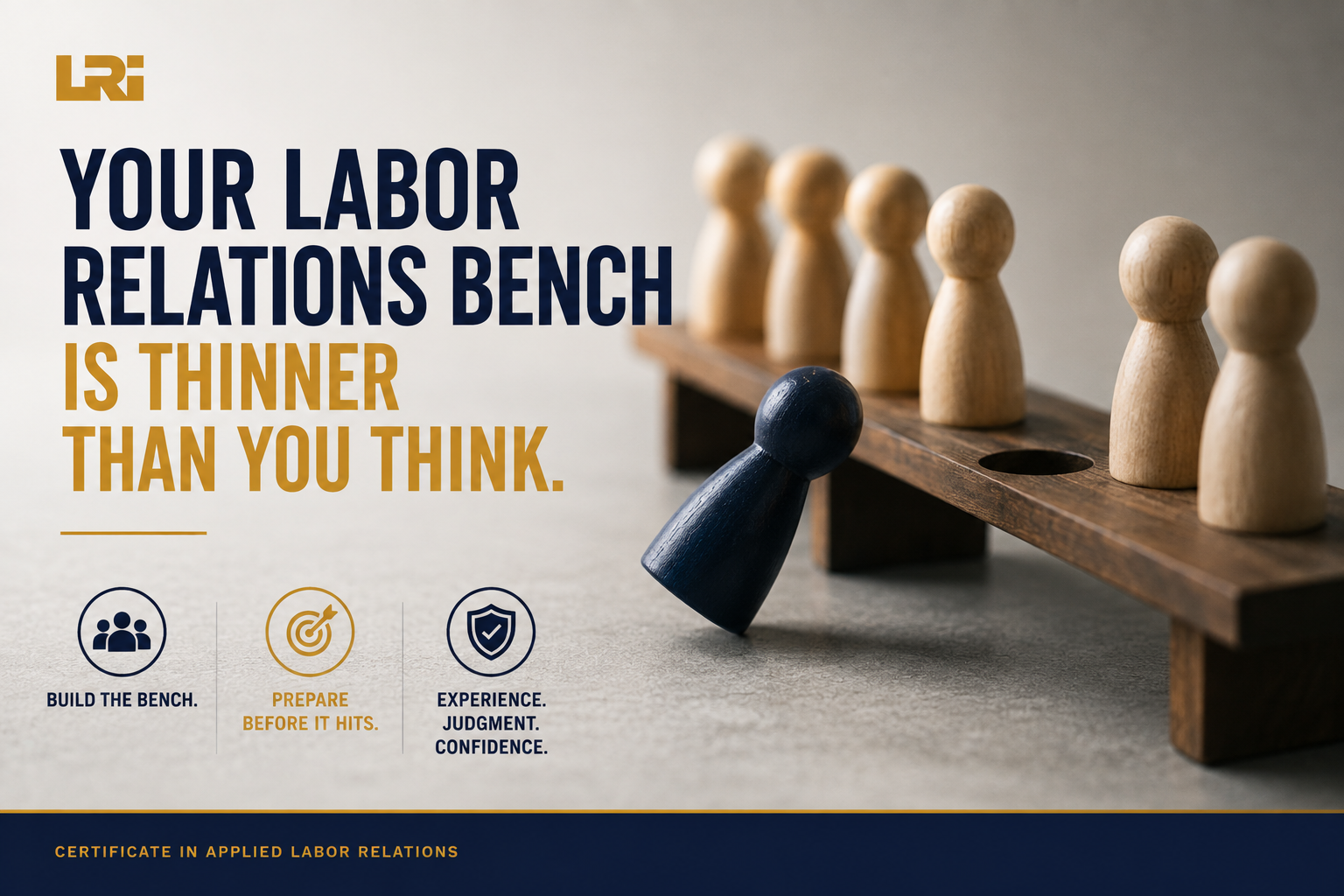
Your Labor Relations Bench Is Thinner Than You Think

by Phil Wilson

I've watched a lot of companies discover the limits of their labor relations talent at exactly the wrong moment.


A petition lands on a Friday, and by Monday it's obvious nobody in the building saw it coming (or has any idea what to do). A manager waves off a grievance, and eighteen months later it's an arbitration loss with a big price tag. A bargaining team gives away language nobody fully understood, and the plant spends three contract cycles trying to claw it back.


These don’t start as legal problems. Lack of training and experience is what turns them into expensive legal liabilities.

Why Labor Relations Knowledge Lives in One or Two People

Most companies' labor relations knowledge lives in one or two people. A veteran or two who've carried it for decades, plus outside counsel on call. All worth what you pay them, but nothing close to what you’d call a bench.


Counsel isn't in the room when the organizing petition lands, for the grievance investigation, or for the management caucus. And the people who know where every past practice and handshake deal is buried won't be here forever. Instead of a succession plan, you’ve got a countdown.


An HR manager who has never sat through an arbitration won’t see the holes in their grievance reply. The operations manager who has never faced an organizing drive won't recognize one until the cards are already signed. That inexperience is invisible right up until it isn't. It shows up later, in an arbitration award, in a bad contract you live with for years, in a campaign you weren't ready for.

What the Certificate in Applied Labor Relations Actually Does

That’s why we built the program I wish was around when I started: the Certificate in Applied Labor Relations. The founding cohort runs in Tulsa this fall.


Six one-week modules, each a standalone course: Proactive Employee Relations, Campaign Preparedness, Contract Administration, Arbitration Advocacy, Collective Bargaining, and Strike Preparedness. Take one week or take all six. Each week earns its own credential. Finish all six plus the capstone, and you earn the full Certificate.

Six Modules, Built as Live Reps Instead of Lectures

The format is the point. More than 200 hours of live instruction, with 70% of class time spent doing the work rather than hearing about it. Participants run a live organizing campaign that's scored as they go. They investigate and resolve grievances. They prepare and argue a case before a practicing arbitrator. They negotiate a contract against a real deadline with a mediator in the room. Every instructor is a working LRI consultant, with guest faculty that includes practicing arbitrators and labor attorneys.


Most labor relations training is a lecture on the law. Ours is reps at the real work, run by people who do it for a living.

The Twelve Instincts That Separate Judgment From Knowledge

The program is built around the twelve instincts that separate a seasoned labor relations professional from a novice. Reading power distance in a room, seeing a dispute through a political and operational lens instead of a purely legal one, and knowing when a small issue is the visible edge of a much bigger one.


You don't build those from a slide deck. You build them through reps, pattern recognition, mistakes, and situations where the right answer isn't obvious. The simulation format compresses that timeline by making people decide under realistic pressure before their decisions carry real consequences.


While you can't manufacture a twenty-year veteran in six weeks, you can make sure someone's first hard bargaining session isn't the one that counts. That’s what this certificate is built to do.

Who Should Hold a Seat

Send someone (or send yourself) if you're:

  • Facing organizing risk, and you want leaders who've felt the first 72 hours of a campaign before the real one starts.

  • Managing an existing union relationship, and you need people who can investigate grievances, read contract language, and work with a steward or business agent without flinching.

  • Heading into bargaining, and you want a team that understands costing, caucus strategy, and where the leverage actually sits.

  • Building a bench instead of renting one indefinitely from a couple of veterans and outside counsel.

Founding Cohort Details: Seats, Cost, Tulsa Dates

The founding cohort is capped at twelve seats, with roughly one instructor for every six participants. Tuition is $2,800 for a single week, or $15,000 for the full Certificate. Held in Tulsa. Lodging is not included.


This investment might look big next to a training budget, but consider the cost of learning these lessons live:

  • What does one badly negotiated contract provision cost every year it stays in the agreement?

  • What does an organizing campaign cost? Or an arbitration loss?

  • How much will it cost when the only person who really understands your labor relations retires?

  • What would you pay to avoid a work stoppage?

Labor relations training is easy to postpone, because the bill for being unprepared rarely comes due today. It comes due when the clock is running, and you need someone in the room who has already done this.


If a name came to mind while you were reading this, that's your answer. If you're not sure whether your team needs it, that's the conversation worth having. Reply and tell me who you're thinking about, or call 800-888-9115, and we'll talk through who from your organization should hold one of the twelve founding seats.  More information here.

Left of Boom Show: The Labor Relations Research Edge

by Michael VanDervort

From SEIU Organizer to Employer-Side Researcher

Nancy Jowske spent a decade as a union organizer for the Service Employees International Union (SEIU) before crossing to the employer side, where she has done research work almost exclusively for LRI for the past several years.

How The Research Practice Grew

Phil and Nancy trace how her research practice grew from a single client's site reports into full industry and regional analysis, and walk through what that research actually involves: cleaning messy National Labor Relations Board (NLRB) filings and duplicate contracts, digging through Facebook pages and union websites, and reading LM-2 reports for what they really show.

What the Research Process Looks Like

Nancy skips total revenue and goes straight to dues and per-capita income, because that's a union's actual business, and flags a common trick: counting retirees as members to make declining unions look like they're growing. She talks about digging deep into OLMS data as the starting point, along with grounding herself in industry knowledge to be effective.

What The Data Can Reveal

She shares a favorite find, a North Carolina organizing campaign secretly led by a professor who took a job at the worksite specifically to run it, and a less dramatic but more telling pattern:

  • Union wages in manufacturing and warehouse work have lagged non-union wages during recent inflation, the opposite outcome of what most people would expect.

Why the Data Matters for Employers and Workers

The episode closes on why the work matters. For employers, it means not assuming who's really behind a picket line. For workers, it means holding unions to the same transparency any member would expect from an institution they're paying into.

Key Takeaways

  • Research grows from raw questions ("should I worry about this location?") into a repeatable process once the underlying data is cleaned and structured.

  • NLRB and Department of Labor filings are messy by default: duplicate petitions, refiled contracts, and inconsistent union names all have to be sorted out before the numbers mean anything.

  • LM reports reward reading past the headline figures: dues revenue, real membership counts, and where organizing costs get buried in representational spending tell the real story.

  • Contract press releases and LM filings routinely diverge from what unions publicly claim.

  • Union wages have not consistently outpaced non-union wages during recent inflation, despite the narrative

  • Good research protects employers from bad assumptions and gives union members the transparency they're owe

Take A Minute This Long Labor Day Weekend

by Michael VanDervort

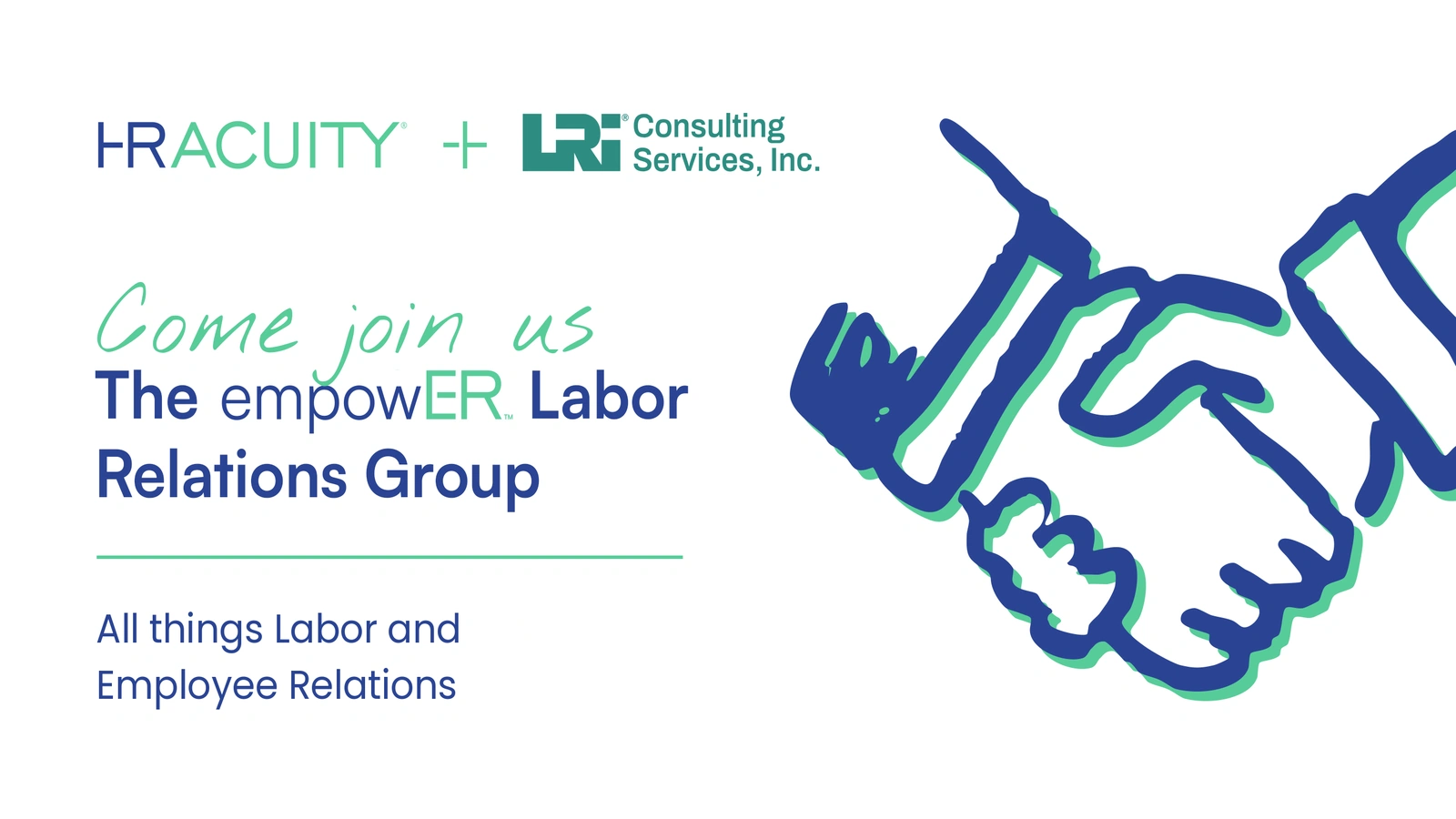
Before the long weekend gets going, join the Labor Relations Group in the empowER community, hosted by HR Acuity. It's a place to connect with other labor and employee relations practitioners, trade insight, and stay ahead of what's happening in the organizing landscape.


Takes one minute to join: https://empower-er.org/

The Teamsters’ Lawsuit On Self-Driving Trucks: California Giveth To Unions, And California Taketh Away

by Kimberly Ricci

The labor laboratory of California is a place where unions lobby for what they can't achieve at the bargaining table. The Service Employees International Union (SEIU) is most notorious for these tactics and pushed for the passage of AB 1228, which created the illusory Fast Food Workers Union after SEIU failed at organizing these workers by traditional means. More recently, the SEIU-affiliated California Gig Drivers Union (CGDU) reached the threshold for certification after Gov. Gavin Newsom signed a law giving rideshare drivers a path to unionize, and he did the same with a bill that made the Fast Food Union possible.


That last lobbying “win” by SEIU swiftly led to significant job losses in the fast food industry. There, employers were financially “squeezed by overnight wage boosts and leaned into automation and leaner scheduling to stay afloat. Whereas it’s too soon to know the CGDU’s fate, we can guess that drivers will feel frustration at their unchanged classification as independent contractors, who will soon be bound by a union constitution and the dues that come with it.

In these instances, the union “won” but, at least where AB 1228 is concerned, workers were harmed, and the jury is still out on CGDU.


The back-scratching relationship between unions and California politicians isn’t holding up for one current battle. That would be the Teamsters’ newly filed lawsuit against the California Department of Motor Vehicles (DMV). The union alleges that the “agency circumvented laws requiring the agency to study and publicly disclose the economic impacts” of autonomous vehicles (AVs). Here, the Teamsters had already attempted to pull off SEIU’s California strategy. After Newsom declined to sign bills pushed by this union, the DMV went forward with its rulemaking, and the Teamsters are hopping mad.

Newsom punted to the DMV

In 2023, the Teamsters joined with the California Labor Federation in urging the passage of AB 316, which they argued put highway safety first and protected workers’ jobs. The legislation made it through the state’s Senate Transportation Committee, and Teamsters President Sean O’Brien declared that Newsom “needs to prove that he cares about workers by signing AB 316.”


Well, Newsom vetoed the bill and explained, "Considering... the existing regulatory framework that presently and sufficiently governs this particular technology, this bill is not needed at this time.” He further explained, “My Administration remains open to working with... [Autonomous Vehicle] stakeholders on the right approach to safely test and deploy this evolving technology in California, while also addressing and mitigating any potential impacts to jobs.”


That didn’t stop the Teamsters. In 2024, the union backed the reintroduced version of the same bill, repackaged as AB 2286, which Newsom also vetoed with the same rationale, given that the DMV was already in the midst of rulemaking on heavy-duty autonomous trucks. The Teamsters kept pushing the issue while taunting Newsom repeatedly over his vetoes, but repeating their strongarm act simply didn’t work.

The DMV’s rulemaking and another Teamsters tantrum

On April 28, the agency formally adopted “the most comprehensive AV regulations in the nation,” which were “the result of an extensive public comment and review process.” These rules provided a heavily scrutinized process for AV manufacturers to apply for testing permits in compliance with zoning and safety specifications. The regulations further contained sections for testing and deployment, enforcement, restrictions, emergency response, and data reporting.


The Teamsters’ lawsuit alleges that the DMV took shortcuts and bypassed an economic impact study that the union argues was necessary. The union further claims that these rules could cost the state 200,000 jobs while Newsom countered that preventing testing phases for autonomous vehicles would harm the state’s economy by stifling innovation.


It’s not lost on us that the Teamsters are ignoring how SEIU’s ceaseless lobbying for AB 1228 caused job losses of its own. The Teamsters have tried and failed twice at the same legislative “win,” and now, the union is hoping that a judge will deliver what California politicians declined to do.

Conclusion

We’ll be watching to see how the Teamsters’ lawsuit against the DMV concludes, but what’s telling at this moment is that the Teamsters thought that they could stamp their feet and get laws passed that ultimately grease the wheels for future organizing drives. When those laws end up harming workers, it becomes clearer that, in California, aggressive unions are playing checkers, not chess by pursuing short-term strategies that backfire on workers even when those union plans are successful.


As discussed above, SEIU claimed victory, and fast food workers paid for it. The Teamsters can’t even get that far, so their next move is court.


Friday Five: Starbucks Workers United's Repeat, Fain's Reckoning, And Chavez's Erasure

by Kimberly Ricci

Starbucks Workers United’s lackluster repeat moves:

Last fall, Starbucks Workers United (SWU) accompanied their strike with requests that customers also boycott the coffeehouse chain. Well, that didn’t work out too well for the union because the company’s corresponding earnings report reflected that the strike did not have a material impact on sales. In fact, CEO Brian Niccol revealed that U.S. same-store sales were up 4% after viral holiday drinks boosted revenue, but that won’t stop SWU from attempting another boycott.


That’s precisely what the union is doing again. This week, SWU “officially” called for another boycott with dates and details allegedly coming soon. Also, the union has been bragging for months about their 700th election victory, and even though a three-month strike at scattered stores didn’t hurt Starbucks, isolated stores are still holding one-day strikes. It’s rinse and repeat from SWU, and nothing seems to help the two sides reach a deal. Negotiations have been on-and-off for four years with no contract in sight.

The scrutiny on Shawn Fain is going mainstream:

We haven’t been able to keep our eyes away from how United Auto Workers (UAW) election season has been clouded by a grand jury subpoena about federal monitor Neil Barofsky’s ongoing investigations.


Barofsky has issued sixteen reports that include allegations about Shawn Fain’s questionable financial expenditures and culture of retaliation. Further, a UAW attorney told Bloomberg that the union “broadly is not the subject of a grand jury investigation,” which didn’t sound great for Fain.


Well, the New York Times has now published an unflattering portrait detailing, among other things, Fain’s “confrontational style” and how “[f]ormer allies have turned on him.” This report further confirms that the U.S. attorney’s office in Detroit is conducting “a criminal investigation into Mr. Fain’s conduct, prompted by the monitor’s findings.”


There’s a lot inside, including the Times going long on Barofsky and Fain’s combative discussions about Fain’s unsavory remarks on the Gaza war. Those clashes, as previously reported by the Detroit Free Press, culminated in Fain “threaten[ing] to fight the monitor in the parking lot.”


It’s certainly not wise to try to fist-fight a federal monitor, but ultimately, the Times relays word from Barofsky’s firm, Jenner & Block, that “[t]he monitor’s findings rest solely on the facts set out in his reports.”

The aftermath of Cesar Chavez revelations continues:

In March, the New York Times investigative report detailing an alleged “pattern of sexual misconduct” against United Farm Workers (UFW) co-founder Cesar Chavez led to his portrait’s swift removal from the Department of Labor headquarters. Additionally, California lawmakers swiftly voted to rename Cesar Chavez Day (Mar. 31) as Farmworkers Day after that report included rape accusations from Chavez’s fellow UFW co-founder, Dolores Huerta.


Months later, landmarks, schools, and libraries across the nation are still working to downplay Chavez’s ghost, but updates have been rolling in:

However, Cesar Chavez High School in Stockton, CA will retain its name for now after a heated public discussion that isn’t finished yet.

Nursing strikes aplenty:

Last week, we told you about how unions are moving up the physician career ladder by organizing attending physicians, and UC Doctors United recently launched as a Doctors Council-SEIU offshoot with the mission of unionizing 10,000 UC physicians. Don’t forget about nurses, though.


Unions haven’t forgotten about them, and Big Labor is planning to launch multiple strikes in the next few weeks. The affected hospitals scheduled for one-day strikes include Saint Mary of Nazareth Hospital in Chicago and Saint Mary’s Regional Medical Center in Reno, along with Shasta Regional Medical Center in Redding, CA. Also, the Teamsters Michigan nursing strike at Henry Ford Genesys will hit its one-year anniversary on Sept. 1.

The successor bar is down. Is the contract bar next?

It’s Friday, and this isn’t the most easily digestible subject. Yet it’s a highly consequential D.C. Circuit decision regarding the NLRB’s ability, or lack thereof, to dream up standards without authority from the NLRA.


In Hospital Menonita de Guayama, Inc. v. NLRB, the court found that the Board didn’t have the statutory authority to create the successor bar, which forced businesses to keep bargaining with an inherited union for up to a year, even without majority worker support for the union.


However, the court didn’t draw the same conclusion regarding the contract bar. This bar presumes that a union still has majority support during a labor contract, and the judges found a rebuttable presumption for the contract bar, which can be disproven with evidence, whereas the successor bar couldn’t be challenged at all.


Still, the contract bar remains vulnerable, since the court did not declare that this bar is supported by statute. In a future case, there’s every possibility that another court could run with the D.C. Circuit’s finding that the Board cannot invent blocks (beyond the specific time-limited block on challenging a union's support right after an election) and strike down the contract bar, too. Stay tuned.

About Labor Relations INK

Labor Relations INK is published weekly and is edited by LRI Consulting Services, Inc. Feel free to pass this newsletter on to anyone you think might enjoy it. New subscribers can sign up by visiting here.


If you use content from this newsletter, please attribute it to LRI Consulting Services, Inc. and include our website: http://www.LRIonline.com 


Contributing editors for this issue: Greg Kittinger, Michael VanDervort, and Kimberly Ricci.


You are receiving this email because you subscribed to receive our labor relations newsletters and updates. You can manage your email preferences by clicking the link at the bottom of any of our email communications.


About LRI Consulting Services, Inc.

LRI Consulting Services, Inc. exists to help our clients thrive and become extraordinary workplaces. We improve the lives of working people by strengthening relationships with their leaders and each other. For over 40 years, LRI Consulting Services, Inc. has led the labor and employee relations industry, driven by our core values and our proven process, the LRI Way.


Share