|
Having trouble viewing this message? Click here to view it online.
To unsubscribe or change contact details, scroll to the bottom and follow the link.
|


|
|
Modal Verbs: Definition and Examples
|
|
Imagine an English language in which we strictly used structures such as the following for expressing an action:
I left.
Pete swims on Tuesdays.
I choose a double major in college.
You assist me?
It happens.
Candace finishes that. |
We understand these sentences at a basic level. But to what extent do they inform us? They convey limited information about the attitude, perspective, or expectation of each action.
How would we fare if all stated actions functioned alone in this way, without any nuance and tone that add to the context?
Let's look at the same expressions above with components that provide us further insight into the action:
I had to leave.
Pete can swim on Tuesdays.
I may choose a double major in college.
Can you assist me?
It might happen.
Candace should finish that. |
These sentences tell us more than the original ones do. They achieve this with modal verbs that extend actions beyond basic facts.
What Are Modal Verbs?
Modal verbs are a distinct group of auxiliary (helping) verbs that further modify a verb's action by expressing facets such as ability, possibility, permission, advice or obligation.
They do not function alone as a main action. By enhancing a main verb, they further shape its meaning from a simple fact to something with more nuance.
| Common Modal Verbs |
Common Modal Verb Phrases |
| can |
might |
should |
have to |
| could |
must |
will |
need to |
| may |
shall |
would |
used to |
Modal Verbs: Form and Time
When a modal verb is paired with a main verb to modify its action in the present, the main verb will be in its infinitive form (without to): may go, must have, should increase.
Modal verbs differ from main verbs in that they will almost always appear in their base form. They do not have infinitive or participle forms, nor do they take progressive or participle endings such as ‑ing and ‑ed.
Base form: can, might, should
Compare with: to can, to might, to should; is canning, are mighting, has shoulded (none are viable) |
Exceptions to this are certain modal verb phrases such as have to and need to, which do change form as the context requires. This makes them semi-modals.
Peter has to write the letter before tomorrow. (Have to changes to has to in order to indicate third person–singular conjugation in the present tense.)
Peter had to write the letter before tomorrow. (Have to changes to had to in order to indicate the action has already occurred.) |
She needs to review the contract more closely. (Need to changes to needs to in order to indicate third person–singular conjugation in the present tense.)
She needed to review the contract more closely. (Need to changes to needed to in order to indicate the action has already occurred.) |
You'll also note that modal verbs do not change their base form regardless of the subject.
| I can |
we can |
|
I should |
we should |
| you can |
you can (plural) |
|
you should |
you should (plural) |
| he/she can |
they can |
|
he/she should |
they should |
Modal Verbs: We Need Them
Compare the following sentence pairs.
Simple verb: Jelena directs documentaries.
With modal verb: Jelena can direct documentaries.
Simple verb: Sameer calculates the risk for investors.
With modal verb: Sameer should calculate the risk for investors. |
The first sentence in each pair is a simple factual statement. We know from reading the two sentences that Jelena directs documentaries, and Sameer calculates risk for investors. The sentences further indicate that the action is in the present and in continuation.
The second sentence in the first pair includes the modal verb can, which further explains that Jelena is capable of directing documentaries, even if she might not be doing so right now.
The second sentence of the second pair uses the modal verb should. Notice here too how the meaning shifts. The modal verb informs us the action (calculate) is either advice or an obligation, and it is perhaps not yet in motion.
As these examples show, without modal verbs, we would lose much of the subtlety behind intent and clarity. This would reduce English to mostly declarative statements and commands open to interpretation.
Modal Verbs: More Examples
With our strengthening understanding of modal verbs, let's look at a few more examples of how they add nuance in different contexts.
Ability
Lawrence can go to law school if he chooses.
Patti can decide to hem her dress further.
Permission
The boys may play outside after they've finished their dinner.
Hey Joe, can I borrow your toolbox? (informal)
Possibility
If we're not careful, we might break that vase.
The impasse in negotiations could last another few weeks.
Advice
In my opinion, the village needs to repair those potholes before someone's car breaks an axle.
If you don't like playing that guitar, you should try this one.
Obligation
Ann must speak with Brenda about changing the car-pool schedule.
Hunter has to coordinate this year's parade.
Likelihood
With her taste in fashion, Anna must adore that new line of shoes.
The repairs to the motorcycle should take a couple of days.
Request
When you're free, would you collect the papers from the desk?
Will Bryan please assist with loading the van? |
These examples demonstrate how modal verbs shape main-verb meanings. We also see how the same modal verb can add differing nuance to verbs.
Patti can decide to hem her dress further. (ability)
Hey Joe, can I borrow your toolbox? (permission) |
|
View and comment on this
article on our website.
|
|
|
|
Pop Quiz
Identify any modal verbs in the following sentences.
1. If Cathryn can attend, I may go as well.
2. Asher must stop wearing that silly hat all the time.
3. Would you please pass the potatoes?
4. I used to bench press more than two hundred pounds, but now I might lift less.
5. When she was in sixth grade, Emily could win spelling bees with minimal study.
|
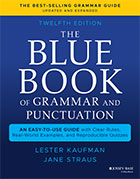 |
The Blue Book of Grammar and Punctuation
by Lester Kaufman and Jane Straus |
The Authority on English Grammar! Twelfth Edition Now Available
An indispensable tool for busy professionals, teachers, students, homeschool families, editors, writers, and proofreaders.
Available in print AND as an e-Book! Over 2,000 copies are purchased every month!
To order the book, simply click the link to order the book from the GrammarBook.com website.
|
Free BONUS Quiz for You!
Friend, because you are a subscriber to the newsletter, you get access to one of the Subscribers-Only Quizzes. Click here to take a Confusing Words and Homonyms Quiz and get your scores and explanations instantly!
We will be adding many more quizzes this year to our already substantial list of them. If you have suggestions for topics we have not yet covered, please send us a message at help@grammarbook.com.
|
Hundreds of Additional Quizzes
at Your Fingertips
Subscribe now to receive hundreds of additional English usage quizzes not found anywhere else!
Teachers and Employers
Save hours of valuable time! You may assign quizzes to your students and employees and have their scores tallied, organized, and reported to you! Let GrammarBook.com take the hassle out of teaching English!
"Fun to test my skills."
"The explanations really help ... thanks!"
"I can select the quizzes to assign to my students, and then the results are reported to me automatically!"
If you think you have found an error in a quiz, please email us at help@grammarbook.com
|
Wordplay

Pop Quiz Answers
1. If Cathryn can attend, I may go as well.
2. Asher must stop wearing that silly hat all the time.
3. Would you please pass the potatoes?
4. I used to bench press more than two hundred pounds, but now I might lift less.
5. When she was in sixth grade, Emily could win spelling bees with minimal study.
|
 |
English in a Snap:
68 One-Minute English Usage Videos FREE |
Learn all about who and whom, affect and effect, subjects and verbs, adjectives and adverbs, commas, semicolons, quotation marks, and much more by just sitting back and enjoying these easy-to-follow lessons. Share them with your colleagues (and boss), children, teachers, and friends as well! Click here to watch.
|
|
