|
Having trouble viewing this message? Click here to view it online.
To unsubscribe or change contact details, scroll to the bottom and follow the link.
|


|
|
Do You Need Commas Before Conjunctions?
|
|
A common debate in English grammar can concern whether commas need to be used before conjunctions such as and, or, and but.
These debates may stem from the fact that different people have been taught different guidelines about this punctuation. Style guides often differ about it as well.
Today's post will help to clear things up so you'll know whether and when to use commas before conjunctions in your writing.
The Basic Rule on Commas Before Conjunctions
If you're looking for a general guideline, we recommend using a comma before coordinating conjunctions such as and, or, and but when they join two independent clauses. An independent clause is a group of words that include a subject and a verb and can stand alone as a complete thought.
Let's look at a couple of independent clauses joined by a coordinating conjunction:
Jane is great at spelling, but her grammar needs some work.
First we will stop at the dry cleaner, and then we will go to the hardware store. |
In each example, the clauses before and after the underlined conjunction are independent. A comma and a conjunction typically separate such clauses. Here's another example:
| I could go with you to the movies, or I could stay home and watch the game. |
Once again we have two independent clauses that have a subject and verb and can stand alone as a separate sentence. We have combined them with the conjunction or preceded by a comma.
Possible Exceptions to the Comma Before a Conjunction
We've established that a general guideline is to include a comma before a coordinating conjunction joining two independent clauses.
In some cases, depending on style and preference, a writer might omit the comma from a sentence with two shorter independent clauses joined by a conjunction:
I'd rather walk but Jenna wants us to drive.
Tim ate pizza and Jon had fries. |
In such sentences, including or omitting the comma is often more a matter of desired effect than of strict grammar. A writer might choose to keep the comma to create a pause:
I'd rather walk, but Jenna wants us to drive.
Tim ate pizza, and Jon had fries. |
Some publications and style guides also may specify that writers should use as few commas as possible. Such guidance is becoming more prevalent, particularly as more people read content on mobile devices and the internet, where cumulatively less punctuation can result in swifter reading.
|
View and comment on this
article on our website.
|
|
|
|
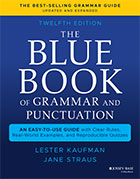 |
The Blue Book of Grammar and Punctuation
by Lester Kaufman and Jane Straus |
The Authority on English Grammar! Twelfth Edition Now Available
An indispensable tool for busy professionals, teachers, students, homeschool families, editors, writers, and proofreaders.
Available in print AND as an e-Book! Over 2,000 copies are purchased every month!
To order the book, simply click the link to order the book from the GrammarBook.com website.
|
Free BONUS Quiz for You!
Friend, because you are a subscriber to the newsletter, you get access to one of the Subscribers-Only Quizzes. Click here to take a Pronouns Quiz and get your scores and explanations instantly!
We will be adding many more quizzes this year to our already substantial list of them. If you have suggestions for topics we have not yet covered, please send us a message at help@grammarbook.com.
|
Hundreds of Additional Quizzes
at Your Fingertips
Subscribe now to receive hundreds of additional English usage quizzes not found anywhere else!
Teachers and Employers
Save hours of valuable time! You may assign quizzes to your students and employees and have their scores tallied, organized, and reported to you! Let GrammarBook.com take the hassle out of teaching English!
"Fun to test my skills."
"The explanations really help ... thanks!"
"I can select the quizzes to assign to my students, and then the results are reported to me automatically!"
If you think you have found an error in a quiz, please email us at help@grammarbook.com
|
Wordplay
|
 |
English in a Snap:
68 One-Minute English Usage Videos FREE |
Learn all about who and whom, affect and effect, subjects and verbs, adjectives and adverbs, commas, semicolons, quotation marks, and much more by just sitting back and enjoying these easy-to-follow lessons. Share them with your colleagues (and boss), children, teachers, and friends as well! Click here to watch.
|
|
