Subject: New! Mind Matters 2.0/Pressure to Hit Send/Teens Bond with AI

Most young adults want love. Few have the skills.

DIBBLE NEWS

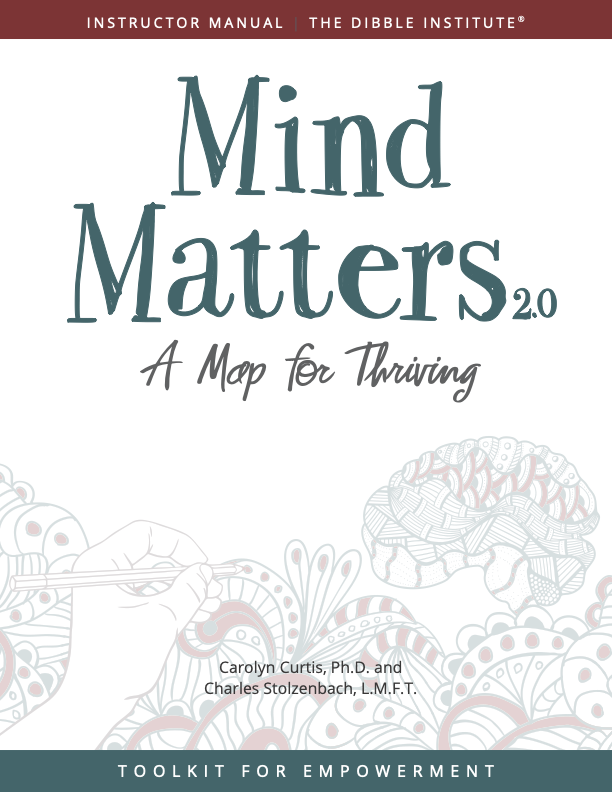
Mind Matters 2.0 is Here — and It’s Better Than Ever

For years, Mind Matters has helped teens and adults do some of the most important work of their lives: building resilience, managing stress, and learning to extend compassion to themselves.


Now, that foundation gets even stronger. Mind Matters 2.0 has been fully updated to reflect the latest research in neuroscience and trauma-informed care — because the people you serve deserve a program that keeps pace with the science of healing.


Every lesson has been refreshed, including a brand-new Lesson 6 devoted entirely to self-compassion and resilience, new digital self-regulation tools, and a positive growth mindset module. It remains designed for facilitation by non-clinicians, for participants ages 12 and up, across the full range of settings where healing happens.


More depth. More tools. The same warm, accessible approach you and your participants trust.


Get a review copy today…

Tips for Facilitating Dibble Programs with Small Groups or Individuals

Delivering a Dibble program in a small group or one-on-one setting is a unique opportunity to go deeper with participants. This more intimate format invites honest conversation, personal reflection, and a stronger facilitator-participant connection. View Dibble’s tip sheet to help you adapt our programs for small settings.


View tip sheet…

THE LATEST

‘Success Sequence’ Urges Marriage, Then Parenthood. These States Want Schools to Teach It

The decades-old concept is getting new attention, largely from Republican lawmakers.


Read more…


Editor's Note: This topic continues to gain momentum. For a policy-focused perspective on implementation, see also: Advancing the Path to Success: How States Can Teach the Success Sequence to Youth

Dating Violence Reported by High School Students

New CDC data shows mixed progress on teen dating violence, with sexual dating violence among high school students declining significantly from 2013 to 2023, while physical dating violence rates held steady.


Read more…

Teen Birth Rates Hit Another Historical Low in 2025

The teen birth rate continues its decades-long downward trend. Researchers say many factors are at play, including less sexual activity and more access to contraception and abortion.


Read more…

NEWS YOU CAN USE

How to Actually Enjoy the Dating Process

A framework for approaching dating with clarity, authenticity, and emotional resilience.


Read more…

Pressure to Send: Teens, Sexting, and Relationships

When a boyfriend keeps asking for a photo, stranger warnings fall short. Research reveals how coercion, gender, and relationship dynamics shape teen sexting.


Read more…

Teens Growing Increasingly Concerned About Their Bond with AI Chatbots

A new Drexel University study found that many teens using AI companion chatbots like Character.AI are developing dependency patterns similar to behavioral addiction, including sleep disruption, declining academic performance, and difficulty disengaging from the bots.


Read more…

TOOLS YOU CAN USE

Love Is More than Hugs and Kisses

Researchers, educators, and organizations are expanding the scientific and practical study of love — from intimate relationships to everyday encounters — to better understand how love as an unselfish, other-focused virtue can promote human flourishing and address societal challenges like loneliness and polarization.


Read more…

Childhood Trauma Doesn’t Have to Be a Lifelong Curse

Decades after a landmark study showed the lasting health effects of such trauma, researchers are finding ways to guard against enduring harm.


Read more…

How, When, and Why to Ask a Partner to Be Exclusive

It’s not about a permanent commitment. It's about giving love a chance to grow.


Read more…

WEBINAR

May 13, 2026

The Dating Recession:

Insights from the 2025 National Dating Landscape Survey


Young adults are living through a dating recession — and it's happening during their prime years.


The 2025 National Dating Landscape Survey reveals a striking paradox: most young adults want traditional relationships, marriage, and family — but many lack the dating skills and resilience to get there. Significant barriers are keeping them from even starting.


It's not a fear of commitment. It's a skills gap.


Despite widespread interest in relationship education, practical dating skills remain largely untaught — overlooked by mainstream culture and the relationship education field alike. The result: young adults who are motivated but unequipped.


They need a road map. One that bridges the gap between wanting a lasting relationship and building one.

Objectives: Participants will learn:

  • How often young adults are dating today — and why the numbers may surprise you

  • The barriers standing between them and the relationships they want

  • What healthy dating skills actually look like

  • How the relationship education field can step up to meet this moment

Presenter: Alan J. Hawkins- Affiliated Scholar, Wheatley Institute at Brigham Young University


Who should attend: Healthy relationship educators, Family and Consumer Sciences professionals, Extension specialists and agents, youth-serving nonprofit staff, faith-based leaders, community organizations, researchers in family science or sociology, policy advocates focused on marriage, family, and youth development


When: May 13, 2026 @ 1:00pm Pacific/4:00pm Eastern


Duration: 60 minutes


Cost: Free!

CURRENT FUNDING STREAMS

$4,000 Micro-Grants Application

Application Due Date: May 15, 2026

Up to twenty micro-grants will be awarded by FUTURES to support Unscripted campaign activities during the 2026-2027 Academic Year. Examples of how the funding can be used are: Printing, space rentals, video or arts equipment, food, or student stipends.


Who should apply? Staff, faculty, or campus offices focused on health promotion or violence prevention — especially those already engaging men in this work or looking to grow these efforts. While campuses do not need robust engaging men efforts already, capacity to effectively run campaign activities—including the background of staff and support of the institution—will be selection criteria.

Weyerhaeuser Family Foundation

Application Deadline: June 15th

The goal of the Youth Initiative is to support direct service programs that promote resilience, stability, and psycho-social health for youth ages 14 to 21 who have experienced trauma because of exposure to Adverse Childhood Experiences (ACEs).

FORECASTED FUNDING STREAMS

Competitive Personal Responsibility Education Program

Estimated Post Date: May 31, 2026

Estimated Application Due Date: July 30, 2026

The Family and Youth Services Bureau will be accepting applications for the development and implementation of the Personal Responsibility Education Program (PREP) in states that do not accept FY2026 allocations for State PREP. (More details to come on which states are eligible) This program supports educational projects for youth ages 10–19 and for pregnant and parenting youth under age 21, focusing on abstinence and contraception to prevent pregnancy, sexually transmitted infections, and HIV/AIDS. 


Projects are also required to implement at least three of the following six adulthood preparation subjects: healthy relationships, adolescent development, financial literacy, parent-child communication, educational and career success, and healthy life skills.

Tribal Personal Responsibility Education Program (Tribal PREP)

Estimated Post Date: June 19, 2026

Estimated Application Due Date: July 21, 2026

Tribal PREP competitively funds projects that educate American Indian/Alaska Native (AI/AN) youth ages 10-19, and expectant and parenting youth under age 21, on both abstinence and contraception for the prevention of pregnancy, sexually transmitted infections (STIs), and HIV and promote successful transition of youth to adulthood through education on key adulthood preparation subjects (APS).


Projects must implement at least three of the six congressionally mandated APS which include: healthy relationships, adolescent development, financial literacy, parent-child communication, educational and career success, and healthy life skills

General Departmental Sexual Risk Avoidance Education (GDSRAE)

Estimated Post Date: June 22, 2026

Estimated Application Due Date: July 29, 2026

*Please note the time between release and due date*

The Administration for Children and Families, Administration on Children, Youth and Families, Family and Youth Services Bureau announces the availability of funds under the Sexual Risk Avoidance Education (SRAE) Program. The purpose of the SRAE Program is to fund projects to implement sexual risk avoidance education that teach participants how to voluntarily refrain from non-marital sexual activity. The services are targeted to participants that reside in areas with high rates of teen births and/or are at greatest risk of contracting sexually transmitted infections (STIs).


The goals of SRAE are to empower participants to make healthy decisions, and provide tools and resources to prevent pregnancy, STIs, and youth engagement in other risky behaviors.

The purpose of this program is to support a comprehensive public health and evidence-based approach that:

  1. enhances behavioral health services for all college students, including those at risk for suicide, depression, serious mental illness (SMI)/serious emotional disturbances (SED), and/or substance use disorders that can lead to school failure;

  2. prevents and reduces suicide and mental and substance use disorders; 

  3. promotes help-seeking behavior and reduces stigma; and

  4. improves the identification and treatment of at-risk college students so they can successfully complete their studies.

Research Grants for Preventing Violence

Estimated Award Date: August 28, 2026

This initiative is intended to support effectiveness research to evaluate innovative programs, practices, or policies to address risk for interpersonal violence and suicide among groups experiencing a high burden of these issues. Innovative approaches are those that have not been rigorously evaluated for effectiveness in reducing interpersonal violence or suicide. Analyses examining how the approach affects different populations that are most impacted by these issues are a priority. Funds are available to conduct studies focused on preventing interpersonal violence or suicide involving youth or young adults (ages 10–24 years), including child abuse and neglect, intimate partner violence, sexual violence, suicide, and youth violence.


Editor’s Note: If you apply for this funding and include a Dibble program, we would be happy to contribute training and materials for the evaluation.

This initiative will solicit applications to support research employing a range of research designs and methods to expand the evidence base on approaches that address the context of people’s lives and living conditions to prevent, treat, and eliminate violence against women (VAW) to improve health outcomes for all.

The goal is to support scientists in becoming independent researchers. Applicants must propose a research project that focuses on at least one of the following NCIPC research priorities related to interpersonal violence and suicide affecting children and youth (birth to age 17). These research priorities include adverse childhood experiences, child abuse and neglect, youth violence, intimate partner violence (including teen dating violence), sexual violence, suicide, and cross-cutting preventions (i.e. examining two or more of these priority topics). Applicants are encouraged to explore multiple forms of interpersonal violence and/or suicide among children or youth, community factors that increase the risk of interpersonal violence and/or suicide, and the practical relevance of the research for prevention and intervention efforts.


Editor's Note: If you apply for this funding and include a Dibble program, we would be happy to contribute training and materials for the evaluation.

Please mark our messages as non-spam and add our address to your inbox contacts book.


The Dibble Institute® is a national, independent non-profit that empowers youth and young adults with skills to build and sustain healthy interpersonal and romantic relationships.


The Dibble Institute® does not sell or share your contact information.

In most cases, we obtained your contact information when you provided it to us when purchasing materials, at a conference, or by attending a Dibble training or webinar; or we obtained it through internal research. If you no longer wish to receive emails from us, simply click the unsubscribe button at the bottom of this email.

See our privacy policy.


Powered by:
GetResponse