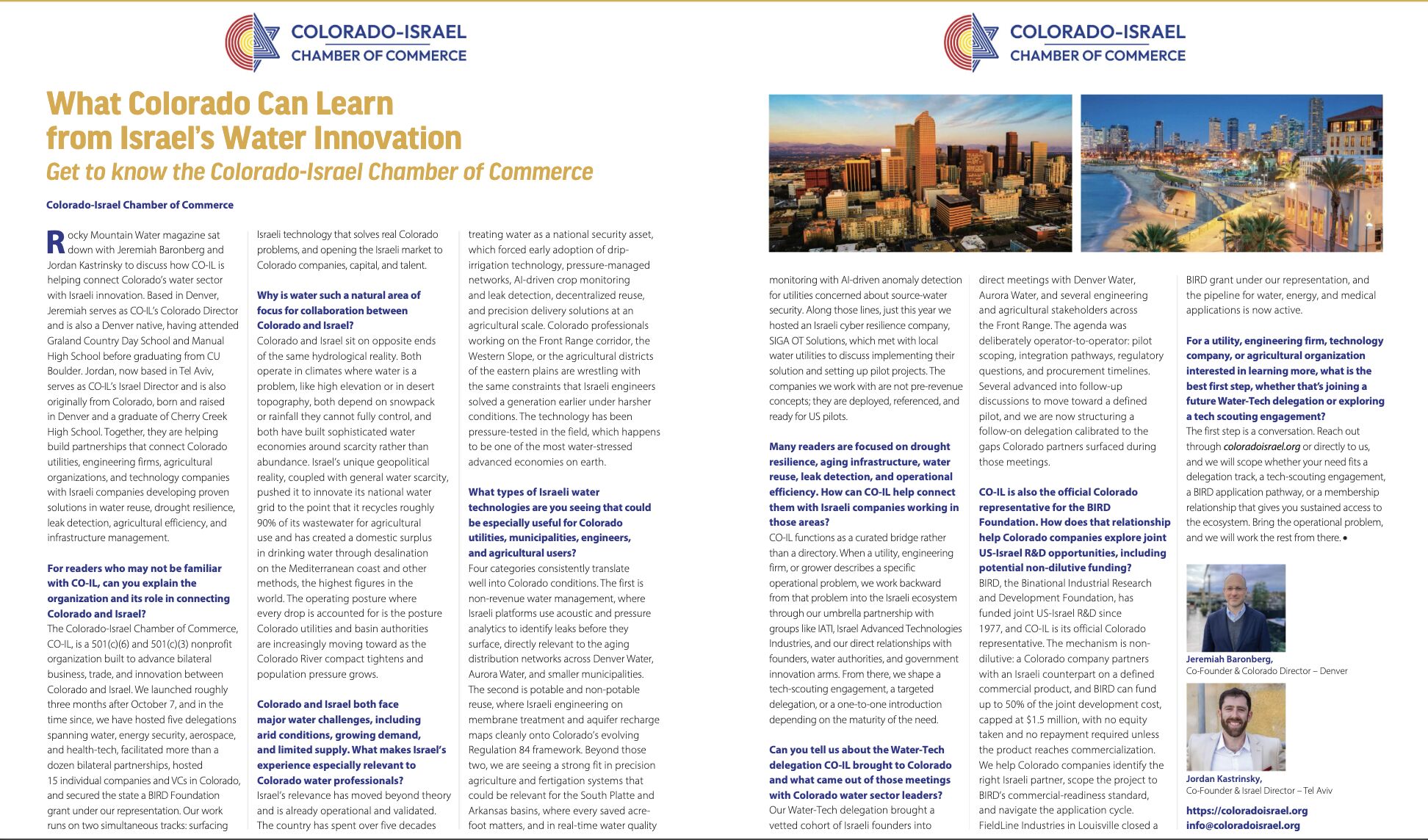
Colorado and Israel share a striking ecological reality: both are semi-arid regions challenged by water scarcity. Yet while the Colorado River Basin continues to dry and the state faces increasing aridification and severe drought-like conditions, Israel has seemingly all but solved its water crisis.💧
How did Israel do it? Can Israel's experience and know-how be applied and translated in Colorado?
To highlight this potential for bilateral cooperation in the water sector, CO-IL sat down for a featured article in Rocky Mountain Water Magazine, where co-founders Jeremiah Baronberg and Jordan Kastrinsky discussed what Israeli water innovation actually looks like in practice and how Colorado water utilities, engineering firms, municipalities, and agricultural organizations can access it. Read the full article here.
If your organization works in water and you'd like to explore how Israeli innovation could support your specific challenges, contact us at info@coloradoisrael.org.
Facts about Israel & water: Israel recycles 90% of its wastewater for agricultural use. To put this in perspective, Spain is a distant second, recycling around 20% of its wastewater, while most Western nations including the United States recycle in the single digits. Drip Irrigation: Invented in Israel in the 1960s, drip irrigation delivers water directly to plant roots. By shifting away from flood irrigation, Israel reduced agricultural water use by over 30% while simultaneously increasing crop yields. Extremely Low Water Loss: Thanks to real-time smart monitoring and acoustic leak-detection technology, Israel's municipal water grid loses only 3–5% of its water to leaks. By comparison, many major U.S. and European cities lose 15% to 30% of their treated water to aging pipes before it ever reaches a tap. A Net Exporter of Water: Because of these combined systems, Israel is one of the only countries in the world that artificially creates a water surplus. As a result, Israel pumps tens of millions of cubic meters of excess water back underground during winter months and low-demand periods, while dedicating roughly 22 million cubic meters of freshwater annually back to nature to rehabilitate drying wetlands and river ecosystems that have been starved of water for decades.
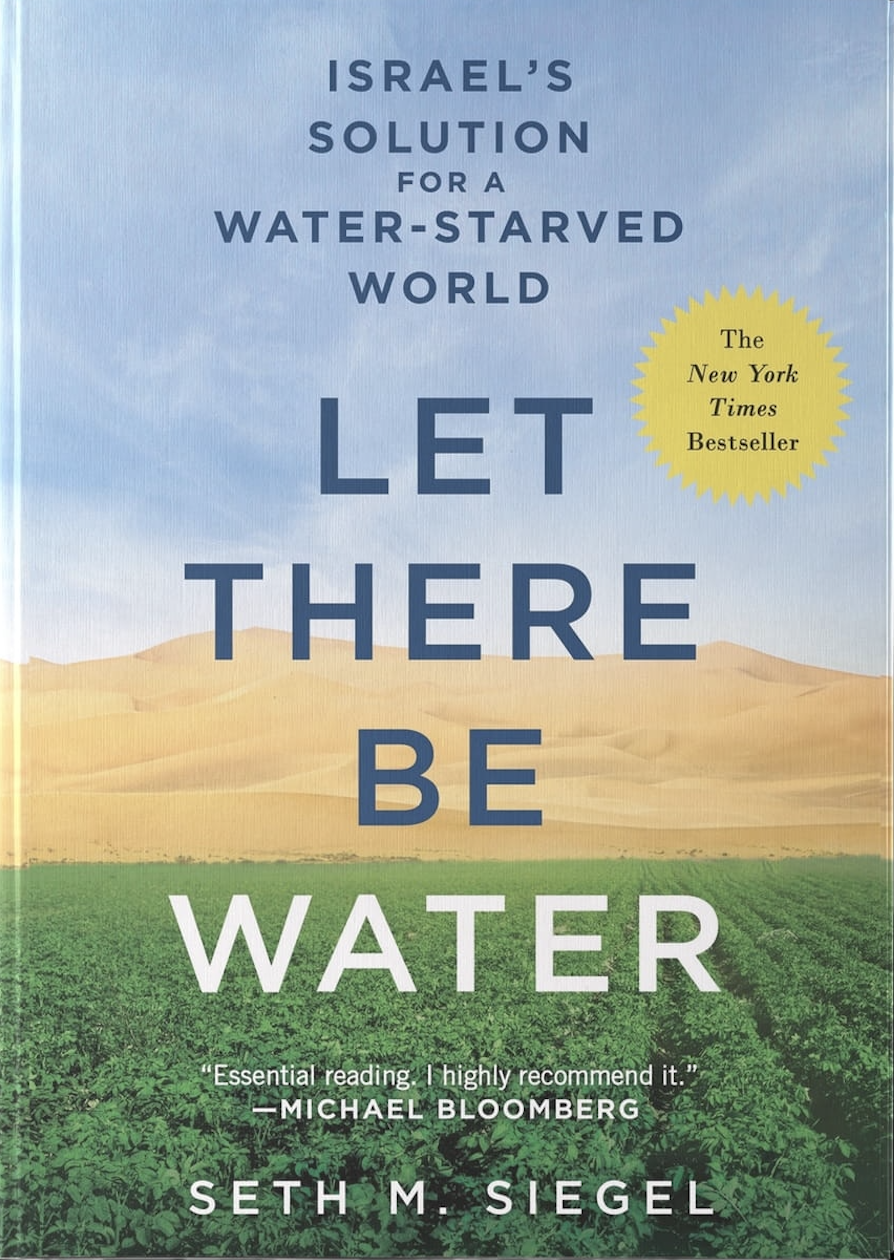
Learn more about Israel's pioneering solutions to its water scarcity challenges in Let There Be Water: Israel’s Solution for a Water-Starved World, authored by friend of COIL, Seth Siegel.
|