[BSHB] New Mash pH Adjustment Tools for Beer Brewing in BeerSmith 4

March 23rd, 2026 at 8:00 am EDT

New Mash pH Adjustment Tools for Beer Brewing in BeerSmith 4

Today I present a quick overview of the new mash pH adjustment tools in BeerSmith 4 which is available now at BeerSmith.com.

The Importance of Mash pH Adjustment for All-Grain Brewing

For many years now, brewers have known that mash pH adjustment is important for all grain brewers. Getting the right mash pH can enhance the extraction of sugars, wort viscosity, hop utilization, color and tanin extraction, improve the flavor of the beer and even help with long term stability.


The basic chemistry is not hard to understand. Pure water has a pH of 7.0, though many tap water sources are slightly alkaline with a pH of around 8. As we add grains to the mash, the grains have some acidity and will lower the pH. Darker grains have more acidity and will lower it more than lightly colored grains. The net result is that the mash will settle to a pH between 5.2 and 7.0 depending on the acidity of the base water, acidity of the grains used and also the buffering capacity of the water which is typically measured using a number called Residual Alkalinity.


The ideal mash pH for brewing is generally in the 5.2-5.6 range. While many darker beers can reach that range without adjustment due to the higher acidity of dark grains, most lighter colored beers require the addition of some acid to lower the pH down to the desired range.

To lower the mash pH a variety of acids can be used. The most commonly used are lactic acid, phosphoric acid and acid malt. These are added in small quantities either at mash in or once the mash pH has settled to bring the mash acid to the desired range.

Adjusting Your Mash pH in BeerSmith 4

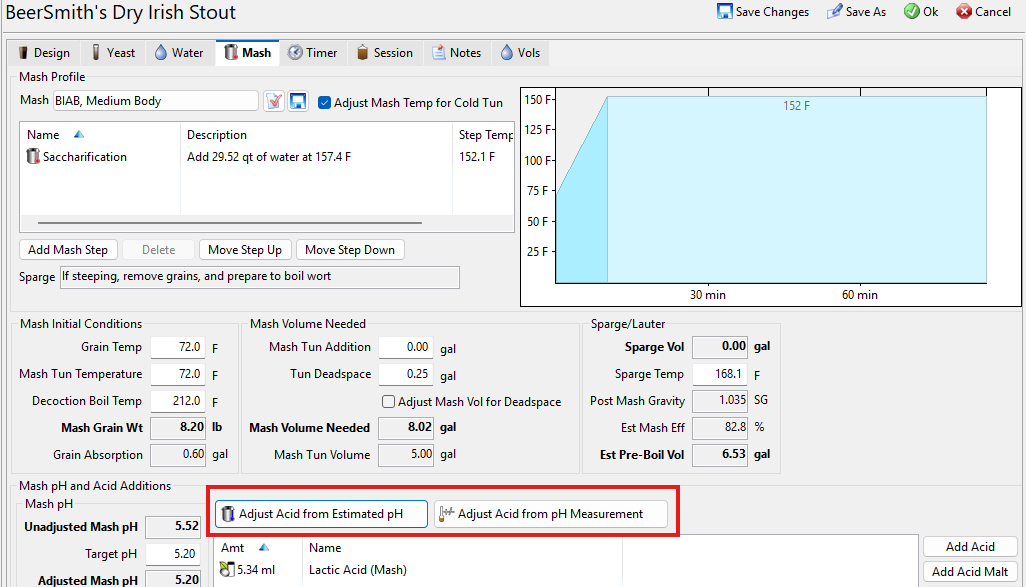
While the older BeerSmith 3 used a somewhat complex calculator system to determine the acid to add things have been substantially simplified in BeerSmith 4. BeerSmith 4 has two buttons on the Mash tab (show below) that you can use. The first one Adjust acid from Estimated pH lets you calculate how much acid to use based on the pH estimated in BeerSmith. This estimate is calculated based on the adjusted water profile you used, the grain bill for your recipe and also the acid you select.

The second button titled Adjust Acid from pH Measurement instead uses a manual pH measurement you enter. The idea here is that you use a pH meter early in the mash process to determine the actual pH and then it will calculate how much acid to add based on the measurement and your target pH.

Mash pH Adjustment Examples

If you have a pH meter you can use either tool depending on how you want to handle your mash pH. I personally recommend making an initial adjustment based on the estimated mash pH and then make a second adjustment if the measured mash pH varies substantially from the target. I have an entire article on the merits of this strategy here.


I should also mention that adjusting your mash pH is the last thing you should do before brewing. If you use the new Run Checks button to check your recipe before brewing you will likely see a reminder to finalize your water profile and mash pH. The reason for this is that any changes to the recipe's grain bill or water volumes can change your water and pH chemistry, so you should generally finalize your water profile first and then finalize your mash pH last right before brewing to make sure they are up to date.

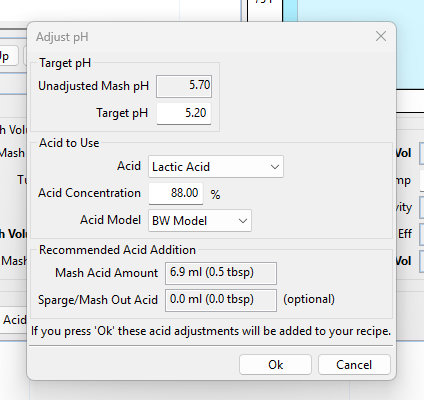
Here's an example using the Adjust Acid from Estimated pH button. In this case the software estimates my pH as 5.7 based on my current water profiles and grain bill in the recipe. I've entered my target pH, which is the pH I want as 5.2, and I have selected Lactic Acid as the acid I want to use. You can also choose phosphoric or acid malt here.


For the Acid Model I've selected the BW model. There are two different models in BeerSmith. The BW model is fairly conservative and assumes the acid added is 100% effective, so it typically recommends a lower amount of acid for adjustment. The second MPH model assumes some chemical buffering takes place so it is more aggressive, resulting in larger acid additions. I actually prefer to use the BW model for an initial adjustment it uses less acid and lowers the risk of me overshooting my target. You can permanently set the pH model in your Equipment profile under Profiles->Equipment if you want to use a particular model for new recipes and also use the Save as Default feature to set up your new recipes to be exactly the way you want them.


You can see that based on my recipe, it recommends the addition of 6.9 ml of lactic acid and also shows the approximate volume which is 0.5 tablespoons. This is the amount I will add to my mash at dough-in to get the pH adjusted quickly up front. There is no sparge addition shown in this case as I was using a BIAB (no sparge) equipment setup but if you had sparge water it would provide a recommendation there as well. When I press the OK button this amount will also be added to my recipe so I have that for future reference.


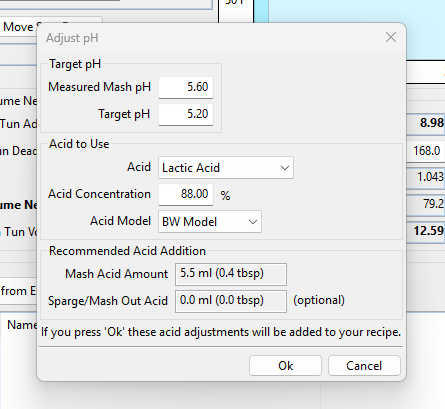
Next lets assume I used a mash pH to measure the actual pH and it was off, or alternately I did not add mash pH acid up front and instead want to add it based on a measurement. In this case I can use the Adjust Acid from pH Measurement button. Lets say my measured pH came in a 5.6 and I want to adjust it back down to 5.2.

The dialog in this case is shown on the right. Here I need to enter my measured mash pH which I took with a meter at 5.6. Next I can enter my target pH which is still 5.2 and choose an acid type and acid model as was described above.


In this case the calculator estimates I need 5.5 ml of lactic acid to get my mash pH back down to the target pH. If I press OK the software will ask me if I want to add that to my recipe or not. In many cases adjustments from a measurement are not kept in the recipe, but in some cases you might want to retain this addition to remind you that you needed a larger amount than anticipated to reach the target pH.


That is a summary of how to use the new mash pH adjustment tools. If you want to learn more I recommend you read my article on mash pH and residual alkalinity here, as well as my article on When and How to Adjust mash pH here.


Thank you for your continued support!


Brad Smith, PhD

BeerSmith LLC


Powered by:
GetResponse